The dignity of fifth-graders

In a timely development, the Columbia Journalism Review just published a long essay on how media outlets cover violent crime in Chicago. They interview a lot of very smart people, including some who have done some of the city’s best reporting already; the whole thing is worth a read.

There seems to be general agreement that the current coverage falls short in a variety of ways: that’s it too obsessed with “box scores” (X Killed Over Y Hours This Weekend), and can be too light on humanizing victims – both the people who are shot, and the family, friends, and neighbors who are also traumatized – and on explaining the larger picture, the social and economic forces that create Chicago’s landscape of crime.

But I think Natalie Moore, the South Side bureau chief for WBEZ, got to the heart of the issue best:

“What do we want people to know? Are we just trying to tell them to avoid the neighborhoods with many homicides?” Moore asks.

Obviously, ideally, you’re checking many boxes: that crime is a major problem in many neighborhoods; that its victims are real people, with families and lives that every reader should be able to empathize with, even white North Siders; that in most places, crime has been falling; that the concentration of crime in Chicago is the more or less predictable result of decades of segregation and economic decline; that in most ways, despite the violence, normal life continues in these neighborhoods: people go to work, to school, have birthdays, and so on.

But I think nearly as important as coming up with an ideal list is acknowledging that choosing one path over another involves tradeoffs. That sounds stupidly obvious, but I think it may be obscured by the coverage philosophy taken by both the Tribune and Sun-Times over the last several years. Both papers have committed themselves to covering every homicide in the city at a level of detail that, as Alex Kotlowitz says in the CJR piece, they have not, historically. The principle, as I understand it, is that each victim deserves the dignity of being recognized, of having their passing officially and publicly acknowledged, and that to do otherwise is an abdication of our collective responsibility to face one of our city’s ongoing tragedies.

That’s an admirable principle for a news organization to hold itself to, and it’s certainly an improvement over ignoring the issue, or pretending it’s not a big deal. But if that is the focus of scarce journalistic resources, then what does that say about our implicit answer to Natalie Moore’s question? More to the point, what are we saying we don’t think is important? Or – to really get down to it – whose dignity aren’t we upholding?

A class of fifth-graders in South Shore has some ideas about that:

We saw your news trucks and cameras here recently ad we read the articles, “Six shot in South Shore laundromat”…. You don’t really know us.

Those who don’t know us think this is a poor neighborhood, with abandoned buildings everywhere, with wood covering the windows and broken doors. They see the candy wrappers and empty juice bottles and think that we don’t care. Uneducated, jobless and thieves. You will be scared of these heartless people. When you see us coming, you might hurry and get in your car and lock the doors. Then speed through these streets at 60 mph like you’re on the highway, trying to get out of this ghetto.

We want you to know us.

The authors of those lines are ten and eleven, and they already know that they and all of their friends and all of their neighbors are pariahs. That is also a tragedy, and not one that any paper I’ve seen has seen fit to dedicate any journalistic resources to at all, prior to this op-ed.

Their pariahdom, of course, was not invented by the media. Its roots go back to the way white people reacted when black people began moving into their neighborhoods, not so long ago – the panic, the desperate attempts to use laws, violence, or anything within reach to keep black people as far from their homes as possible. In short, racism.

The South Shore Drill Team. Credit: Eric Allix Rogers

But a social phenomenon as widespread and powerful as the pariahdom of Chicago’s black communities requires ongoing rationalization, and by far the most powerful at the moment is an overwhelming fear of violence that is completely untethered from the reality of daily life in those neighborhoods. Visiting the South Shore Cultural Center, or getting a meal at Lem’s BBQ on 75th St., does not actually involve taking your life into your hands; but a huge number of North Siders, suburbanites, and non-Chicagoans who have been fed a steady diet of “war zone” stories for years think otherwise.

Fifth-graders in South Shore, and every other black neighborhood, are children like their peers everywhere else. They are not thugs to fear and mock. But a huge number of North Siders, suburbanites, and non-Chicagoans fear and mock them. And the fifth-graders know it.

That is also an affront to dignity.

I’m not, of course, under the impression that newspapers have the power to erase the legacy of racism. But I think that if the answer to “What do we want people to know?” doesn’t include “That you don’t have to be terrified of everyone, including fifth-graders,” we need to think about that some more. And if we think about it and decide that that is still our answer, we need to acknowledge what, and who, we have chosen to shortchange, and we need to have some very good reasons for it.

Things that are true about crime in Chicago

I can’t find the tweet, but the other day Chris Hayes (backed up by @prisonculture) was talking about how several facts that are often presented as contradictory are, in fact, simultaneously true. Here’s a partial list:

1. Crime is too high. This is the point from which discussions should begin, both to acknowledge that these conversations are, in fact, about the really intense suffering of human beings, and also to preemptively tether any further points to the very serious and sad reality they’re trying to describe.

2. Crime has fallen dramatically, both in the city as a whole and in the vast majority, if not all, neighborhoods. I’ve written about this; Andrew Papachristos, who has better credentials than me, has written about it.

3. Crime statistics in Chicago, as in many other cities, are manipulated. The two-part Chicago Magazine piece that came out a bit ago is the best place for details on the Chicago version, though if you’ve seen The Wire, you basically know the story. Note, though, that even the authors of the Chicago piece acknowledge that what they’ve uncovered doesn’t mean crime hasn’t been falling, even over the three-year period they investigated.

4. Chicago is nowhere near the “murder capital” of the United States, nor is it anywhere near as dangerous as wartime Iraq or Afghanistan. The media, by and large, has simply failed to do its job on this front, repeatedly claiming or strongly implying that Chicago is the most dangerous city in the country. It’s not even remotely true.

5. Chicago’s “murder inequality” has gotten worse, and may be worse than other cities’. I’ve written about this before.

You rarely see any one person make – or even acknowledge as true, despite what I would consider overwhelming evidence – all of these points at the same time. I suspect that’s because for reasons both general (police departments don’t like to admit to their own funny business; neighborhoods suffering from crime are loathe to be told things are getting better) and specific to Chicago (extreme, and mostly earned, distrust of the police; distrust of Mayor Emanuel; a strong national narrative about Chicago’s crime rates going back to the 1920s), conversations about crime tend to break down into “sides.” On one side – blatantly generalizing – are city officials and their supporters, who would like to emphasize that things are getting better, while acknowledging more quietly that things are still pretty bad. On the other are people who believe that city officials aren’t doing everything they could to prevent crime, and emphasize the extent to which the status quo is traumatic and unacceptable.

There are, of course, lots and lots of people who don’t fit easily into either of these camps. But to the extent you do, you’re likely to resist acknowledging some of the facts above, because you don’t think they help your side. If you’re Rahm Emanuel or with the CPD, you don’t necessarily want to talk a lot about the extent to which crime is a disaster in huge parts of the city, or the extent to which crime is suffered unequally – other than when you have to, for example after the Fourth of July weekend, at which point you’ll pound a lectern and then try to move on. If, on the other hand, you’re trying to press the case that Emanuel hasn’t done enough about crime, you might think that someone who talks about the fall in crime – or the fact that Chicago isn’t actually the most dangerous city in the country – is making excuses for policies that are costing people’s lives.

Since Rahm Emanuel and Garry McCarthy don’t make a habit of responding to this blog, I mostly get pushback from the latter group. When I write about Chicago’s fall in crime, or about the extent to which people exaggerate Chicago’s crime relative to other cities, I often hear from people who aren’t just incredulous about whether I’m telling the truth; they accuse me of actively wanting to sweep the problem under the rug. Given that I’ve written about how serious Chicago’s crime problem is on this blog and in national outlets, that seems a bit weird; but it’s true that if you see every conversation about crime as a debate between two “sides,” these facts don’t necessarily help theirs.

That said, they’re really important. Partly that’s just because they’re the truth, and promoting a culture that says it’s offensive to talk about facts that might not mesh with a given political program or narrative is a really terrible idea for all sorts of reasons. But it’s also because in the larger picture, the widely-believed falsehoods about Chicago crime – that it’s getting worse, and that it’s exceptionally bad in an American context – are actually devastating for the very neighborhoods that their deniers are dedicated to serving.

Fleck’s Coffee on 79th in Chatham. One of many really pleasant corners of the South Side that more people might know about if they weren’t so terrified. Credit: Strannik45, Flickr

As Robert Sampson wrote in Great American City, neighborhood reputation has an enormous impact – larger, in many cases, than the actual crime and poverty that reputation is supposed to reflect – on a community’s future trajectory: whether people will move in or leave; whether people will spend their money at local businesses; whether, in other words, the neighborhood thrives or suffers. Misinformation about crime is certainly not the only contributor to the negative reputation of Chicago’s black neighborhoods on the South and West Sides (and, to a lesser extent, Latino neighborhoods there) – there’s the heavy baggage of racism, among whose many tentacles (if you’ll forgive the mixed metaphor) an eagerness to believe in mythological quantities of violent crime is only one.

But myths about crime is one of them, and it is hard to read the coverage – and listen to how people talk about it – and read Sampson’s research, and conclude that it doesn’t have an effect.


The “Take a stand against violence” slur

This is quick, but it’s one of my least favorite things:

As he has in the past, Emanuel said gun violence plaguing the city must be addressed in a variety of ways, which he said include policing, tougher gun laws, more investment to help children in impoverished neighborhoods and instilling a “shared sense of purpose and values” in communities across Chicago….

Right: similarly, the Mexican drug war began in 2006 when Mexicans suddenly found themselves without a shared sense of purpose and values.

Chicago gangland violence unleashed by Prohibition in the 1920s might have been assuaged if Chicagoans had just felt themselves more strongly to be part of a larger, purpose-driven community.

This slur – that violence could be prevented by the people who live in the neighborhoods it affects, if only they cared or tried hard enough – needs to end. For one, you only have to walk a few blocks in most of the communities most affected by crime in Chicago to see lots of indications that the people who live there – shock of shocks – are, in fact, “taking a stand” already.

You see signs like this all over the South Side. It’s almost as if black people like safe neighborhoods, too! Photo credit: yochicago.com

But what makes this trope really sublime is the fact that neither mayors, nor police commissioners, nor the most esteemed criminologists, have more than the barest understanding about why crime goes up or down to begin with. Concentrated poverty and unemployment can’t help, of course, but consider that crime continued to fall or remain steady in Chicago and the rest of the country during the worst economy since the Great Depression. So people like Mayor Emanuel, faced with a problem he doesn’t know how to fix, instinctively reach to blame the people who are most brutally affected.

Of course, this slur wouldn’t work if we weren’t so eager to believe that people who are poor or non-white – the people who disproportionately suffer from crime – are somehow less civilized, less moral, less interested in their communities, than everyone else. But that’s a lie.

So is “take a stand.” End it.

A Note on Data: Early 90s Population Estimates and Chicago’s Homicide Rate

This came to my attention this week, and I feel like in the interest of transparency I ought to make a note about it.

Because people don’t read all the way to the end of blog posts, I also feel like I should put the conclusion at the beginning. So:

  • Over the course of the 1990s, the Chicago Police Department used two different population estimates to calculate murder rates. In this post, I used the one that the CPD was using in the years I covered. But there is also a reasonable argument to be made for using the one it chose to use later in the decade.
  • If you use the second estimate, mostly things look the same. In particular, the “skyrocketing inequality of violence” skyrockets just as much, still roughly tripling from the early 90s to the late 2000s.
  • One thing that does change is that some, but not all, of the areas that show a rise in homicide rates with the first population estimate show a modest decline with the second population estimate. This is because the second population estimate suggests that fewer people were living in heavily non-white areas of the South and West sides in the early 90s, and so it gives them a higher homicide rate to begin with. Specifically, of the seven police districts that have rising homicide rates according to the first population estimate, four (the 3rd, 7th, 11th and 15th) show modest declines according to the second, one (the 6th) is roughly flat, and two (the 8th and 22nd) still show clear (in fact, larger) increases.
  • I don’t think it’s clear which estimate is better.
  • Bottom line: it’s somewhat ambiguous exactly how much of Chicago’s South and West sides saw homicide rates rise over the last 20 years – although substantial portions certainly did. It remains crystal clear that the inequality of violence has increased by a factor of about three over those same two decades, and that that gap has extremely serious consequences.

In somewhat more detail:

In the early 1990s, the CPD used population estimates from local planning bodies, either the city itself or the Northeast Illinois Planning Commission, to determine how many people lived in each police district. Those are important numbers for calculating crime rates, since a neighborhood’s safety level is usually described in terms of crimes per number of people – number of homicides per 100,000 residents, in this case. Beginning in 1995, however, with a report that covered 1993-94, the CPD switched to using population estimates provided by the U.S. Census. The Census numbers differed from the city/NIPC numbers mostly in that the Census counted fewer people – in some cases as many as 30% fewer – in the mostly black and Latino sections of Chicago’s South and West sides.

As a result, going back and plugging the Census-derived population numbers into the CPD’s earlier reports makes the South and West sides look more dangerous, because there are the same number of crimes but fewer people. This doesn’t affect the trends in geographic inequality of violence, but it does, as I described above, create a higher baseline against which to compare homicide rates from the late 2000s. In four districts, the baselines are so much higher that what previously looked like increases in homicide rates over 20 years look like modest declines. In another, the increase is wiped out but there is no decline, and in two there are still increases – in fact, the increases get bigger.

Which set of numbers – the city/NIPC’s or the Census’ – are better? I don’t know. On the one hand, the Census is clearly the governmental head-counting of record. On the other, the 1990 Census was the target of a lawsuit from nearly every major city in the country, including Chicago, that alleged severe undercounting (in the hundreds of thousands in Chicago)particularly in high-poverty neighborhoods with few white people – ie, exactly the neighborhoods at issue here. Either way, the scale of the disagreement – again, as much as 30% in some districts – means that at least one of these estimates has to be quite flawed.

In any case, to repeat myself: the bottom line is that there is some ambiguity about exactly how much of Chicago’s South and West sides actually saw increases in homicide rates, although substantial portions undoubtedly did.

And what is still crystal clear is that the inequality of violence has increased by a factor of about three over the last twenty years, and that that gap has extremely serious consequences for the city.

#crimeisdown

I saw that hashtag in the headline of a DNAinfo story and got excited. Maybe truth in crime reporting was going viral! But no.

You won’t hear Lakeview’s top cop talk statistics at community meetings anymore — even if numbers suggest that crime is down from the year before in the neighborhood…. At a heated August policing meeting, residents both decried the statistics showing crime was too high — a beat in Lakeview led the city in robberies — and questioned whether the official data could be believed…. The [Lakeview] blog [Crime in Wrigleyville and Boystown] has taken on a popular hashtag, #crimeisdown, to express frustration.

So some group of Lakeview residents have taken a factual statement and turned it into a slogan for a bizarre form of trutherism, and then whipped up enough fear around that (again, factual, even though it is meant to be ironic) slogan to bully their local police contacts into tiptoeing around the fact that this supposedly ironic slogan is, in fact, non-ironically accurate, because to do otherwise would be too upsetting for those residents. This is hyperlocal news by Orwell.

There is the mandatory caveat that, of course, it is very possible to use statistics to callously dismiss the victims of crime. Individual experiences matter, obviously, even in the context of an overall crime decline. It’s even possible that some police officers at earlier Lakeview meetings were callous in exactly that way; I don’t know, because I didn’t attend them. If that’s the case, then shame on them.

But sometimes I think there is the opposite problem, which is people thinking that statistics have nothing to do with individual experiences. In fact, the “statistics” at issue are simply the result of counting how many people have been victimized by crime. There is no fancy manipulation. If the statistics go down, that means fewer people have been made victims. That means that you, personally, might be one of the people who weren’t robbed, or broken into, or shot. It’s impossible to prove that a given individual is the one who escaped that fate, of course; but it is a fact that had Chicago’s murder rate held steady over the past 20 years, for example, many thousands of people who are still alive would have suffered violent and tragic deaths. That is an amazing and wonderful thing.

The Lakeview residents quoted seem to think that the official statistics greatly undercount the real number of victims; it’s almost certainly true that the police numbers are at least somewhat low, since not every victim reports their crime to the police. But there’s absolutely no evidence that I’ve heard of that would suggest this problem has been getting bigger, and certainly not so much bigger that it would offset the truly enormous declines in assaults and robberies the city has seen over the last two decades. There’s also no reason to believe, as far as I can tell, that this problem would be especially severe in Lakeview as opposed to elsewhere in the city. In fact, I would tend to think that the residents of Lakeview would be much more likely to report a crime than in one of Chicago’s many non-white neighborhoods, where relations with the police are considerably more fraught. That means that the official statistics, if anything, probably understate how safe places like Lakeview are compared to the rest of the city.

As for the fact that, in the second quarter of 2013, the beat that encompasses the Southport and Halsted bar scenes in Lakeview had the highest number of robberies in the city – well, yes, that’s true. And maybe that suggests there ought to be some extra police presence there. But it also seems likely that the number of robberies in that precinct has something to do with it being one of the premier night-life areas in the entire city. That means that 1) there are a huge number of people there, several nights a week, which raises the total population and therefore should raise the total number of crimes, and 2) there are a huge number of people stumbling around drunk late at night, probably with cash, which is checking pretty much every box you need to increase your chance of being robbed. Not, of course, that you shouldn’t be able to feel safe at any time, anywhere, but the reality of pretty much every big city in the U.S. is that lots of drunk people with money late at night = some increased number of muggings. My guess is that if you are a non-drunk person, not spending a lot of time walking around by  yourself very late at night, Lakeview is an incredibly safe place to be.

In fact, I don’t have to guess: Looking at the incident log at the Chicago Data Portal, I can confirm that, for example, of the 22 robberies committed in this beat during the second quarter of 2013, exactly three happened between 5 am and midnight. Three. That means 19, the overwhelming majority, happened at some time between midnight and five in the morning.

The other thing I’d like to say about all this is it indicates one problem with conventional approaches to “democratic” community interaction with local government. If the police hold a community meeting, by definition the people who show up are going to be the people who are most alarmed about crime. In some parts of the city, that’s fine, because they actually have serious crime problems by almost any metric, and I think most residents – even those who appreciate the many other positive things about their community – would agree. In Lakeview, though, this dynamic can lead to some pretty skewed demands. An unscientific survey of friends who live in/frequent Lakeview suggests that very few of them consider that neighborhood particularly dangerous. In fact, most of them say they appreciate how safe it is. But these meetings are full of angry people shouting about how terrible crime is. If you’re a public official or community leader at that meeting, how do you respond to that?

Homicide Awareness!

Listing every factual error in the most recent of the documentaries released this summer called “Chiraq” – there are two of them – is easy, because its director, British-born Will Robson-Scott, does not actually attempt to make any factual claims. Or, rather, he makes exactly one, which is superficially true but deeply misleading, as I’ll discuss in a minute.

Instead, Robson-Scott gives us thirteen minutes of black-and-white cinema vérité in a genre that might be called Violence Porn. Violence Porn is a cousin of Ruin Porn, the much-maligned and yet perennially popular family of photography and cinema that invites us to gawk at empty streetscapes and rotting theaters in places like Detroit or Camden, NJ. Except instead of asking us to feel sadness or disgust about cityscapes, Violence Porn asks us to marvel at just how incredibly scary young black men in Chicago are.

The folks behind VICE’s HBO show are Robson-Scott’s brothers in this endeavor, having also shot a thirteen-minute piece called “Chiraq,” which came out in June. It’s a bit more ambitious in terms of actually providing information and context, with the downside that almost all of that information and context is completely wrong. Its very first line claims that “in the last two decades, most major cities in America have seen a dramatic drop in violent crime, except Chicago” – curious, given that the homicide rate over the last twenty years has fallen by nearly 50%. It claims that the South Side “has lost most of its schools,” which, despite Mayor Rahm Emanuel’s best efforts to close allegedly underutilized buildings, is not even close to true. It claims, without qualification, that the demolition of public housing has made crime worse in outlying neighborhoods, a proposition fiercely denied by many of the academics who have studied the issue. And it strongly implies that violence is escaping the traditional “bad” neighborhoods and “seeping” into the rest of the city, which is exactly the opposite of what has actually happened in the last two decades: violent crime is more concentrated in certain areas than ever before, with terrible consequences.

If either of these documentaries had shown any interest in research or fact-checking, it might be easier to forgive them for having devoted so much time to filming young black men, usually shirtless or in hoodies and preferably heavily tattooed, jumping around in groups, throwing gang signs and flashing guns. But they didn’t show any such interest, and so we’re left to conclude that this, in fact, is the point. Neither documentary allows more than a minute or two to elapse without such a shot, and both devote the majority of their interviews to brief expressions from these young men about how crazy life is on the South and West sides. “We like to eat the body up,” says one man, explaining why murder victims in the city are shot so many times. “We were brought up to beat your motherfuckin’ ass,” says another.

None of this is to say that Chicago doesn’t have a very serious crime problem, or that its crime problem – or that of other cities – isn’t worth the attention of a documentary film. Such a documentary might accomplish one of two things: It might allow us to understand the big picture by telling us what all the news reports add up to, why the problem exists, and what possible solutions might address it. Or it might give us the human story behind the numbers and socioeconomic forces, allowing us to understand what it’s like to live in affected neighborhoods, what the motivations are of people who take part in the violence, and how everybody else copes in their day-to-day lives.

Neither “Chiraq” accomplishes, or even attempts to accomplish, either of those objectives – the big picture facts are either absent or wrong, and it’s hard to get a sense of the interview subjects as people when they’re only allowed a few lines of dialogue each. Instead, the most generous interpretation of the purpose of these documentaries is a kind of awareness campaign, akin to wearing a colored ribbon to draw attention to a deadly but relatively low-profile disease.

But that’s absurd. The first thing that any American – and many foreigners – will say if you ask them about the South and West sides of Chicago is that there is a lot of crime there. Awareness is not the problem.

In fact, you might say that part of the problem is too much awareness – and here we get to the heart of the matter. Both documentaries are called “Chiraq” because they claim (this is Robson-Scott’s only verifiable fact) that there have been more murders in Chicago since 2001 than U.S. soldiers killed in Iraq or Afghanistan. This, supposedly, is context. But what does it tell us? Are Iraq and Afghanistan less dangerous than Chicago? Obviously not; those figures don’t account for the fact that there are many, many times more people in Chicago than American soldiers stationed in those war zones, and they don’t include casualty figures for locals, who have died at rates hundreds of times higher than people have been killed in Chicago. Does it say something about the relative importance of violent street crime and overseas wars? Maybe; but why is that the comparison? Why not compare it to other, less far-fetched analogues, like the number of people who die in car accidents, or heart disease?

The answer is that these documentaries, and Violence Porn in general, are premised on reinforcing stigma: the stigma of poor inner-city neighborhoods, the stigma of being black, and especially of being a young black man. Car accidents and heart disease are tragedies that might happen to anyone; a war zone is something savage and foreign that belongs elsewhere: not for nothing does the VICE documentary conclude that “the South Side of Chicago is basically a failed state in the borders of the U.S.,” where locals “proudly declare themselves savages or soldiers.” This is why neither documentary can show us anyone in these neighborhoods but young black men who are gang members, or the mothers of young black men who have been murdered: to depict an average citizen going to work, or taking their young child to school, or even just mowing their lawn, would clash with the stigma that gives these films all their power.

Ultimately, the message is that you, the presumably white, or at least middle-class, viewer of the documentary, need to be very afraid of the unhinged people who live in these areas. (At one point, the VICE correspondent looks at a map of gang territory and helpfully volunteers that it “scares the living shit” out of him.) Or, rather, you should continue to be very afraid. Because these places have already been suffering from white and middle-class stigma for decades, pretty much since they were turned into all-black ghettoes around the middle of the twentieth century. I, a white person who lives on the North Side, run up against this stigma whenever I try to take a friend to visit a restaurant or gallery even in a relatively safe black neighborhood on the South Side, and they refuse because they “don’t want to get shot.” (This is usually accompanied by a laugh, to suggest that they’re kidding, but the fact that they actually won’t go suggests that they’re not.) The people who live in those neighborhoods run up against the stigma every day because of the social isolation, lost business investment, and paltry consumer spending it causes, which just furthers the economic decline that the “Chiraq”s are supposedly lamenting. This is not a minor issue: one study by Harvard professor Robert Sampson found that a neighborhood’s reputation was a better predictor of its future poverty rate than actual signs of disorder like graffiti or crime.

And so it’s hard to conclude that these documentaries do anything other than make the problem worse. It would be nice if the next round of journalists who venture into America’s crime-plagued neighborhoods treat the people they find there as people, and not spectacles.

We’ve Talked About Homicide In Chicago At Least One Million Times But I Don’t Think This Has Come Up

Here are two maps:

HOMICIDE RATE BY POLICE DISTRICT

1990-1993                                       2008-2011

Hom90 hom20
        RateLegend

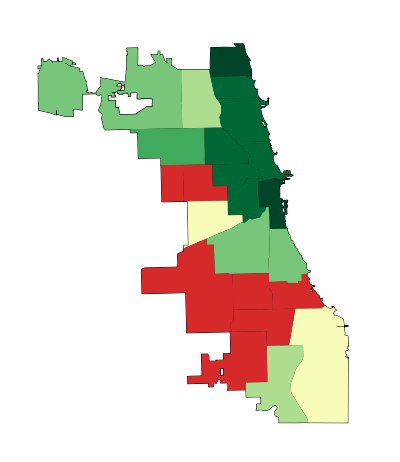
Like the captions say, the one on the left shows homicide rates by police district in the early 90s, when crime was at its peak in Chicago, and the one on the right shows the same thing, but about two decades later.* The areas in dark green are the safest; the ones in dark pink are the most dangerous. The colors are calibrated so that green areas are safer than average for the early 90s, and pink ones are more dangerous than average for the early 90s. The 2008-2011 map keeps the same calibration: green is safe compared to the early 90s, so that you can see change in the levels of violence over time.

And, indeed, the first thing that jumps out from these maps is that there’s way more green nowadays, and it tends to be darker. The city is way safer! Some areas we might consider a bit dicey today – like, say, the Lawndale/Little Village area – actually register as light green, meaning that by early 90s standards, they would be considered relatively safe.

[For those of you craving numbers, the murder rate averaged 30 per 100k during the first period, and 17 per 100k during the second, a decline of nearly 50%.]

Of course, the other thing we notice is that there are some very distinct patterns to safety. These maps are breaking exactly no news by indicating that the more dangerous parts of the city are on the West and South Sides, but it is striking, I think, to see that nowadays, basically the entire North Side is the darkest green, which translates to a homicide rate of less than 6 per 100k. In fact, the  dark-green part of the city has a murder rate of 3.3 per 100k.

Three point three. In New York City, which is constantly (and mostly correctly) being held up as proof that urban safety miracles can happen in America, it’s 6.3. Toronto, which as far as North American big cities go occupies a fairy tale land where no one hurts anybody, had a homicide rate of 3.3 per 100k as recently as 2007. The North Side is unbelievably safe, at least as far as murder goes.

But there are none of the darkest green on the West or South Sides. There’s actually a fair amount of pink, meaning places that are relatively dangerous even by the terrifying standards of the early 90s.

This raises a question: Has the great Crime Decline benefited the whole city equally? Are the South and West Sides still relatively dangerous because they started from such a bad place, or because they haven’t seen nearly as much of a decline as the North Side has?

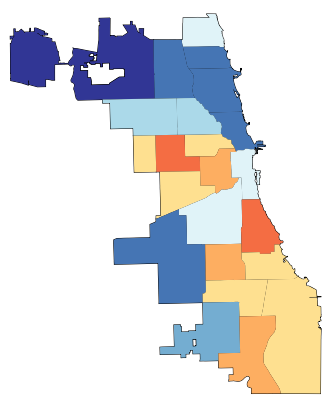
Here is the answer in another map:

CHANGE IN HOMICIDE RATE, EARLY 90s – LATE 2000s

Murderchange

DeclineLegend

The areas in darkest green saw the greatest decline; red means the murder rate actually increased.

So: Yes, the great Crime Decline is a fickle thing. The North Side saw huge decreases (in Rogers Park, it was over 80%) pretty much everywhere; the few areas that are lighter green were the safest in the city to begin with. The parts of the South and West Sides closest to downtown – Bronzeville, the West Loop, Pilsen, etc. – got a lot safer. But most of the rest actually got worse, including some neighborhoods that were already among the most dangerous in the city, like Englewood and Garfield Park.

This is a complicated state of affairs, and probably goes at least part of the way to explaining why, in the face of a 50% decrease in homicides citywide over the last two decades, many people persist in believing that the opposite is true: because in their neighborhoods, it is. It’s a dynamic that defies an easy narrative, and makes me slightly less angry (though only slightly) at all those journalists who have written in the last year or two about murder in Chicago without mentioning that the city is, in fact, safer on the whole than it has been in fifty years.

Here is one final pair of maps:

RATIO OF POLICE DISTRICT HOMICIDE RATE TO CITY AVERAGE

1990-1993                                       2008-2011

Homicideratios90shomicideratio2

RatioLegend

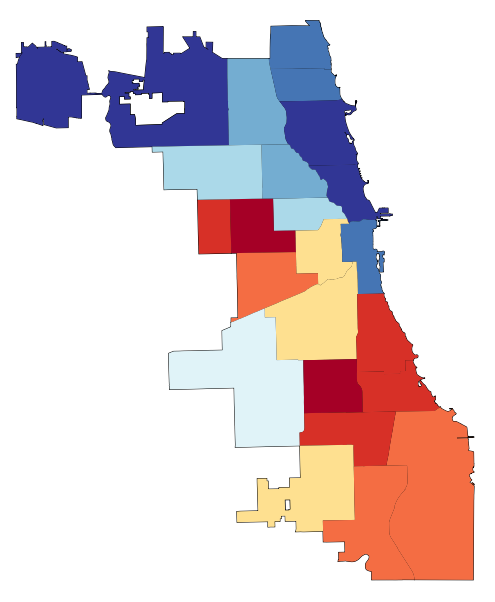
This is slightly less intuitive. These maps show the how the homicide rate in any given police district compares to the citywide average, using ratios; for example, if the homicide rate in West Town is 10 per 100k, and citywide it’s 5 per 100k, West Town’s ratio is 2 to 1. If West Town were 2.5 per 100k, its ratio would be 0.5 to 1. (Obviously the numbers in these examples are made up.) Blue areas have ratios below 1, and so are relatively safe; red ones above 1, and are relatively dangerous.

With the help of these maps, I’m going to ignore what I said about all this defying an easy narrative, and try to supply one: Over the last twenty years, at the same time as overall crime has declined, the inequality of violence in Chicago has skyrocketed. The pattern of what’s blue and what’s red in each map is mostly the same; I count only three out of twenty-five districts that switched from one color to another. But the colors are much darker in the 2000s than they were in the 1990s. There have always been safer and more dangerous areas here, as there are everywhere; but the gap between them is way, way bigger now than it used to be.

Numbers will help this case. Imagine that for each of these two time periods, we cut the city into equal thirds: one contains the most dangerous neighborhoods; another, the safest; and the last, everything else. In the early 90s, the most dangerous third of the city had about six times as many murders as the safest third. By the late 2000s, the most dangerous part of the city had nearly fifteen times more homicides than the safest third.

In addition, here are two charts:

HomRatio90

Homratio20

The divergence is self-evident. The early 90s look very roughly like a normal curve: most neighborhoods are in the middle, and there’s a clear, if slightly bumpy, slope down towards the extremes.

Today, any semblance of a normal curve has been annihilated. Or, actually, that’s not quite right. Now it looks like there might be two completely separate normal curves, one with a peak at 0.2-0.4, and the other peaking at 3.1-4. Plus a few guys who got lost in the middle.

I suppose there are many, many things that one might say about what this means, but here’s the bottom line: The disadvantages and tragedies that people in “dangerous” neighborhoods experience are both absolute and relative. The death of an innocent person** is an indescribable loss no matter what. And, on that count, things are somewhat better for Chicago’s most violent areas: the homicide rate for the most dangerous third of the city declined from 51 to 39 per 100k in the time period we’ve looked at here. That is a real accomplishment, and hundreds, if not thousands, of people are still with their families and friends because of it.

But in other ways, it does matter if other parts of the city are getting safer much, much faster. When people weigh safety in their decisions about where to live, they do so by comparing: How much safety am I gaining by living in one neighborhood versus another? The same is true of entrepreneurs considering where to open their next business. The same is true of tourists looking to explore the city. The same is true of locals looking to travel to another neighborhood to eat out or go shopping.

On every one of those counts, the disadvantages that are accruing to already-disadvantaged neighborhoods in terms of lost population, investment, and connections to the rest of the city are now much more severe. The hurdles are that much higher.

That’s bad for those physical neighborhoods. It’s also terrible for the people who have good reasons to live there, like social networks, nearby family, or the affordability of real estate.

Because I don’t have the data in front of me, but who would doubt that over these same twenty years, there has also been a growing gap between how much it costs to live on the safe North Side compared to the more dangerous parts of the South and West Sides? Who would doubt that, as the North Side reaches Toronto-level peacefulness, the cost of rent has greatly diminished the number of apartments there affordable to the poor and working class?

In other words, just as the stakes have been tripled as to whether you live in Relatively Safe Chicago or Relatively Dangerous Chicago, it has become much, much harder to establish yourself on the winning side.

So: Next time you hear someone talking about “record violence” in the city, tell them that actually, murders are down almost 50% from twenty years ago. And then tell them that what’s really alarming is murder inequality.

* Why does this data end in 2011? Because I made these maps using data from the Chicago Police Department annual reports, which are available online, and which only broke down crimes by police district in the 1990s. In 2012, the police district boundaries changed, making it not quite an apples-to-apples comparison to prior years. Maybe somewhere data exists by Community Area for the early 90s, and then I could redo all of this.

** And I think reporting like that done by This American Life at Harper High in Englewood ought to challenge conventional middle-class ideas about “innocence” in the ghetto. It is very easy for those who don’t live in the neighborhood to talk about “thugs” and “gangsters” getting what they deserve. It is also very cruel, and very naive about what exactly “gangs” are, and what kind of people join one, and how, and why.

Murder and the media

The title of this post suggests a more comprehensive look at the issue than I’m planning. Eventually, maybe.

Instead, for right now I’ll just grumble slightly about this post from Carol Felsenthal at Chicago Magazine. (With the stipulation that, generally, Felsenthal does interesting things when she drops by once every two months to write a blog post.)

Basically, Felsenthal says that we shouldn’t be happy that Chicago’s murder rate declined 40% over the first four months of the year from 2012 (and 7% from 2011, a more “normal” baseline), because a bunch of people got shot on Tuesday night. Which – sure, of course, that’s true, I guess, as far as it goes. And yet the fact that a lot of people got shot Tuesday night, and the fact that violence continues to be a huge problem, does not really address the fact that, were this year like last year, more people would have been shot. And fewer people shot is good.

It’s a fine line, of course, that one must walk – how to be genuinely cheered by progress when there is clearly so far to go. (And when the relatively innocuous words “so far to go” mean, more concretely, a tremendous amount of human tragedy and suffering.) But if we don’t cheer progress, how are we supposed to carry on? How do we know when we’re winning? The cynical refusal to celebrate the lives we haven’t lost because the murder rate has declined is a rejection of the value of those lives, it seems to me, just as much as apathy towards the entire situation. And if that seems like a macabre way of thinking – well, maybe it is. But we live in a sometimes macabre world.

Also, her final line – “The number [of non-fatal shootings] might shock Chicagoans into doing something—anything—to strangle the hold that street gangs have on our city and its future.” – irks me because it repeats a common idea that makes absolutely no sense, which is that somehow Chicago hasn’t been able to deal with its murder problem because Chicagoans just don’t want to enough. Otherwise, we would do “something”! Of course, Felsenthal doesn’t say what that magical something might be. That’s because she doesn’t know.

In most neighborhoods in Chicago that deal with serious violence problems, you don’t have to walk very far – often less than a block – before you see evidence that, in fact, the people of that community have been doing “something” to reduce crime. You see CeaseFire signs in a living room window and posters advertising marches against violence or after-school programs for teens in churches and libraries.

The people who are affected by this violence aren’t passive. They are, in fact, doing “something,” and almost certainly if they weren’t the problem would be worse. But there is no magic solution that would eliminate homicides, but which they – we – have not tried because we don’t care enough.