Watch Chicago’s middle class vanish before your very eyes

Note: I owe both the concept for this measurement of income segregation and much of the actual data – all of it, except for 2012 – to Sean Reardon and Kendra Bischoff, who wrote a series of wonderful papers on the subject and then were kind enough to send me a spreadsheet of their data from Chicago a while ago. The maps, however, are mine, as is all the data from 2012, and any mistakes in them or in the interpretation of the data is entirely my responsibility.

I think one reason I’ve felt less than compelled by Chicagoland, CNN’s reasonably well-made documentary series, is that its tale-of-two-cities narrative is so worn, so often repeated, that it’s become a little dull. Not the actual fact of inequality – which only seems to cut deeper over time – but its retelling.

In fact, I think the point has long passed at which simply repeating the story of Chicago’s stratification is equivalent to fighting it. For a lot of people, in my experience, it’s the opposite: an opportunity for distancing, for washing of hands. It’s a ritual in which we tell each other that this is the way it’s always been – The Gold Coast and the Slum was written about already well-entrenched institutions, after all, over three-quarters of a century ago – that these facts somehow seep out of the ground here, as much a part of the city as the lake, and that as a result there’s really nothing we can do about it.

But this obscures much more than it clarifies. Inequality has always been a part of Chicago – as it has always been a part of the United States, and a part of humanity – but the forms it has taken, and the severity of those many forms, have changed in truly dramatic ways. Take, for example, today’s monolithic segregation of African Americans: at the turn of the last century, black Chicagoans were less segregated than Italians, and not because Italians were then hyper-segregated.

Moreover, decisions made by people in the city have played, and continue to play, a huge role in determining what those changes look like. Had Elizabeth Wood received any serious support from white residents or their elected representatives – instead of meeting Klan-like violent resistance – the history of racial integration, economic integration, and public housing in this city would be very, very different. This isn’t to say that national and global factors aren’t important, since they obviously are. But neither do we lack responsibility.

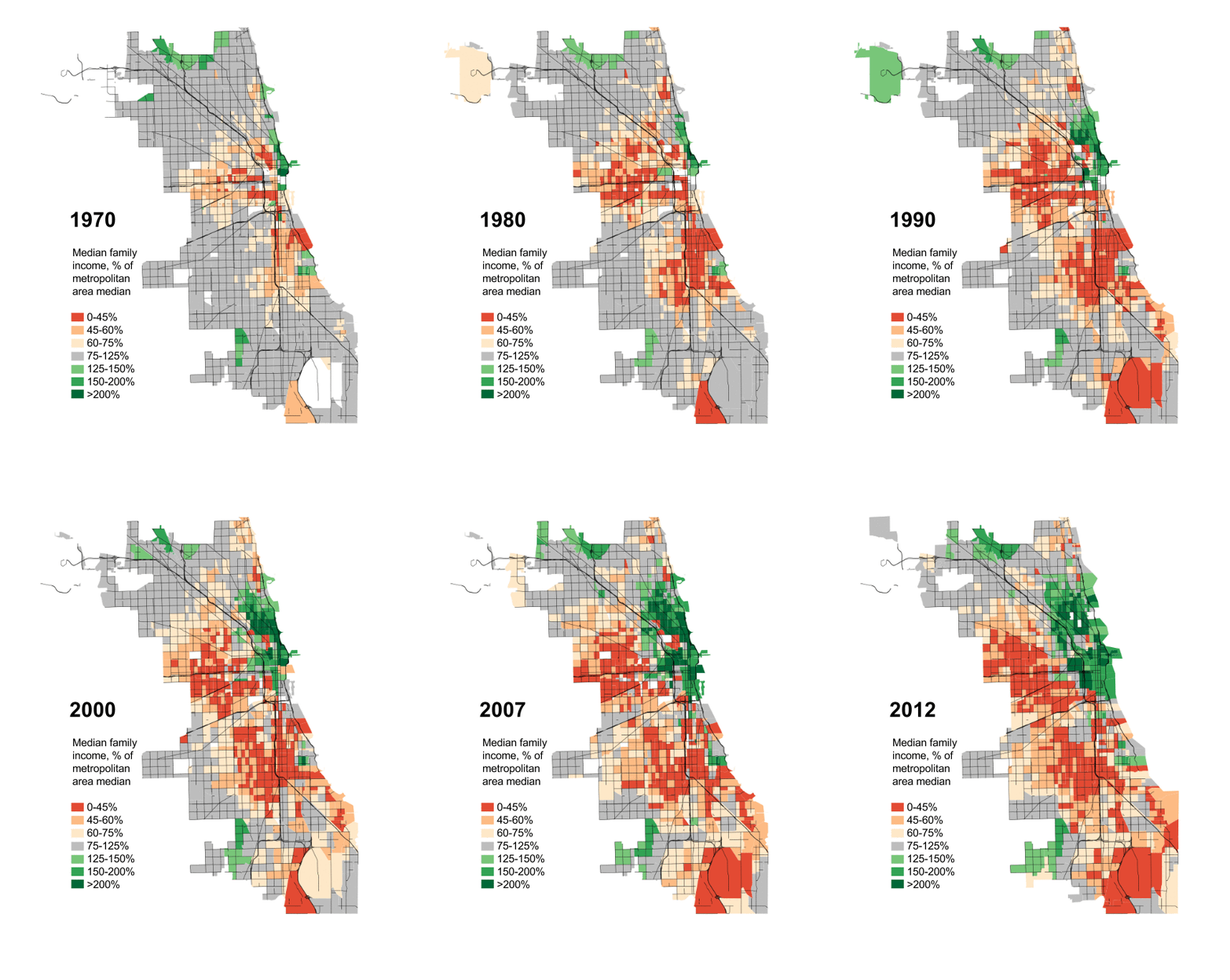
Anyway, this is all by way of introducing the following maps: their goal is not merely to depress you (you’re welcome!), but to suggest just how dramatically the reality of Chicago’s “two cities” has changed over the last few generations, how non-eternal its present state is, and that a happier alternate reality isn’t just possible, but actually existed relatively recently.

I feel relatively comfortable telling the story of how Chicago came to be so segregated by race; I’m much humbler about my ability to explain this, except inasmuch as the ever-widening ghetto of the affluent could not exist without, yes, radically exclusionary housing laws, and I will take that up separately in another post. In the meanwhile, I’ll take a page from Ta-Nehisi Coates and ask you all, if you have some background in this, to talk to me like I’m stupid: what does the literature say about growing economic segregation? Who and what should I be reading?

One last piece: the obvious and immediate reaction to these maps is to see them as a direct consequence of rising income inequality. There is some truth to that, but the researchers from which much of this data came have already discovered that income segregation has actually risen faster than inequality. So that’s not the end of the story.

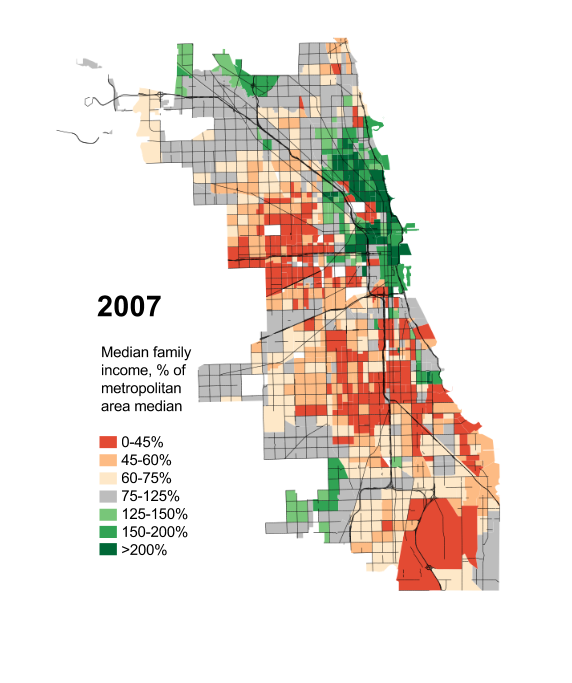
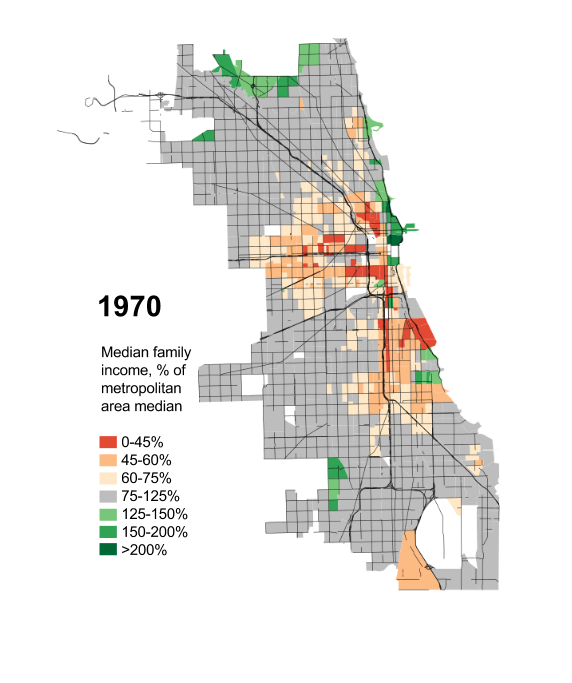
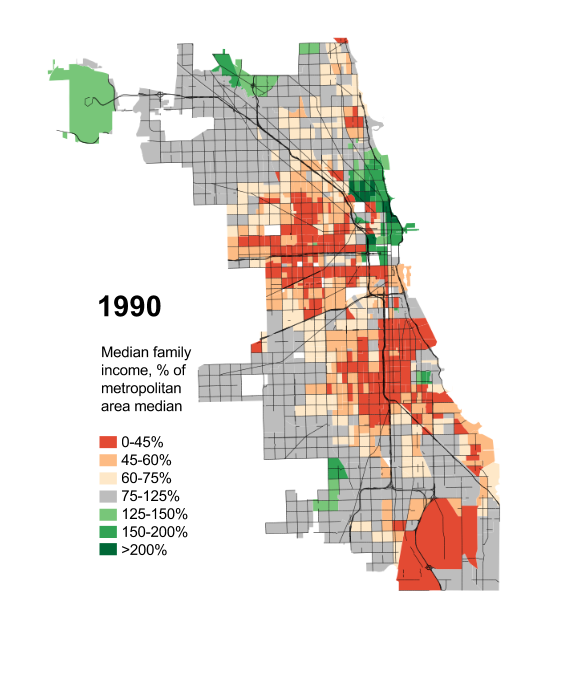
Anyway, here you go: the disappearance of Chicago’s middle-class and mixed-income neighborhoods since 1970, measured by each Census tract’s median family income as a percentage of the median family income for the Chicago metropolitan region as a whole.
Seg70aSeg80a


Seg90aSeg00aSeg07aSeg12a


IncSegGIF

Thanks

Last night I had the pleasure of talking to a captive audience about zoning at the Open Gov Hack Night. I had a total blast. Those of you I met: Thank you so much for coming, and I hope we get to meet again soon. Those of you who couldn’t come: Another time!

If you didn’t get to see it, or you thought it was just so wonderful that you want to see it again, the video is below.

FYI

On Tuesday, March 18th (next Tuesday!), I’m giving a short talk about why land use law is ruining your life. It’ll be at the Open Government Hack Night at 1871 in the Merchandise Mart in downtown Chicago at 6:00 pm, and I believe (?) there’s gonna be food. Much of the source material is from the blog, but there will be a few new data projects and maps I’ve been working on, too.

You should come! So far I have met only two blog readers I didn’t already know before I started writing, and I’d love to meet more. Plus, you know, there’ll be food.

The world cooperates with the timing of my blog posts

No sooner do I write a taxonomy of gentrification than a Huff Post story piggybacking on a Tom Sugrue op-ed goes semi-viral in my corner of Twitter. (Sugrue, in case you didn’t know, is perhaps the world’s foremost historian of America’s Rust Belt cities, in particular Detroit, and is featured twice on my Bookroll to the right. If you haven’t read him and you live in America – or if you plan on spending any significant amount of time living here, or even talking about it – please do yourself the favor.)

As online missives about gentrification go, this is definitely better than average. It also, though, seems deeply confused – not because it makes any unreasonable points, but because it moves back and forth between many of the compelling but contradictory arguments I went over yesterday.

To begin with, the title – “Detroit Doesn’t Need Hipsters to Survive, It Needs Black People” – suggests that the author believes in the “intrusion” and “displacement” arguments: Detroit has become a community for black people, and so they should continue to “own” it, culturally and economically.

But then later the author reveals that, actually, she has integrationist sympathies:

Detroit’s population now hovers around 700,000 people. Thirty-eight percent of its residents live under the poverty line, and the city’s median income is less than $27,000. The city has a persistent legacy of residential segregation — metropolitan Detroit is the most segregated urban area in America — which plays a role in many residents’ anxiety about being physically displaced.

She notes with approval that integration is reversing capital’s 50-year racist boycott of Detroit:

Attracting wealthier residents and new businesses to the city is not without its benefits. It’s helping to stabilize the city’s tax base, for one thing, which means more money for essential services like garbage pickup, cops and firefighters.

She also quotes Sugrue on the city’s need to do “things like revamping the public school system,” which – having read his books – I feel relatively confident he thinks is predicated on at least some measure of desegregation.

But then she veers back to intrusion, quoting a U of M sociologist who describes the process much better than I did:

Meagan Elliott, an urban planner and Ph.D. candidate in sociology at the University of Michigan, is studying the ways in which newcomers’ efforts to revitalize Detroit neighborhoods can impact long-term residents. Her focus is on “cultural displacement,” a condition that she defines thusly: “By cultural displacement, I mean a sense of place and community and feeling like you have the right to creating the vision for that community’s future. Even if people are not forced from their homes due to rising rents, they may feel like their community is less their own than it used to be.”

But then Ms. Elliott says that actually Detroiters ought to embrace their new (mostly white) neighbors, who are actually doing some good things for the city. And the article ends by suggesting that maybe Detroit’s new white mayor is going to put things in the right direction.

Remember, the title of this article was “Detroit Needs Black People.”

My point, to the extent I have one, isn’t that this is so ridiculous, but that it would be nice if we were all a bit more self-conscious about where our sympathies and priorities lie. If they conflict – as mine do – that’s totally fine. But recognizing that they conflict is a necessary first step to coming up with any sort of coherent attitude and set of solutions. It’s also the first step to (pardon the editorializing) not talking about gentrification like an asshole, and (for example) using a public forum to call people who move to an interesting neighborhood they can afford “motherfuckers,” or writing an entire column in a national magazine about how racist some guy is for wishing his childhood neighborhood hadn’t changed so much.

Cleveland, the South Side, love, ownership

Angie Schmitt speaks the truth:

What are some of the stereotypes about Cleveland? Poor? Check. Segregated? Check. Blue collar? Check.

Anyway, I think what really defines Cleveland, Cleveland’s place in the scheme of things, lies just outside the art museum: very poor and segregated neighborhoods. So poor, so segregated, that they rise to being nationally exceptional. And while it’s ok to take pride in our art museum — great even — it doesn’t give us a pass on something like that. It’s odd to insist it does, IMO.

I think there might even be sort of a direct tension there. The art museum just raised $350 million for a really beautiful renovation. I think it’s easy for them to do that in part because of the prestige we imagine it affords on us personally, as Clevelanders. This is especially true for rich folks, I think, Cleveland’s titans, the ones who give money. Because being important in Cleveland is one thing, but if Cleveland isn’t a city that matters in the scheme of things, what does that say about our important people?

Anyway, sometimes I like to idly wonder how far than $350 million would have gone toward fixing what’s wrong with Glenville and East Cleveland, although I’m pretty confident the money would have been much more difficult to raise. Could it have helped solve some of the problems that have come to define us?

Relatedly: I was on the train earlier this week, and two white men got on and asked their neighbors, who were two black women, how to get to a hotel. The women told them. And then began a sort of stock conversation that Chicagoans have with tourists: How do you like the weather, ha ha? The men, who were from Atlanta, did not like it. Have you been on a subway before? Yes, but not often. Would you come back? Oh, yes. We love Chicago, the men said.

The men reached their station, and left.

One woman said to the other: I hate it when people say that – I love Chicago. No, you don’t. You love downtown and the North Side. The other woman said, Uh huh.

I thought, unhelpfully: I love the South Side.

I decided I would write a blog post about it. The South Side for North Siders: How to love your city.

I would write about the grand old highrises along the lake in South Shore, and their post-war cousins, in all their glazed-green-brick glory. And the manicured bungalows on the side streets around 79th in Chatham, and the park where I eat hot links from Lem’s BBQ in Park Manor. And the greystones that make my heart ache on King in Bronzeville, and the row of cottages on Berkeley in Kenwood. And the parents who kibbitz every morning on the 59th St. bus while they take their kids to school, while I take myself to school.

I imagine, though, that had I said all of that to the women, they might have responded: That’s a bit too easy. You get to love all of that and then go back to your neighborhood, where the schools more or less work and the streets are more or less safe and your neighbors are people who are not slandered the world over as impoverished barbarians.

That would be fair.

Of the many crimes of segregation, surely one of the most pernicious is that an imaginary boundary between people, between places, becomes real. That it is a self-fulfilling prophecy. Blackhood and whitehood and the ghetto are no more intellectually or philosophically serious than a grade school experiment, but also they are. The South Side is every bit as much my city as the North Side, to own me and be owned by me, but also it isn’t.

I acknowledge that.

But also I think it’s necessary to acknowledge that the emperor is naked. Those boundaries don’t exist, at least not in any moral or economic or human sense; and to the extent that they do, they don’t demarcate separate worlds but different faces of the same world. There was not one housing policy for the ghetto, and another for the Gold Coast; racism did not appear in the ghetto, and disappear in the Gold Coast; there was not one capitalism for the ghetto, and another for the Gold Coast. All of it was the same: our housing policy was to create in one place a ghetto and in another a Gold Coast; racism’s mandate was to create in one place a ghetto and in another a Gold Coast; capitalism’s outcome was to create in one place a ghetto and in another a Gold Coast.

I’ve written before that the young and economically mobile don’t get to opt out of being gentrifiers, but really the issue is much larger than that: no one gets to opt out of owning all the evils they have been breathing in – and out – their entire lives. If the very same forces created both the ghetto and the Gold Coast, then they created both me and the parents on the 59th St. bus; if they are still operating – and they are – then I and the parents on the 59th St. bus are in the process of recreating the ghetto and the Gold Coast every waking minute. And if the ghetto and the Gold Coast are both our parents and our children, then surely we’re entitled to love them.

Is this too much mumbo-jumbo? Maybe. There’s another way of saying all this, which involves recounting the names of Cabinet secretaries and budget appropriations and dates and times and graphs and spreadsheets. If you read this blog, you know I’m comfortable enough with all of that. If you look to the right, I’ve assembled a list of some of the people who have done it that way best.

Sometimes, though, I think it’s worth it saying it this way, which involves gesturing at love and sadness.

Credit where credit is due, i.e., Tracy Swartz and Redeye

On this blog and on Twitter, I have expressed a certain amount of exasperation with how the media has handled the Ashland BRT debate, and debates over public transit in general. In particular, I’ve criticized the Sun-Times, Tribune, and Atlantic Cities for obscuring the basic facts of the proposal and – most egregiously, in my mind – having written thousands of words about a major bus overhaul without talking to a single bus rider. As a result, their articles mischaracterized the debate as a battle between regular folks who drive and meddling government planners and transit nerds.

This morning, though, Redeye’s transportation reporter, Tracy Swartz, wrote an article that actually described both the benefits and costs of BRT – much faster buses, some increased car congestion, etc. – and talked to bus riders and explicitly described the debate as between drivers and people who take the bus. That’s not exactly the framing I think is best, since people can move between those categories, and a good number of people are, in fact, going to start taking the bus more often if BRT goes through, but it’s a hell of an improvement over everything else I’ve seen. The only point I wish she had included is the official estimate of how much time drivers will lose in congestion because of BRT, since I don’t think the answer is at all intuitive for most people. (For the record, it’s something like 10-15%.)

I don’t have much else to add, except: it can be done! Transportation writers, take note.