On the subject of Metra

Got a couple other things in the works, but for the moment, a developer read my post at Streetsblog last week about how Metra needs to get some people near its damn stations and proposed a 20-story rental tower across the street from a station in suburban Park Ridge. Park Ridge is not amused:

“Something like this is not going to be well-taken. And it’s not well-taken by me,” said commissioner Jim Argionis.

“We can’t make this work. This can’t be done,” Kocisko said. He added that though the city may generate added property tax from the development, there would also be an increase in city services required for so many new residents.

Kirkby called the plan “preposterous” and compared the design to something that might be found in Chicago’s Gold Coast neighborhood or in Dubai.

A couple thoughts.

1. That is one ugly building. (There’s a rendering in the article I linked to.)

2. Park Ridge is exactly the kind of suburb/neighborhood that is hugely desirable and yet has used its zoning laws to keep out the kind of people for whom moving to Park Ridge would be a major advancement in terms of neighborhood safety, access to jobs, and high-quality public education. As of 2010, Park Ridge was 93% white, the median family income was $110,000, and the median house sold for $420,000. It’s got to be less than half an hour on Metra to downtown Chicago. And yet Park Ridge – like, say, Lincoln Park – actually lost population between 2000 and 2010.

3. In the real world, Park Ridge is never going to approve a 20-story glass box in the middle of a small, low-rise downtown surrounded by single family homes. But there is, in fact, a middle ground. Instead of saying “We can’t make this work,” a commissioner might say something like: “This plan as submitted doesn’t make sense for Park Ridge. But we know that we have to let our town grow. Come back to us with something that won’t look like it was airdropped in by mistake. Come back with a midrise, in other words, whose aesthetics match the expectations of the community.” There are ways to add density without sticking your finger quite as deeply into the eyes of your new neighbors.

Just for fun, here’s Park Ridge’s zoning map. See if you can find the places where apartments aren’t illegal! (Hint: It’s almost nowhere.)

parkridgezoning

Two for Thursday: Milliken and Metra

I have two pieces up elsewhere today. At the Washington Post, a look back on the 40th anniversary of the Supreme Court decision that reversed Brown v. Board of Ed:

In other realms, Roth’s logic – that political boundaries must be subservient to larger questions of justice, including segregation – is taken for granted. Think, for example, about Congressional districts. To start with, they’re redrawn every ten years to adjust to shifting populations. Not only that, but there are lots of rules designed to make sure the new districts aren’t unfair in ways that violate anyone’s civil rights. If they are, they can be thrown out by a judge, and ordered to be redrawn.

We go through all of this because we understand that unfair Congressional districts can be devastating for minority communities, denying them political power and, along with it, the ability to fight for policies that improve their lives.

School districts, of course, play just as large a role in determining their residents’ life chances, but share basically none of these rules.

And at Streetsblog Chicago, a post on ridership trends and the incredible wasted potential of Metra, Chicago’s commuter rail:

A coordinated effort between Metra, Chicago, and the suburbs to increase service and encourage development around walkable stations that serve relatively high population density could go a long way to improving access to jobs and amenities via transit for hundreds of thousands of people — and at a fraction of the cost of new rail construction.

At its most ambitious, that might look like the long-sought conversion of the Metra Electric line to true rapid transit — promoted most recently by the Transit Future campaign. But short of that, Metra could take a page from our sister city to the north, Toronto, whose commuter rail agency recently announced it would increase all-day frequency to every 30 minutes, making off-peak trips there much more convenient.

MetraRiders

Watch New York City’s middle class (and poor) get pushed around; or: the incredible invisibility of disadvantage in the proximity of privilege

EDIT: Actually, there is something in particular I’d like to get out of this. It’s similar to the point I made with the Brooklyn map: namely, that the invisibility of the poor and nonwhite when they aren’t interacting with more privileged people is just astounding. Look at Manhattan; look at the Bronx. Look, for that matter, at Brooklyn again. Whose stories do we hear?

That would be a stupid rhetorical question – duh, Daniel, we hear rich people’s stories – if it weren’t for the fact that even I, a person who has made this exact point multiple times before, was shocked at the extent to which very low-income neighborhoods persist in New York. Why was I so surprised? Because all people talk about is how New York has become a gated city of the ultra-rich. Because of the social bias that I just suggested was blindingly obvious. And which nevertheless, in this case, I fell for.

And if I fell for it in this case, then surely I’m still falling for it in dozens of others. Andrew Sullivan’s blog, for as long as I’ve read it, has carried on its masthead an Orwell quote: “To see what is in front of one’s nose needs a constant struggle.” That’s true in a very general way, of course, but it’s also worth remembering that it’s true in some pretty specific ways: for whatever reason, the struggle is particularly difficult when it’s poor or nonwhite people in front of your nose. That’s a lesson for anyone who cares about cities – or, you know, humans, since an interest in cities is at bottom an interest in humans and their habitats – whether you’re part of the media, or an urban planner, or a neighborhood activist, or just one of those humans in their habitat.


I’ve been holding onto this for a while, not quite sure what to do with it, but now I’m releasing it into the wild. It comes from the same data set and researchers (Sean Reardon and Kendra Bischoff) as the Chicago map, with the same disclaimer that any mistakes in the translation of spreadsheet to map are entirely of my own doing.

Anyway, I know much less about New York’s social geography than I do Chicago’s, so I won’t say too much, but several things obviously stick out here. One is that though Manhattan has almost entirely eliminated middle-class or economically balanced neighborhoods, the rest of the city has a good deal more of them than Chicago. To some extent, I suspect this has something to do with New York’s much more ambitious (and, sometimes, progressive) housing policy: fewer than half of tenants there live in pure market-rate housing. Although New York, like most of the rest of the country, would do well to allow more housing where there’s capacity, demand is high enough that lots of subsidies are likely called for.

The other thing is just how much of New York, currently a global symbol of gated-city affluence, is actually poor. Look, for example, at the Bronx: it’s a sea of red. A decent amount of Brooklyn, too. Another reminder of how the obsession with gentrification obscures the larger issue of income segregation.

Also: man, Harlem is gentrifying. That sort of dark-red-to-green is something you didn’t see too much in the Chicago map.

Finally, this map really ought to have a scale capable of showing the extremes of wealth in parts of Manhattan that just don’t exist in Chicago. Twice the metro median family income really doesn’t cut it.

* These are not polished maps: I just don’t have time to polish them, but I wanted to get them out, and the broad trends are pretty apparent. You’ll see that some tracts in Staten Island are missing until 1990-2000; I figure people don’t care that much about Staten Island. (Sorry, Staten Island.) Also there are some weird things that happen with tracts that include parks, where small populations are included where they weren’t before. Apologies.

NYGIF


frame_000 frame_001 frame_002 frame_003 frame_004

The “Take a stand against violence” slur

This is quick, but it’s one of my least favorite things:

As he has in the past, Emanuel said gun violence plaguing the city must be addressed in a variety of ways, which he said include policing, tougher gun laws, more investment to help children in impoverished neighborhoods and instilling a “shared sense of purpose and values” in communities across Chicago….

Right: similarly, the Mexican drug war began in 2006 when Mexicans suddenly found themselves without a shared sense of purpose and values.

Chicago gangland violence unleashed by Prohibition in the 1920s might have been assuaged if Chicagoans had just felt themselves more strongly to be part of a larger, purpose-driven community.

This slur – that violence could be prevented by the people who live in the neighborhoods it affects, if only they cared or tried hard enough – needs to end. For one, you only have to walk a few blocks in most of the communities most affected by crime in Chicago to see lots of indications that the people who live there – shock of shocks – are, in fact, “taking a stand” already.

You see signs like this all over the South Side. It’s almost as if black people like safe neighborhoods, too! Photo credit: yochicago.com

But what makes this trope really sublime is the fact that neither mayors, nor police commissioners, nor the most esteemed criminologists, have more than the barest understanding about why crime goes up or down to begin with. Concentrated poverty and unemployment can’t help, of course, but consider that crime continued to fall or remain steady in Chicago and the rest of the country during the worst economy since the Great Depression. So people like Mayor Emanuel, faced with a problem he doesn’t know how to fix, instinctively reach to blame the people who are most brutally affected.

Of course, this slur wouldn’t work if we weren’t so eager to believe that people who are poor or non-white – the people who disproportionately suffer from crime – are somehow less civilized, less moral, less interested in their communities, than everyone else. But that’s a lie.

So is “take a stand.” End it.

Where does Chicago’s black middle class live?

(As a foreword: I’m very conscious, as I write this, that I’m explaining something a large number of readers already know; I want to acknowledge that what I’m doing is not unearthing some previously-undiscovered secret, but trying to demonstrate a few of the basic facts of the city’s social geography that really, truly are mysteries to a huge number of people, both in Chicago and in the rest of the country. It would be nice if we lived in a world in which the black middle class were not an exotic demographic to most non-black Chicagoans, let alone the dominant view from outside the city: but we don’t, so here we are.)

There are at least three ways one might go about answering that question.

1. If you picked a random middle-class black person, where are they most likely to live?

To answer this question, you probably just want to count up all the middle class black households and tally them by neighborhood. So that’s what I did. The tricky part, obviously, is defining “middle class.” In the end, I went with something like what I did with my Chicago income segregation maps: households making at least 75% of the metropolitan average income, which works out to about $45,000 a year. There are a million problems with this: it doesn’t account for household size, or life station (a 26-year-old with a bachelor’s making $40,000 doesn’t count, even though nearly anyone who met them would consider them middle class, while a single parent with four children making $45,000, whose economic and social position is likely much, much more precarious, does), or any number of other things. I considered using education, but in a city like Chicago – and this is especially true among African Americans, I think – a huge number of people with middle-class lives have union jobs that don’t require a college education.

Anyway, with all those caveats, here’s the map:

B45totSo the answer is mostly on the South and West Sides: that’s Austin there on the far West Side, with the largest number; Roseland, Auburn Gresham, and South Shore are the leaders on the South Side.

There are things to say about this, but I’m going to go through the next two maps before I say them.

2. If you picked a random person in a given neighborhood, what’s the likelihood that person would be black and middle-class?
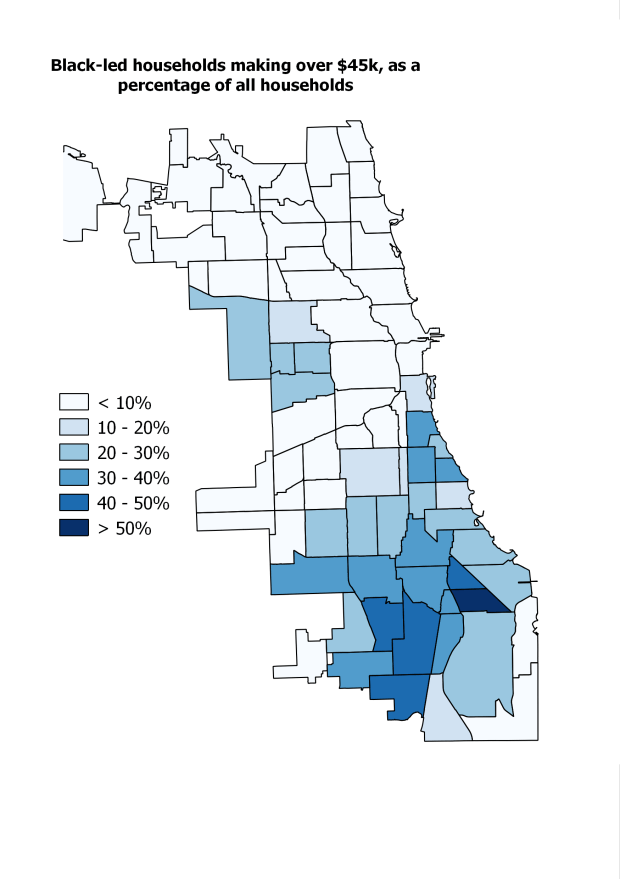
B45per

In effect, what this does is control for the number of people in each community area. Austin, for example, which looked super impressive in the first map, now looks less impressive; it turns out that it has a lot of middle-class black people mostly because it has a lot of people, period.

Anyway, the standouts now are Calumet Heights, the darkest-blue trapezoidal shape on the far Southeast Side; Avalon Park just to the north; and Roseland, Washington Heights, and West Pullman on the far, far South Side.

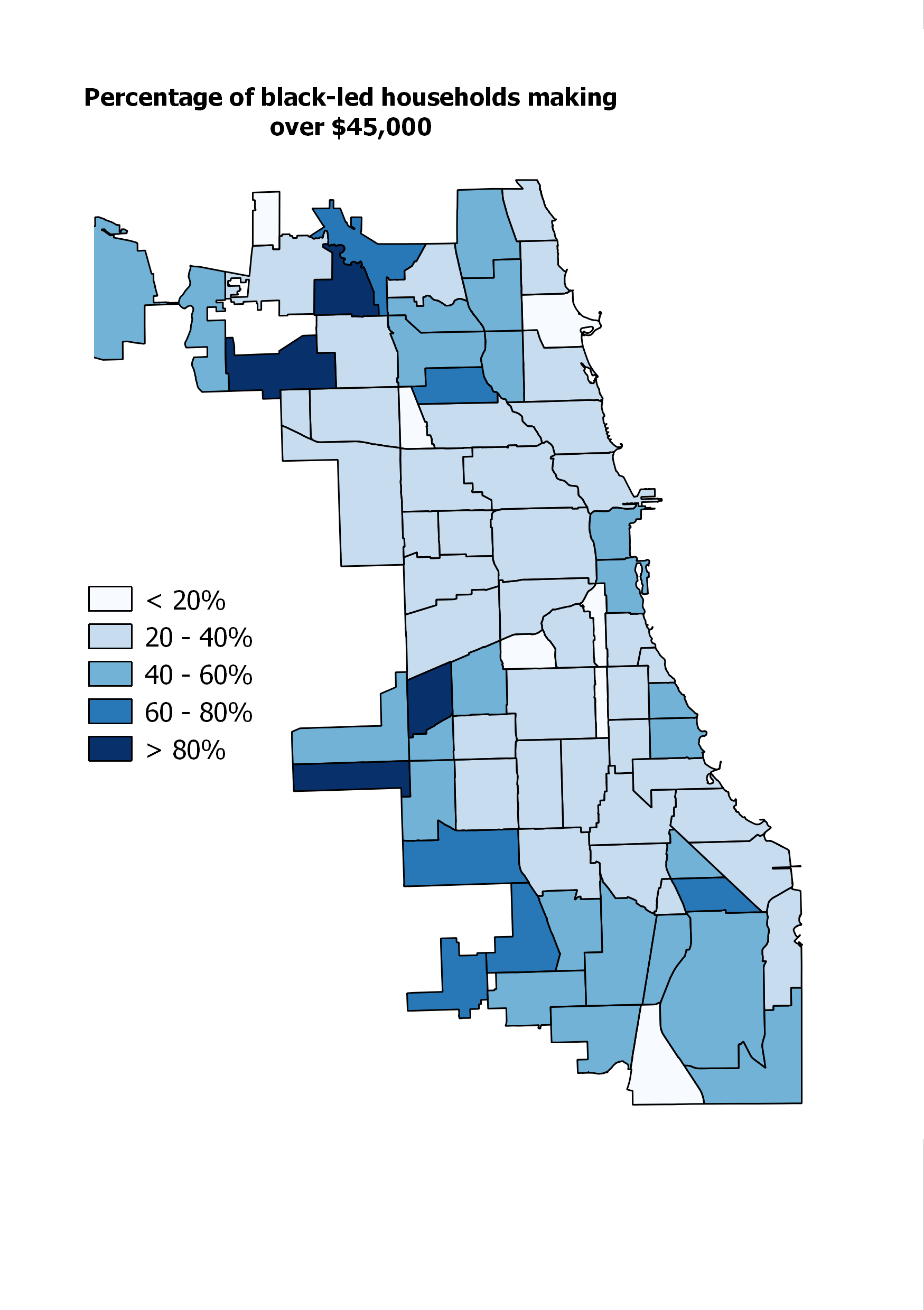
3. Finally, if you picked a random black householder in a given neighborhood, what is the likelihood that person would be middle-class?

B45perofB

This is a considerably weirder, and in some ways more misleading, map. There are now standouts on the Northwest and Southwest sides, in addition to the far South Side; but, if we refer back to the first map, we see that most of those places have vanishingly few black households to begin with. In fact, it’s much worse (in the sense of the numbers are much smaller) than that map even suggests: in many of the darkest-blue areas, we’re talking about dozens of households. Many of these are areas that, up until twenty years ago or so, had literally – or almost literally – zero black residents. To the small extent that they’ve been integrated since then, they’ve been integrated with solidly middle-class people.

Anyway, a few notes on the whole thing:

1. The black middle class exists in Chicago. In large numbers. This shouldn’t really be news, but speaking in my capacity as a white person who knows a lot of white people, and other people of various ethnic backgrounds from the North Side and suburbs and other parts of the country/world, it really is.

2. Perhaps even more importantly, the vast majority of Chicagoans who are both black and middle-class live on the South Side, and to a lesser extent, the West Side.

3. The concentration of middle-class households varies dramatically from one black neighborhood to another.

4. Still, the majority of Chicagoans who are middle-class and black live in neighborhoods that are mostly not middle-class – as opposed to Chicagoans who are middle-class and white, for whom the opposite is true. In this way, Chicago is pretty similar to the rest of the country.

The takeaway, for me, is that these maps contradict two of the biggest lies – or, if we’re being kind, misconceptions – about the social geography of Chicago. The first is that the black neighborhoods of the South and West Sides are an undifferentiated landscape of economic hardship. This is false in a couple of ways. For one, though there are, in fact, many people who are suffering for want of a decent wage in these areas, there are also many thousands of households that are not. (Though they are likely still disadvantaged by other consequences of segregation, including worse access to jobs and basic amenities, higher crime, lower-performing schools, etc.)

For two, just like white, Hispanic, and Asian people, black people are segregated by income. That is to say: some black neighborhoods are much wealthier than others. Of course, this kind of stratification is complicated, since it’s layered on top of – and interacts with – racial segregation. But the view of Chicago as bifurcated between the privileged North Side and deprived South Side needs to get sophisticated enough to recognize the major differences in privilege/deprivation between, say, Englewood and Calumet Heights. It also needs to recognize that even in neighborhoods that are majority low-income, there are generally a significant number of middle-class residents.

The second big lie, related to the first, is that basically everyone on the South and West Sides would get out if they could. This is sometimes stated explicitly; more often, I think, it’s the unspoken assumption that frames most outsiders’ conversations about those parts of the city. It assumes that everyone in Chicago follows roughly the same ladder of neighborhood prestige: one that tops out in Wicker Park, or Lincoln Park, or North Center, or Norwood Park, depending on your family status and subcultural preferences.

But this isn’t remotely the case. Someone who had only lived on the North Side – or outside the city – might figure that the reason there are so few black people (or Latinos! more on that in a sec) in, say, Lakeview, is that Lakeview is so expensive, black and Latino people have lower average incomes, etc., etc. And surely that is, in fact, a large part of the answer. But it’s not the entire answer, and one way to prove it is to show that, actually, the median black householder in Lakeview actually makes less money than the median black householder in Roseland, a neighborhood whose name is usually accompanied in media reports with adjectives like “struggling,” or “blighted,” and so on. It’s actually not even close: over $40,000 in Roseland, versus $33,000 in Lakeview. Those sorts of inversions of North Side/non-Chicagoan perceptions about neighborhood prestige are actually pretty common: black median household income is $24,000 in West Town, $31,000 in Lincoln Park, and $35,000 in North Center, but $39,000 in West Pullman,  $42,000 in Washington Heights, and $56,000 in Calumet Heights. And in Ashburn – a neighborhood on the very southwestern edge of the city that’s about 50% black, and which most North Siders (including me, until friends moved there a few years ago) have never even heard of – it’s over $70,000.

Why does all of this matter? Number one, it’s something that lots of people are wrong about, and I don’t like it when people are wrong about things. More generally, though, widely-held perceptions of neighborhood quality and prestige – especially when those perceptions are held by people with lots of economic and political power – play a huge role in shaping the future of any given neighborhood. From a governance perspective, there are lots of reasons you’d want the people in charge of a city to have an accurate impression of the communities they’re governing before they start making up policies for them; but also from a purely social point of view, the fact that most non-black Chicagoans – and the vast majority of non-Chicagoans – can’t distinguish between Englewood and Calumet Heights means that they won’t ever visit, spend money, and certainly won’t consider living, in neighborhoods that they would likely find generally pleasant. (I apologize for picking on Englewood: I definitely don’t mean to suggest that it doesn’t also have positive qualities, or that no one should go there. I’m making some big-picture observations about the size of its challenges relative to other neighborhoods, and common ways that people react to places with those kinds of challenges.) In short, it’s hard to build much of a local economy in a place that 75% of the population shuns without even thinking about it. (Read Robert Sampson’s Great American City for more on that.)

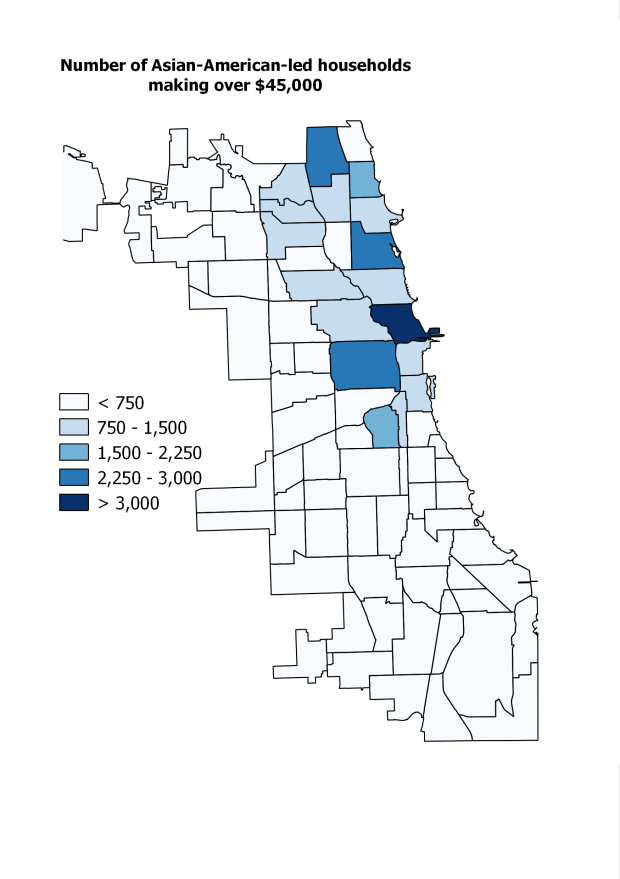
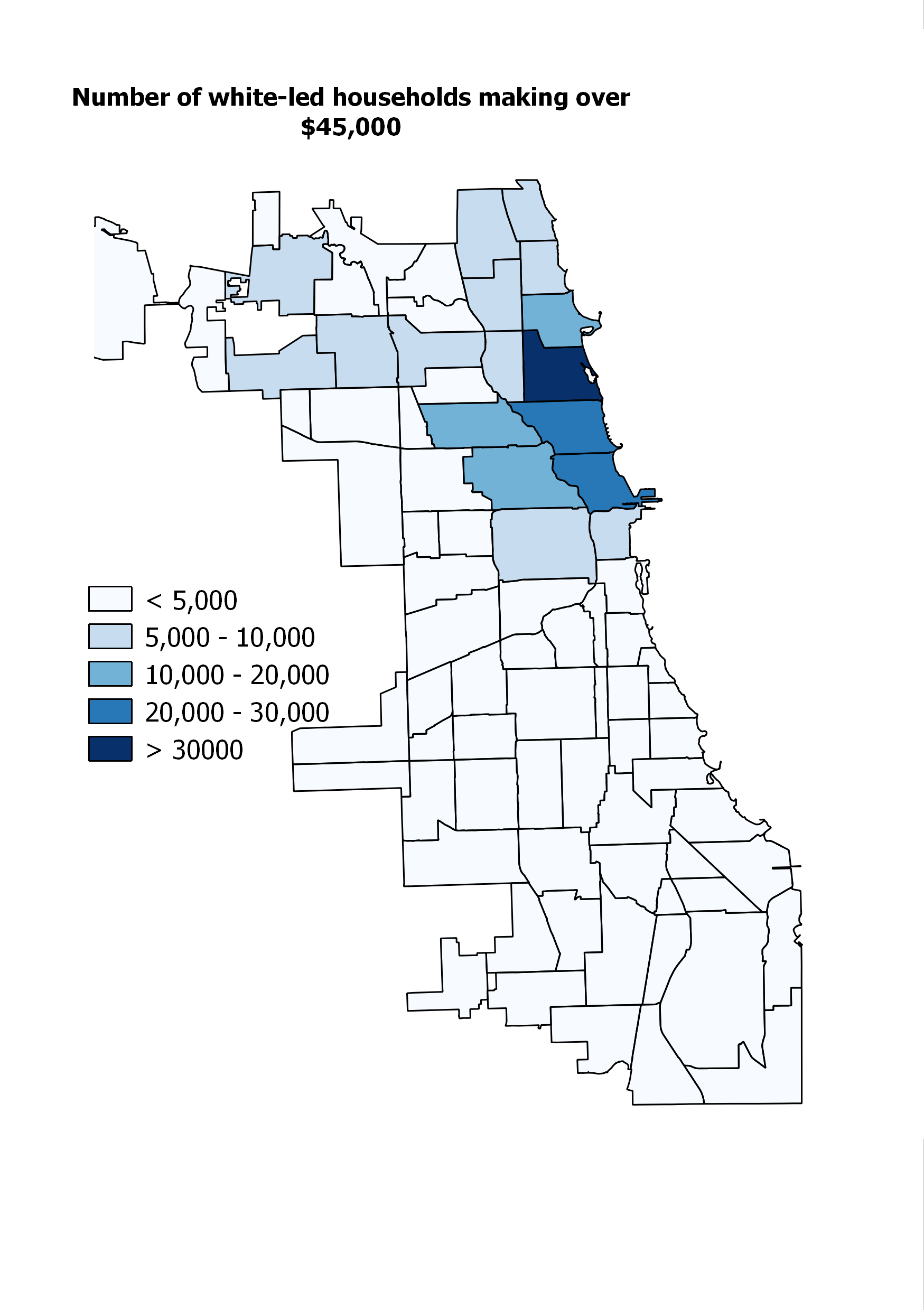
Anyway, this post is now long enough: I have more to say, but I will put it off to another time. I’ll leave you with two final maps: versions of map #1 above for Latinos, whites, and Asians. They’re fairly self-explanatory, but suffice it to say that most of this post could be rewritten, with only minor edits, to apply to Chicago’s Latino middle class as well.

L45tot

W45tot

A45tot