Quick thoughts on the Market Urbanism approach to gentrification

Over at Market Urbanism, Adam Hengels has written a mini-manifesto on gentrification. (In which, by the way, he graciously cites this blog. Thanks!) It’s a strong articulation of why anti-gentrification politics centered on opposing new development can’t work, though I think Adam is a bit too hasty in presenting zoning deregulation as a complete fix, or the only possible approach.

Anyway, this is his Twitter-friendly takeaway:
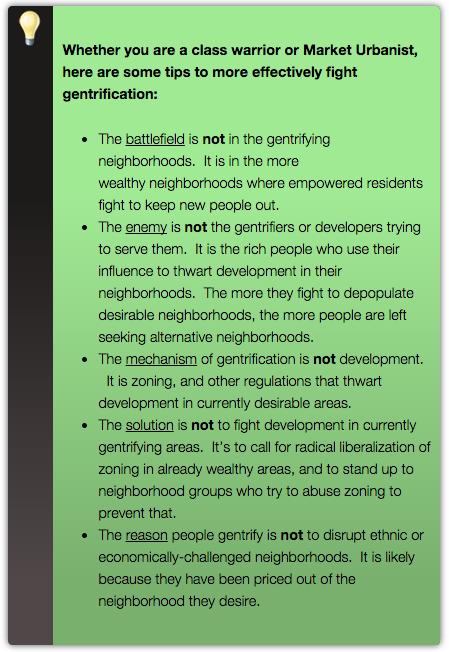
Adam Hengels, Market Urbanism.

In the interest of time (my own and yours), in bullet points:

  • The battlefield is both in the gentrifying neighborhoods and in the wealthy neighborhoods. The battle is also, for that matter, in the poor neighborhoods that are not being gentrified, since their gradual or rapid disinvestment sets the stage for reinvestment later on. (See the rent gap theory.) In a narrower sense, Adam is right that the engine of gentrification – that is, growing demand for housing in a system that will only accommodate that demand through rising prices – is churning both in Logan Square and Lincoln Park (or Bed-Stuy and Greenwich Village, to use a New York example). We focus on Logan Square and Bed-Stuy because they are going through a process not only of rising rents, but of dramatically transitioning social networks, from generally lower-income, mostly blue-collar people of color, to generally higher-income, mostly white-collar white people. That represents a shifting of some of the most important social-spatial boundaries that exist in American cities, and so is extremely notable. But Lincoln Park and Greenwich Village have also been changing over the past, say, 15 years – it’s just that the shift from upper-middle-class white professionals to even wealthier white professionals is a less dramatic redistricting of social geography.

    Nevertheless, I don’t think it’s productive to tell the residents of Logan Square and Bed-Stuy that their observations about the changing character of their neighborhoods aren’t valid. The fact that the outcome of the Logan Square battle depends on the outcomes of other battles around the city doesn’t mean it’s not a battle.

  • I think this is basically right, if by “enemy” you mean “the people with the power to change what you don’t like.” That said, again, I think it’s worth acknowledging that for people who are opposed to gentrification for reasons of culture or community, gentrifiers can be the people who are directly undermining the things you wish to preserve. Moreover, the fact that they are moving next door to you only because they can’t afford the trendier neighborhood two subway stops closer to downtown doesn’t mean that they won’t also be inconsiderate neighbors. And even if they’re considerate neighbors, it doesn’t mean that they aren’t undermining what you value just by their very presence. Which, as I’ve said before, is not necessarily a problem with a solution.
  • This seems like it’s leaving some stuff out. Zoning is one really big reason why shifts in demand translate into big changes in prices, as opposed to changes in the amount of housing stock. The things that drive the shifts in demand are different. Another reason, potentially, is that housing is priced by the market to begin with. Many New York City neighborhoods have bulwarks of economic and racial diversity in the form of non-market housing, which makes up something like half the city’s units (combining public housing, subsidized housing, and rent-controlled or stabilized units).
  • Again, this is one approach. Another would be nationalization (insert tongue-in-cheek emoji), or at least the large-scale removal of housing units from the market. That said, a quick evaluation of our political and financial situation suggests that such a removal is not really possible at anything like the scale that would be required. So yes, zoning deregulation really ought to happen. But that’s not exactly politically popular either, even if it doesn’t come with anything like the financial requirements of creating non-market housing. Which is to say: we need both as much zoning deregulation as possible, and as much non-market housing as possible, because we’re not likely to get anywhere close to solving the problem with either of them.
  • Yes. Yes! The greatest insight of a market-based analysis of gentrification is that the actors who are given agency, who are treated as first movers in virtually all narratives about this kind of neighborhood change, are in fact pawns. They may be pawns of greater means than some other pawns, but at bottom their choices are also about constraints: Where can I be closest to my friends, potential employers, and the amenities I want, while staying within my budget? Which is why Adam’s first point, even if incomplete, is still important. In a real sense, the battle begins outside the “gentrifying” neighborhood. Mangling the old line about immigration, a gentrifier might say: We are here because they [richer people] are there [in the neighborhood where I’d rather live].

Gentrification and the Wealth Gap

The Washington Post
The Washington Post

A bit ago, I wrote about how conversations about neighborhood change often paper over very real conflicts of interest among members of “The Community”:

A very common refrain in gentrification debates is that “the community should decide,” or that changes should “benefit the community.” But as Michael Kendricks points out, “the community” is always made up of many different people, with many different interests. Virtually any decision that’s made about a new housing development, or store, or transit project, will benefit some members of the community at the expense of others. That is politics, and anyone who has been to a neighborhood meeting about anything, large or small, has seen firsthand that neighborhoods are not above, or below, politics.

It’s far from an original observation to note that homeowners tend to benefit from gentrification, since rising property values directly increase their wealth. (Of course, they may also be squeezed if their property taxes increase much faster than their income.)

But we rarely acknowledge just how huge those stakes are. A new series from the Washington Post on the black professional class suburbs in Prince George’s County, Maryland (and Pete Saunders’ astute take on it) helps to quantify what happens to black wealth when home values don’t increase. The massive wealth gap between whites and blacks – several times larger than the income gap – is driven in large part by the difference in home values in mostly white neighborhoods compared to ones that are mostly black. And, as the Post explains, the extremity of that gap is in large part a result of the collapse of home values during the Great Recession:

The recession and tepid recovery have erased two decades of African American wealth gains. Nationally, the net worth of the typical African American family declined by one-third between 2010 and 2013….

Overall, the survey found, the typical African American family was left with about eight cents for every dollar of wealth held by whites….

Many researchers say the biggest portion of the wealth gap results from the strikingly different experiences blacks and whites typically have with homeownership. Most whites live in largely white neighborhoods, where homes often prove to be a better investment because people of all races want to live there. Predominantly black communities tend to attract a narrower group of mainly black buyers, dampening demand and prices, they say.

And the only obvious way to rebuild this wealth in the short to medium term is to raise property values in black neighborhoods. Which, whether or not that’s accompanied by racial change, is likely to price some renters and prospective buyers out.

This is not a “gentrification is clearly good, so stop complaining” argument. According to the Post story, only 43% of black Americans own their own home, so even strong gains in to property values would only go so far. But the issue of wealth deserves a more central place in the story of changing real estate values, and anyone whose knee-jerk reaction is to condemn rising home prices in non-white neighborhoods ought to have something to say about how else we can close the wealth gap.

How many carless workers are there in Chicago?

BUSES
BUSES

Redeye‘s Tracy Swartz – one of the city’s best writers on the transportation beat outside of Streetsblog Chicago, to whom you should still give money – has an interesting article about why people choose to remain on transit (or not) while gas prices plummet. There are actually some interesting lessons in that part of the article, but I want to focus on this line:

Some CTA riders also don’t have cars to make the switch to driving when gas prices are low. About 16 percent of workers 16 years old and up don’t have access to a car to commute to work, according to U.S. Census Bureau American Community Survey estimates from 2008 and 2012.

Tracy showed me the ACS tables where she got that 16% number. But for the purposes of this article, I think they’re a bit (unintentionally) misleading. They tell us that 84% of Chicago workers live in a household with at least one car – but that’s not the same as being able to use a car to commute.

In my household, for example, there are three adults and one car. According to the Census, that means that all three of us have “access” to a car. But practically, only one can actually drive to work. Some households in a similar situation may be able to carpool, but given job sprawl and service sector work schedules, it’s unlikely that number is super large. (The Census says less than 10% of all workers carpool to work.)

So what’s a better estimate of how many workers can actually use a car to commute? To figure that out, I used this Census table, which gives the number of cars in a household by the number of workers.

First, in households with only one worker, about a quarter (113,000 out of 456,000) have zero cars.

Screen Shot 2015-01-20 at 7.35.10 PM
Source: 2013 American Community Survey


Of the 254,000 households with two workers, about 11% (29,000) have no cars, and 38% (97,000) have one car. That translates to 155,000 workers without their own car.¹

Source: 2013 American Community Survey

Of the 57,000 households with three or more workers, about 9% (5,000) have no cars, 19% (11,000) have one car, and 31% (18,000) have two cars. That translates to at least 55,000 workers without their own car.²

Source: 2013 American Community Survey

So, altogether, there are at least 113,000 + 155,000 + 55,000 = 323,000 workers who can’t use their own car to drive to work.

The Census also tells us that there are about 1,191,000 workers in all. Which means that 323,000 / 1,191,000 = 27% of Chicago workers do not have their own car to drive to work. That’s a good deal more than 16%.

Incidentally, this also means that a huge number of Chicago’s workers – roughly 39% – live in a household where, even if they themselves drive, their spouse, or child, or parent, or friend, rely on public transit (or in some cases bikes) to get around the city. And that doesn’t include households where a high school or college student relies on transit to get to class.

Source: 2013 American Community Survey

¹ There are two carless workers for each zero-car household, and 29,000 * 2 = 58,000. There is one carless worker for each one-car household, so 97,000. And 58,000 + 97,000 = 155,000.

² There are three carless workers for each zero-car household, and 5,000 * 3 = 15,000. There are two carless workers for each one-car household, and 11,000 * 2 = 22,000. If each two-car household has three workers, then there’s one carless worker for each of those. (If there are more than three workers, then there’s more than one carless worker – but let’s be conservative.) So that’s 18,000. And 15,000 + 22,000 + 18,000 = 55,000.

Two fun things to do

First of all, Streetsblog Chicago – which, on a shoestring budget, regularly produces some of Chicago’s best reporting on urban transportation – is holding a fundraiser to buy new shoestrings and resume publication after a brief budget-related hiatus. It’s next Thursday the 29th, in the form of a pedway bar crawl with Moxie, the LGBTQ urban planning organization. It meets at 5:30 at Infields, in the basement of Macy’s on State Street.

Without Streetsblog, many of these stories simply won’t be covered anywhere. If you’re at all free, I’d love to see you there. If you can’t make it, consider pitching in electronically! Streetsblog Chicago is a fucking valuable thing, and we shouldn’t just give it away for fuckin’ nothin’.

Also, less importantly, I’m going to be speaking on a panel with the lovely Yonah Freemark and Pete Saunders about neighborhood change at UIC’s Urban Innovation Symposium. We’ll be speaking on Friday the 30th from 12:00 to 12:45 in the Lecture Room at Gallery 400, 400 S. Peoria. Come if you want!

The new asymmetry of segregation

A while ago, in one of his dumber moments, the urban economist Ed Glaeser wrote a report for the Manhattan Institute called “The End of the Segregated Century.” The headline came from the finding that all-white neighborhoods – meaning, literally, neighborhoods in which there existed not a single non-white person – were basically extinct for the first time in American history. Glaeser admitted that, of course, there were a good deal of the opposite type of neighborhoods – ones in which there were literally, or virtually, no white people – but minimized them by pointing out that most had declining populations. The emphasized takeaway was “the end of segregation.”*

Many people at the time pointed out that this conclusion was exceedingly silly. More recently, though, Dan Keating at Wonkblog took Glaeser’s data and drew a much more insightful, and important, conclusion: Segregation still exists, but “The End of the Segregated Century” does show that it’s changed in a really dramatic way over the last 40 years. Where once residential segregation was more or less symmetrical – over here we have overwhelmingly white neighborhoods, and over here overwhelmingly black ones – contemporary segregation is asymmetrical. White neighborhoods are increasingly mixed with Latino and Asian families (and a handful of African-American ones), while black neighborhoods are still basically all-black.

Keating illustrates that change by highlighting neighborhoods that are more than 85% white or 85% black in various cities around the country:

Screen Shot 2015-01-05 at 2.39.03 PM Screen Shot 2015-01-05 at 2.39.14 PM Screen Shot 2015-01-05 at 2.39.25 PM

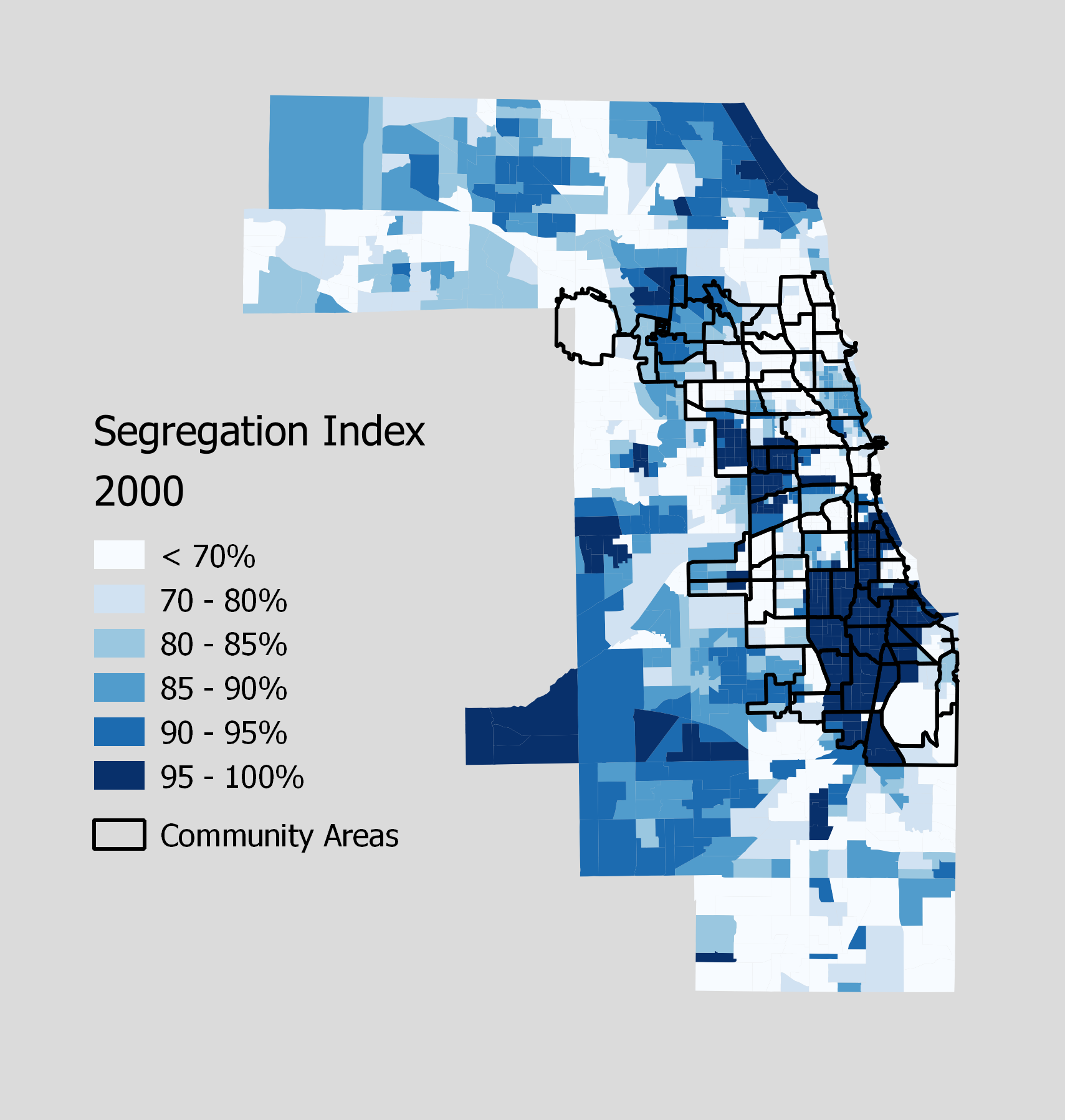
I had actually made a very similar series of maps before this was published, although I think Keating’s are easier to read. In mine, every neighborhood is colored according to a “segregation index,” which is just the percentage of residents who belong to the area’s largest racial/ethnic group. As a result, you can’t directly see which areas are mostly white and which are mostly black, but you can see a bit more detail in changes over time.

Seg80

Seg90Seg00Seg10

Every decade since 1980 has seen the gradual integration of neighborhoods all over Cook County, turning the heart of the Chicago metro area from a place where the typical neighborhood was 90-95%, or more, of a single ethnicity, to one in which those kind of communities are relatively rare.

Except for black neighborhoods.

Which have remained almost uniformly 95%+ black.

Ironically, this shift is partly explained by another Glaeser paper. In “The Rise and Decline of the American Ghetto,” he and another economist named Jacob Vigdor use data on housing prices, levels of segregation, and legal context to suggest that the forces that built and sustained black-white segregation from the early 20th century until about 1970 are different than the forces that sustain it today.

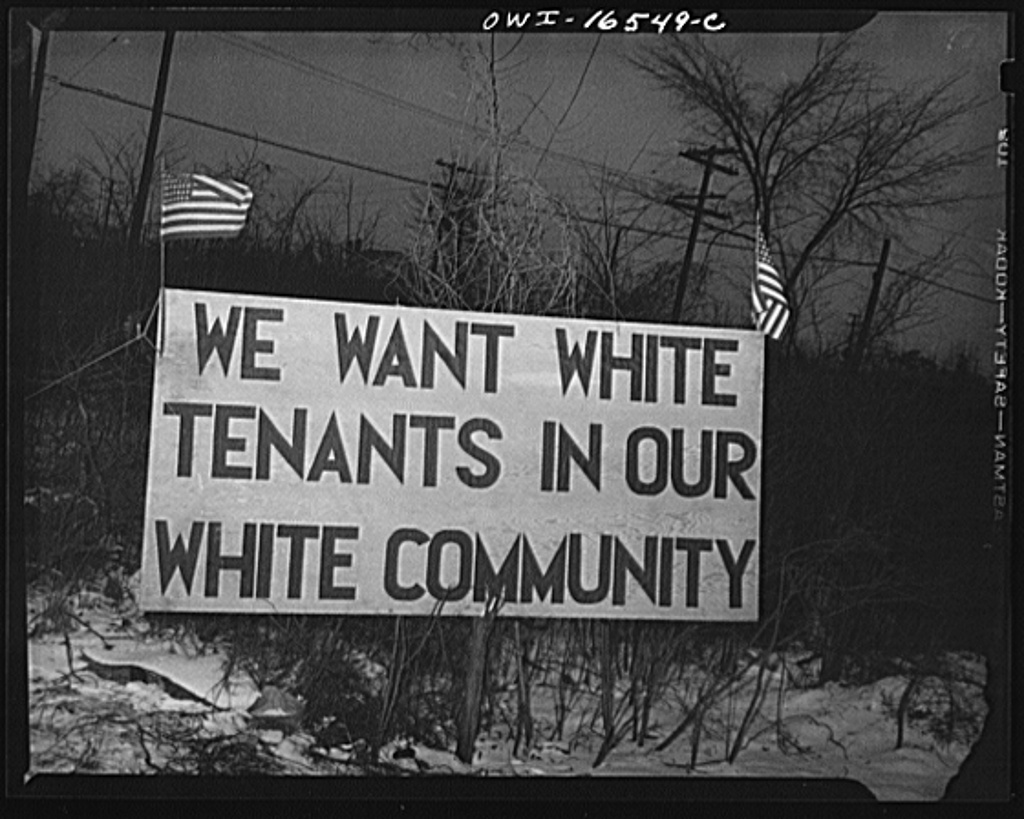
The theory goes that up until 1970, segregation was enforced through what Glaeser and Vigdor call “collective action racism”: that is, white people got together and decided to, say, legally prohibit the sale of homes in white neighborhoods to blacks, or use the housing finance system to keep blacks in certain communities, or build public housing in such a way that it maintained segregation. Outside of the legal system, whites organized formally and informally to intimidate blacks who moved into their neighborhoods. Sometimes, that looked like racist signs and vandalism. Sometimes, it looked like bombings, beatings, and riots.

This is the polite version.

But the Civil Rights era eviscerated a lot of the legal and financial systems that kept blacks and other non-whites out of white neighborhoods. (Even if it didn’t create new systems to reverse those wrongs.) Outright discrimination on the part of realtors or home sellers became much more risky. (Although it’s still quite common.) Slowly, it became unacceptable – from the point of view of both white peers and the police – to respond to a black person in your neighborhood by throwing a bomb through their window. (Though high-profile segregatory violence continued through the 1970s and beyond, especially around the issue of school integration.)

What didn’t change, however, was whites’ overwhelming preference not to live around black people. So segregation has declined only very slowly, thanks to what Glaeser and Vigdor call “decentralized racism.” By “decentralized racism,” they mean essentially shunning: whites won’t move to black neighborhoods, and they will flee their own neighborhoods if too many black people move into them. One result is that while in the pre-Civil Rights era, blacks paid more for housing than whites – because they were forced into relatively small, overcrowded neighborhoods with an inadequate supply of homes – today, whites pay more than blacks, in part because whites bid up prices in the limited number of communities with a sufficiently small number of black people. (Raising the possibility of racial arbitrage – a possibility which, as we discussed, has so far gone unfulfilled, because non-blacks apparently really don’t want to live around black people.)

Another way to visualize this is to show the change in the “segregation index” from 2000 to 2010.

SegCh0010

Despite noticeable shifts all over Cook County – from the desegregating suburbs in the southwest, west, northwest, and north, to the increasingly-segregated (white) North Side, (Latino) far Southwest Side, and (white-becoming-black) south suburbs, the established black ghettos on the city’s West and South Sides are almost totally unchanged.

Why does this matter? There are a number of things, but one in particular, I think, is that it suggests one of the problems with segregation: the issue is not just that white and black people live in different neighborhoods, but that black neighborhoods are shunned in a way that other ethnic enclaves – from Pilsen to Chinatown to the Indian-Pakistani Devon Avenue – are not, and in a way with really powerful negative consequences for successful businesses, schools, wealth building through homeownership, and so on. This is one reason that I’m so allergic to the rhetoric around violence in Chicago: treating the entire black South and West Sides as if they were “war zones” – places where you take your life in your hands just visiting – is one of the main ways that the shunning of black neighborhoods is openly justified among whites and other non-blacks. It’s why a bunch of ten-year-olds wrote an open letter to the rest of the city begging you not to be afraid of them.

There are, however, a handful of places where black neighborhoods are integrating in Chicago. I’ll go over them in more detail in a future post.


* It’s a pattern that recurs with some frequency: Glaeser does excellent empirical work, and then draws odd conclusions from the very useful numbers he finds.