Stereotypically, American transit users are low-income. In some places, like Chicago, transit is good enough, at least in some places, for middle-class and even upper-middle-class people to use it. But even here, surely more money makes you more likely to drive?
But not quite. In the Chicago metropolitan area – meaning these numbers include the suburbs, not just the city – the median income for a person who drives to work alone is $39,957. The median income for someone who takes transit to work is $40,314.
It gets even weirder if you make a map:
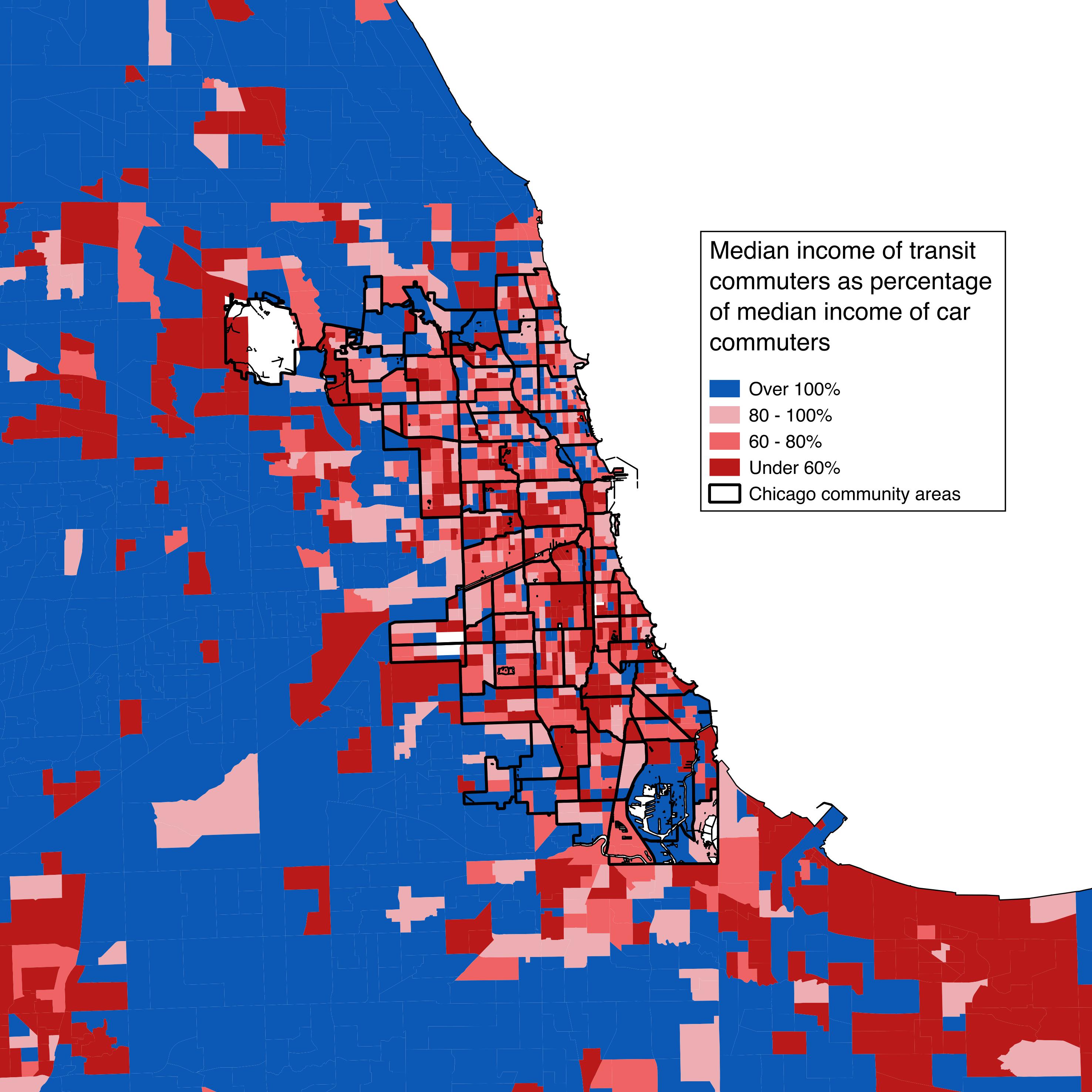
In short, blue areas are places where the median transit-rider’s income is higher than the median car-driver’s income. As the colors get deeper red, transit-riders’ incomes are falling relative to drivers’.
The results are pretty much the opposite of what you would expect: the suburbs are almost entirely blue, meaning that an average transit-rider from, say, Naperville, is actually richer than an average driver. In the city, that’s reversed: drivers tend to be wealthier than transit-takers. (If you only look at the city, things look a little more explicable: transit-riders’ relative income is highest in gentrified North Side neighborhoods with good transit access, especially along the Blue, Brown, and Red Lines.)
What’s going on? I can’t prove it yet, but I strongly suspect that it has to do with where different kinds of jobs are.
Our normal paradigm of how someone chooses to use transit has to do with income: we assume that in any given situation, transit is probably some amount less convenient but also some amount less expensive than driving, and so people who are more price-conscious – that is, lower-income people – will be more likely to sacrifice convenience for the sake of saving money. Under that model, rich people should be more likely to drive pretty much everywhere, but as the convenience of transit improves – that is, in dense cities – the gap should narrow.
But what this suggests, I think, is that income is playing a smaller role than job location. If you live in the suburbs and work in the suburbs, transit is almost certainly a terrible option for you. Metra runs infrequently and there are few jobs to walk to from Metra stations; Pace also has long gaps between buses on many routes, and is too slow to make efficient trips across the vast distances beyond the Chicago city limits. That means that you’ll have a very strong incentive to drive, even if you’re low-income. (And recall that in places where transit is very, very bad, even most low-income people will find a way to get access to a car so they can participate in society.)
If you work in the city, though – in particular if you work downtown – transit might be a great option. Metra will drop you off within walking distance of your job, doesn’t require paying for downtown parking, and may very well be faster than taking highways into the Loop at rush hour.
That means that suburban residents who work downtown are much, much more likely to take transit than people who work in another suburb. Which wouldn’t mean anything by itself – except that the types of jobs that locate downtown don’t look like the types of jobs that locate in the suburbs. Although downtown Chicago has plenty of service sector jobs – the people who work in restaurants, supermarkets, and clothing stores – it also has a massive concentration of high-paying white collar positions. That means people who work downtown are disproportionately likely to have upper-middle-class or upper-class white-collar incomes. Which means, in turn, that transit riders in the suburbs are more likely to have those incomes as well.
Suburban jobs, in contrast, are a wider mix of service sector, blue collar, and higher-paying office jobs. That means that drivers – who will disproportionately be people who work in the suburbs – will, on average, have more average-looking incomes.
I would take two big things away from this. The first is that improving transit, which is frequently cast as a social justice issue (including by me), does not automatically benefit lower-income people more than higher-income people. (Which doesn’t mean that it isn’t worthwhile – there are other reasons to support transit.) In terms of who benefits, there’s a big difference between, say, adding a rush hour express train from Naperville to the Loop and upgrading suburb-to-suburb Pace buses – or, for that matter, buses in the city.
But the second is that you can create major transit benefits without actually doing anything at all to transit service. These maps show that wealthier people are taking better advantage of transit infrastructure in the suburbs – not because they have better access, but because of where their destinations are. That means that bringing a wider range of jobs to transit-accessible locations – in downtown Chicago, but also other Metra stops, or places where Pace buses converge, or other easily-accessible places in the city – may matter as much or more than building new lines or services. And recalling that most trips aren’t actually commutes, this applies to other kinds of destinations as well: grocery stores, other kinds of shopping, and even homes.
Which means that if you care about people being able to save money by taking transit – or the mobility of people who can’t drive, including the disabled, the young, and many of the elderly – a major part of our program needs to be about focusing new construction near transit. That doesn’t require any big multi-year studies or multi-billion-dollar federal grants: it just requires some zoning changes. Let’s get on that.
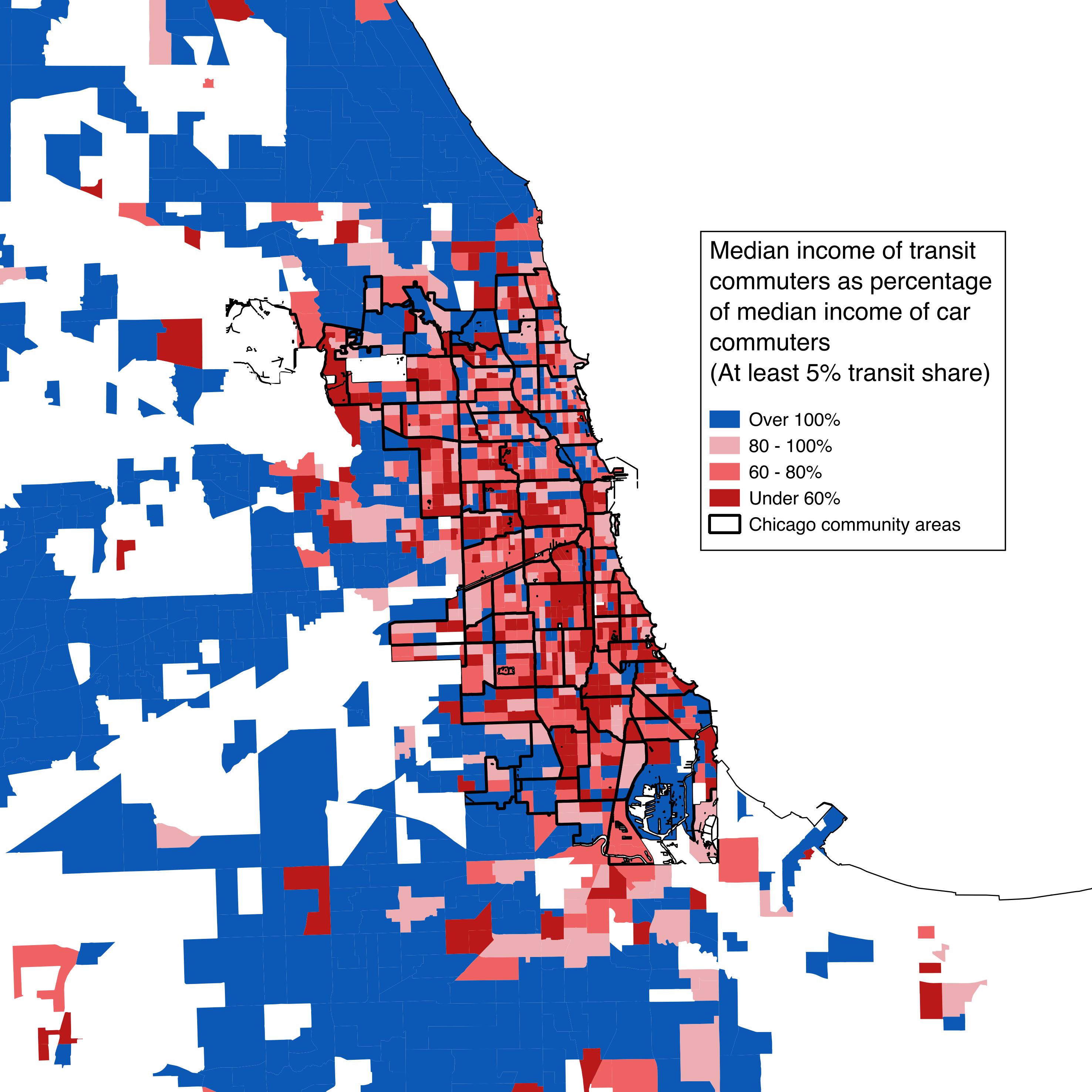
As an addendum: of course, in many places, even if transit-takers are wealthier, there are very few of them. If you remove all the places where fewer than 5% of residents take transit to work, you see that much of the Chicago suburbs is very car-dependent – but the overall pattern remains the same.

 Daniel Kay Hertz