Data Points for Glaeser, Krugman et al

On the train coming home from school today, I came across two headlines on my phone. Headline number one:

“The Great Growth Disconnect: Population Growth Does Not Equal Economic Growth,” at The Atlantic Cities. Upshot: There isn’t really any correlation between metro areas that are becoming richer and those that are becoming more populous. This goes against all sorts of economic theory and common sense and observed history, but is a pretty well-established recent trend, and also is actually a major contributor to the divergence of income across the country.

Headline number two:

“Development Watch: Lincoln Park,” on Curbed Chicago. Here we learn that a developer wants to build a six-story apartment building in the highly desirable neighborhood of Lincoln Park, just north of downtown Chicago, replacing a three-story building and increasing the total number of dwelling units on the property from 43 to 60. But the neighbors – whose annual income, if memory serves, is somewhere in the vicinity of twice the average of the Chicago metro area as a whole – don’t want to have six-story buildings around. And so probably the building will get downsized, and fewer people will get to live in one of the highest-quality-of-life neighborhoods in the city, meaning more people will have to choose between living in a less-desirable neighborhood, or not living in Chicago at all.

Most of us understand externalities, and the need to regulate them. We understand, for example, that a neighborhood’s right to determine its own development patterns does not include, say, building an industrial facility that dumps its toxic waste downriver. Why should it include preventing people who want to live there from living there, when there are national consequences to this kind of behavior if every such neighborhood engages in it?

Book Liveblog in Action

Not actually an update on Sprawl, although I have reams of notes to deliver at some point this week.

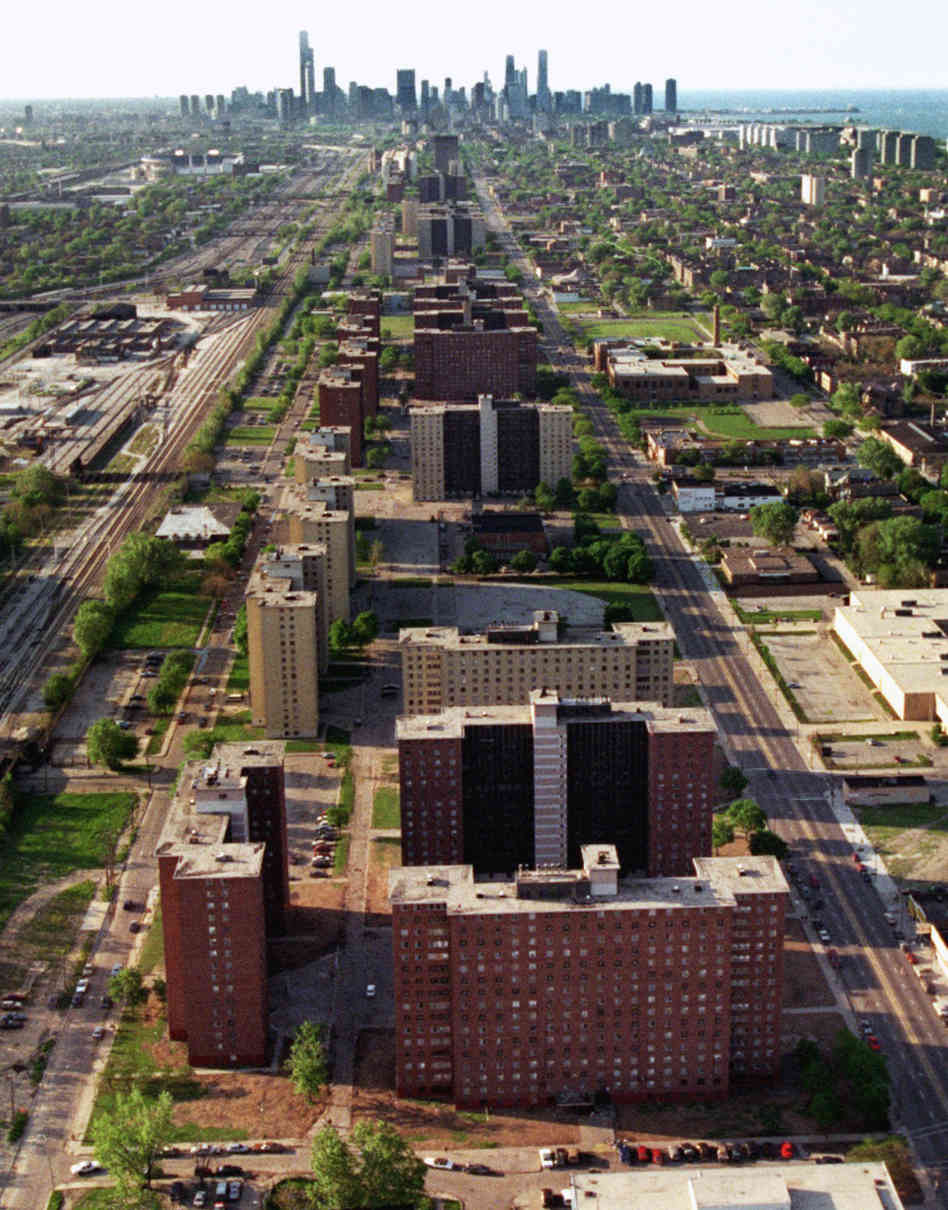
BUT: I was walking down Cottage Grove in Woodlawn today, heading to the Green Line, when I realized that I was literally passing through the middle of a very stark example of the sort of New Urbanist Urban Renewal that I wrote about last time. Specifically this:

It is hard to imagine large, invasive, confiscatory government programs to retrofit the suburbs along urbanist lines as long as the residents affected are members of the middle class. It is much easier to imagine that happening to a relatively poor community in, say, an auto-dependent inner-ring suburb along a light rail line and in a potential path of gentrification. In a sense, that precedent has already been set in Chicago, with the demolition of public housing towers and their redevelopment as urbanist-style mixed-income housing. The diagnosis of the towers’ failure, after all, wasn’t just about the sin of segregating poor people from the rest of society; the popular narrative is that the form of the buildings themselves made it impossible for them to house decent communities.

This is the west side of Cottage Grove, right around 62nd Street:

It’s a little hard to see – the light was pretty harsh – but this is Grove Parc Plaza, a 500-some unit public housing complex from the late 1970s. It used to run on both sides of Cottage Grove from 60th to 63rd, but now maybe a third of the project has been torn down. Directly across the street from these buildings is Woodlawn Center South, part of the mixed-income complex that’s replacing it:

Design-wise, Grove Parc Plaza is nothing stellar, although it doesn’t appear as cheaply built as some of the worst of the high-rise projects. In fact, it looks solid, if inelegant; certainly some new paint, a bit of landscaping, and maybe some added details around the windows and doors or a cornice would make the buildings more appealing. Woodlawn Center, on the other hand, is everything modern urban housing is supposed to be: a solid wall addressing the street, human-scaled but dense, bright, lots of windows.

Chicago Weekly, the University of Chicago newspaper, puts it this way: “Technically, the remnants of Grove Parc lie just across the street on 62nd and Cottage Grove, but it now looks so different next to these modern visions of subsidized housing that it might as well be in a completely different world. Shabby and brown, faded signs out front state the now defunct number of the housing manager’s office, a parking lot of cracked-up tar.”

Certainly, the complete reconstruction of this stretch of Cottage Grove makes it look more attractive – or, at least, more truly mixed-income, or, one more step away from euphemism, more middle-class – than it might appear if Grove Parc had just been rehabbed and marketed as mixed-income housing. But it’s also notable that the design excuse, the same one that was used to level huge parts of Bronzeville and other neighborhoods in Chicago and around the country, has the ancillary benefit to the city of removing all of the poor people who used to live there. Sure, the new buildings will also have low-income units. But the process of starting from a blank slate, of uprooting existing residents and physically demolishing their homes, obviously changes the sense of community ownership, and the fact that the CHA loses track of many of those residents before their new homes are ready can’t hurt, either.

It’s also the case that older buildings, in most neighborhoods, are the bread and butter of affordable housing in otherwise desirable areas: most people are willing to put up with floors that creak a bit, or smaller kitchens, in exchange for access to jobs, amenities, and education, if their budgets won’t let them have both. Destroying older buildings because they don’t fit the right design profile, then, reduces affordable housing even outside the context of subsidies.

So: New Urbanist Urban Renewal in action. I’d love to hear any other examples people can think of in comments.

“Sprawl, A Compact History”: The Liveblog, part 1

Can one liveblog a book? Particularly a book that was published several years ago?

I’m motivated to try, anyway, because of the minor blogging fiasco (although even a regular-sized blogging fiasco, I think, is the smallest kind of fiasco that can exist) that became of Rethinking Federal Housing Policy by Glaeser and Gyourko, which was a fantastic book, and about which I’ve been meaning to write for a month. But I haven’t, and when this week I finally sat down to do it, I had forgotten half of what I wanted to say.

So this time we are being proactive.

So far I have only read about 10% of Sprawl, which comprises the Introduction and a few chapters on the history of sprawl up to World War One or so. So let me say up front that I am expecting some of the questions or objections I raise to be answered or ameliorated further on, in the 90% of the book I have not yet read.

But still: particularly the Introduction, I think, contains Bruegmann’s – the book is by Robert Bruegmann, a professor of history at the University of Illinois at Chicago – ideological narrative about what sprawl is, and how we should think and talk about it, and that is important on its own.

What’s immediately obvious after only a few pages is that a) Sprawl is delightfully iconoclastic in its appreciation for low-density environments, and b) Robert Bruegmann is very smart. This is not a New Geography piece about how urbanists hate children, or how feminists want to use cities to emasculate men. It has an agenda, but it pushes that agenda with a great deal of rigor and skill.

The best moment, I think, comes when Bruegmann writes that sprawl “is not so much an objective reality as a cultural concept,” like “blight” before it, and then goes on to draw a straight line between blight and sprawl, as the particular types of neighborhoods most disfavored by the elites of their time and place. Bruegmann isn’t the first person to notice that urbanists have a class problem, of course – there have been tomes written on new urbanist gentrification, and the socioeconomic politics of bike lanes, and so on – but vanishingly few popular urbanist writers so clearly establish the city as an environment that is inherently political, down to the most basic words we use to describe it, and which is purposefully shaped by the interests that compete over it. Interests which may be slightly more threatening than gallery owners or bicyclists.

I hope, in fact, that the few paragraphs that Bruegmann uses to set up those ideas are greatly expanded upon later; they raise an awful lot of questions. The juxtaposition of “sprawl” and “blight” is particularly provocative, especially for someone, like me, who has spent many hours reading about the truly horrific things that happened in the name of blight removal. Of course, the fact that the elite supports a particular idea doesn’t mean it has to be bad for the rest of society. Not only that, but the anti-sprawl crusade has a long way to go before it has the sort of monolithic elite support that anti-blighters enjoyed from, say, the 1930s to the 1960s. There are still many powerful interests – builders, real estate people, not to mention the millions of voters who live in low-density suburbs and the elected officials who are accountable to them – in favor of sprawl. Then again, the anti-blight movement also began with lefties and academics who, in the late 1800s, came up with theories about the pernicious effects of high-density living on health and morality, and whose appeals to the general public eventually won over. Clearly, the anti-sprawlers have already made huge inroads on that front since the 1980s; who’s to say what the ideological landscape will look like in another two decades?

The prospect of anti-sprawl as an anti-blight-style class war is even more troubling in light of the sort of Great Inversion-type demographic shifts going on between suburbs and inner cities. It is hard to imagine large, invasive, confiscatory government programs to retrofit the suburbs along urbanist lines as long as the residents affected are members of the middle class. It is much easier to imagine that happening to a relatively poor community in, say, an auto-dependent inner-ring suburb along a light rail line and in a potential path of gentrification. In a sense, that precedent has already been set in Chicago, with the demolition of public housing towers and their redevelopment as urbanist-style mixed-income housing. The diagnosis of the towers’ failure, after all, wasn’t just about the sin of segregating poor people from the rest of society; the popular narrative is that the form of the buildings themselves made it impossible for them to house decent communities.

Image

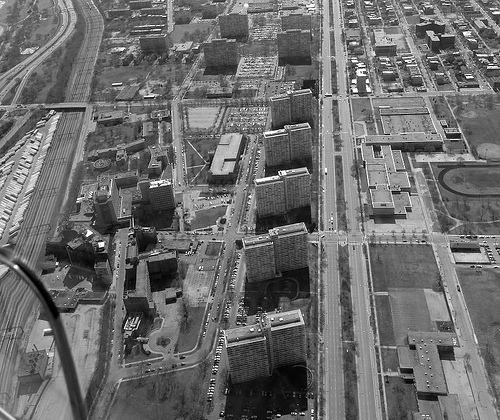
Bad midcentury towers in parks

And so, just like the midcentury planners who bulldozed the ghettoes instead of rehabbing existing buildings because they thought the traditional urban form was inherently dysfunctional, Chicago scattered CHA residents and started over in a way that was more attractive to the middle-class and business interests. All this, while just a few miles away, private residential towers built at the same time and in the same form survive as thriving middle-income homes, in defiance of the theory that cities must look a certain way if they are to function.

Image

Good midcentury towers in parks

I am less excited, so far, about Bruegmann’s dissembling about the definition of sprawl. It is one thing to note that the word is used in ways that are colored by class and cultural politics, and that there is not necessarily any obvious red line between what is popularly considered sprawl and what is not. True, streetcar suburbs that are today widely admired by urbanists would have been considered low-density a hundred years ago; true, one person’s comfortable urbanity is another person’s suburban hell.

But it’s an entirely different thing to claim, as the Introduction seems to do, that there is no obvious or important difference between the suburbs produced over the last fifty years and the ones that sprouted up outside gated cities during the Roman Empire or along commuter rail lines in Europe and North America in the 19th century. From all of the perspectives that I take to be the most common and serious urbanist critiques – that is, roughly in descending order according to how much I care, economic justice, environmentalism, public safety, social interaction, and aesthetics – there is a major break that occurs when all local travel must happen by car. That is the point at which lower-income people must choose between an untenable financial burden or a loss of access to jobs, stores, and cultural amenities; when the greenhouse gases produced per household can rise most quickly; when streets become designed so that they are dangerous for anyone not encased in a metal shell; when the sort of spontaneous or casual social interactions that are common in public spaces in cities become much more rare; and when most visual charm usually evaporates. (Making local travel by car mandatory, by the way, also makes non-car long-distance travel incredibly difficult, since it requires sufficiently low densities that the number of people within reasonable distance of any given commuter rail station will be very low. This is part of why commuter rail lines built into car-dependent neighborhoods have generally been such miserable failures.) And until roughly World War Two, those types of communities were vanishingly rare. The invention of the railroad, of course, allowed people to live in suburbs where non-local travel – to downtown, say, or far-off factories – couldn’t be done by foot, and developments in the early automobile era were also planned so that people might drive to a distant central business district. But walking to accomplish local travel – to the nearest school, grocery store, shopping district – was still possible, or even preferred. That’s why in the older suburbs of Chicago or other Northern cities, you often have commuter rail stations every half-mile, so that almost everyone could be within walking distance. That’s why in the older car-based suburbs – here I’m thinking of some place like Dempster Street in Skokie – you have sidewalks, and a street grid, and stores placed behind only very small parking lots, if any.

Dempster: A wide road for fast driving, plus sidewalks, stores reasonably close to the street, and a surrounding neighborhood with single family homes sufficiently dense that a good number of people can walk to these stores.

The failure to make that distinction – that of local walkability – infects several other aspects of his argument. Take, for example, this passage:

Gentrification and sprawl at the edge have been flipsides of the same coin. In a typically paradoxical situation, no matter how much the new, more affluent residents profess to like the “gritty” urban character of the place, so different in their minds from the subdivisions of the far suburbs, what makes the neighborhood attractive today are less the things that are actually traditionally urban but those that are not. The most important of these are sharply lowered population densities, fewer poor residents, less manufacturing activity, and the things that the Lower East Side finally shares with the suburbs: reliable plumbing, supermarkets with good produce, and a substantial cohort of middle-class residents.

This is right, as far as it goes, and in fact dovetails very nicely with what I’ve written before about most people wanting, above all, safe neighborhoods with access to jobs and amenities and decent schools. Here, Bruegmann suggests, correctly, that there is no reason that those things are the natural domain of the suburbs. Whether or not it makes sense to say that urban neighborhoods that have acquired those characteristics have “suburbanized,” it does make sense to point out that having those characteristics is a prerequisite for any place that aspires to house middle-class people, regardless of its urban form.

But if all that’s attractive about these inner-city neighborhoods is their “suburban” qualities, why do people pay such a premium to live in them, not only in American cities like New York or San Francisco, but in central cities around the world? What is the extra desirable quality? All the evidence suggests that it’s the massive access to jobs and amenities which, for the most part, can only exist in cities dense enough that having all local travel done by car is logistically impossible.

Or take this line:

Using the most commonly accepted and objective characteristics attributed to sprawl – that is involves low-density, scattered development with little overarching regional land-use planning – I try to show that…our understanding of urban development is woefully out of date because it is based on old and obsolete assumptions about cities, suburbs, and rural areas. In fact, I argue that many of the problems that are usually blamed on sprawl – traffic congestion, for example – are, if anything, the result of the slowing of sprawl and increasing density in urban areas.

If we don’t believe that sprawl has a real definition – or if we use a mushy one like “low-density,” which Bruegmann spends pages correctly accusing of being a massively subjective and relative descriptor – then I guess this makes sense. If suburbs are densifying, then that must mean that the problems associated with “sprawl” should be declining, right?

But if we realize that the actual issue, again, is the requirement to use a car for all local transportation, then this makes much less sense. Of course, given how much space cars take up, denser car-dependent cities will have worse traffic than less-dense ones. And, I mean, consider the alternative: if cities avoid traffic congestion by making all neighborhoods sufficiently low-density that all travel can be done by car without traffic jams, then you would have to travel quite far to actually get to anything. Which means that either 1) you won’t avoid traffic jams after all, because the number of miles driven per person will rapidly increase as development spreads further and further away from job and amenity centers, or 2) people will only be able to access the jobs and amenities that are very close to them. In other words, they won’t do any non-local travel at all. And that would defeat the entire purpose of living in a big city.

All of this said, I am more excited about reading Sprawl than I have been about any other urban policy book for quite some time. It’s an extremely smart analysis of the issue from a perspective that is woefully underrepresented in contemporary conversation. I’m very much looking forward to writing up the next installment.

The Blog in Brief

Cleaning out my Feedly “Saved for Later” folder:

1. I take issue with two recent Greater Greater Washington posts.

First, I’m not actually sure I agree with either the framing or substance of this post about BRT. Maybe it helps for planners or self-defined urbanists to think of BRT as a collection of features, rather than a package, but I think that’s just confusing for the public at large, and it makes it way easier for cities to “cheapen the brand,” as it were, by calling something “BRT” that’s really just signal prioritization or some such tinkering. If I were the head of a transit authority, or a think tank, or writing an influential blog, I think I would try to promote the idea that BRT is, in fact, a package of features that together deliver about as good a transportation service as you can get without actually putting vehicles either underground or on an elevated structure, way cheaper than any train technology. The CTA has stumbled around on this, but eventually found its way to my position: its Jeffery Jump line, which has half-mile stations but dedicated lanes only in peak direction during rush hour and no pre-paid stations, was initially billed as BRT, but now CTA officials take pains to call it “BRT light.” Good on them for that.

GGW also writes:

Even worse is what happens when all the tools in the box are used at the same time—what enthusiasts laud as the “gold standard” that resembles a “subway in the street.” If buses are to carry subway-like passenger volumes, traffic lights and pedestrians can’t get in the way. Gold-standard BRT becomes an interstate-like highway through the city, what urbanists have been fighting since the 1960s.

Except that virtually nowhere in the U.S. are any bus lines likely to carry “subway-like passenger volumes.” The demand just isn’t there; even in Chicago, the Ashland BRT is only likely to carry around 45,000 people a day. But, yes, BRT does require relatively wide avenues with relatively fast-moving traffic. That’s a feature, not a bug. If we choke crosstown surface transportation, we’re reducing people’s access to the amenities, jobs, and other people that are the very raison d’etre of big cities. Not every street in a major city can be optimized for pedestrians with narrow, traffic-calming dimensions.

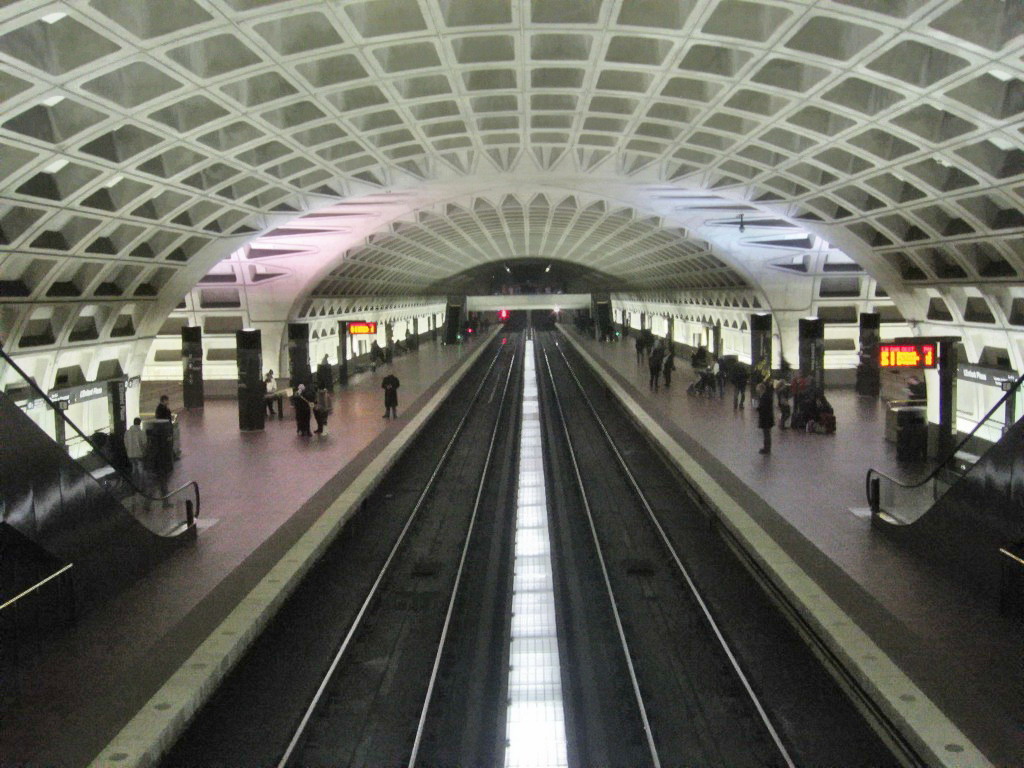
The other GGW post that made me go “huh?” is this one, claiming that what the DC Metro really needs is to visually differentiate its stations by taking a cue from LA, which does things like put fake palm trees and film reels at its Hollywood station. Supposedly this is because a) people can’t tell one station from the other, which is making them confused, and b) subway stations should be bright and colorful to reflect the joy that is life.

A + B = yuck

lasubway

A + B = yuck

But look: visual cues like palm trees will only register with people who know to associate that with a given station, and those people will already know how to get around. Everyone else is going to take way longer to go through the thought process Giant Fake Film Reel –> We Must Be At Hollywood than they would to just read a sign that said, “Hollywood,” or listen to the driver say, “This is Hollywood.” And as for aesthetics – well, yes, the Moscow subway is truly a subterranean palace, and although I’ve never been there, it looks like LA is doing a good job making their stations inviting, too, in a very different way. But ideas like painting Harry Weese’s honeycombed ceilings blue or orange according to the line that runs there just make me want to gag. It’s a matter of taste, of course, but DC has what is recognized by a good number of people to be one of the most architecturally significant subways in the world. The people who think its aesthetics are grim are unlikely to be swayed by a coat of paint, and they would be right. Make the lights brighter and add signage, if necessary. Don’t try to make it something it can’t be.

(Note that this principle should have been applied to Chicago’s renovated Red and Blue Line subway stations, which might have been restored to a somewhat-less-stark-than-Weese Art Moderne aesthetic, but which instead were slapped with a hodgepodge of more “popular” styles that at best clash with the vestiges of the originals, and at worst look like one long tiled bathroom wall.)

2. At its worst, urbanism as a subculture seems to combine the humorless self-righteousness of activist politics, the impersonal spreadsheet thinking of dataheads, and the bloodless management-speak of business schools. At its best, of course, and at all sorts of points in the middle, it is much more attractive. But even so, I appreciate the attempt by the Wannabe Urbanist to inject a bit of the humanities, or its sensibility, into the  conversation.

I’m not sure that what we really need is more sentences like “Question anyone who uses the term urbanism: does their usage reinforce the dominant forces of capitalist urbanization?”, but I do think that passages like this are a breath of fresh air in the face of urbanist triumphalism:

[F]or regular people, urban living in modernity is about absorbing and adapting to changes often out of our control, and negotiating the practical and emotional consequences….

It is easy to get caught up and distracted by the spectacle of urbanism, the glittering megastructures and brand-name architectural projects; it is just as easy to be seduced by the tactical urbanists and neo-Jacobsians into thinking that if we (and be we, I of course mean the urbanists who clearly know what is best for our cities) all just got together with shovels, we could build the bike lanes and curbside seating areas that would solve all these problems.

The point I am trying to articulate is that the experience of modern urban living is not a set of images; it is the difficult project of being ourselves in cities whose form and function are controlled by forces of capital, whose interests rarely align with those of any other party.

I think that last part actually does the rest a disservice, by limiting the point to the influences of capital. The larger theme is a very powerful one that’s very underdiscussed: the experience of living in a city is terribly humbling for anybody who is remotely honest with themselves. The forces beyond one’s control, whether that’s some other person or collection of persons, or some systemic force that’s not really under anyone’s control, are overpowering. It is challenging both on the level of daily subsistence, and on an emotional, even existential level. Who do you belong to? What do you belong to? The overlapping circles of in-groups and out-groups and territories and allegiances and relationships are almost literally never-ending. Suppressing all those tensions from the conscious mind is possible, I suppose, but they’re always there, and they certainly inform how we feel about the way a city ought to work, and what it ought to look like. It would be nice if the urbanist conversation brought that to the surface every now and again.

Also, points for bringing up the sensual experience of cities, which is especially on my mind right now as I’m reading James Baldwin’s Another Country, a book that makes love to Manhattan on every second page, and claws at its eyes on every fourth.

Correlation and Causation: City Journal Doesn’t Understand the Difference; Also: The Overton Window of Urban Policy

So George Packer writes that New Yorkers are whispering about whether de Blasio is going to return the city to its hellish 1970s past, and four weeks later City Journal helpfully publishes those whispers, in earnest, in the form of a mostly ill-considered post:

Perhaps the most important question in the looming mayoral race is this: Will the next occupant of City Hall remember the hard lessons that New York has learned over the last 40 years, or will the city revert to a functionally bankrupt metropolis with chaotic schools and dirty, dangerous streets?

By far the worst part is this passage about crime:

During Koch’s three terms, crime rates zigged up and zagged down, but in 1989, despite all that he had done to make the city safer, crack ruled the night, and murders jumped to a record 1,905.

When David Dinkins took office in 1990, hopes were high that the new mayor’s low-key approach and strong support in minority neighborhoods would cool the fevered streets. Instead, the city saw 715,000 felonies committed in 1990, while murders spiked to an all-time high of 2,262. The NYPD didn’t get the tools that it needed until the mid-1990s, when Giuliani adopted the Compstat system of analyzing crime data, along with proactive tactics and accountability throughout the department. Giuliani and the police reduced the number of homicides to 629 in 1998, and all categories of crime fell sharply.

Because Mayor Michael Bloomberg and Police Commissioner Ray Kelly retained and strengthened Giuliani’s reforms, crime rates continued to fall.

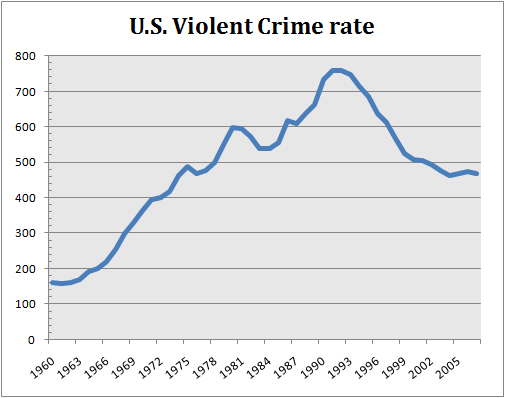
If you know anything about national crime trends over the last 30 years, which presumably someone at City Journal who read this before it was published does, none of what I just quoted makes any sense. To refresh our memories:

Image

Source: Volokh Conspiracy

So crime in New York peaked in the early 1990s, just like it did in almost every city in the country, and fell dramatically during the Giuliani and Bloomberg administrations in the mid-late 90s and 2000s, just like it did in almost every city in the country. Now, we could look at this data and conclude that Giuliani and Bloomberg, far from being New York’s crime-fighting heros, somehow managed to bring down violent crime all over the country. And that would be very impressive. But it’s obviously completely implausible.

So the other, more reasonable, conclusion to make is that the correlation between the change in administrations and the falling crime rate in New York is just that – a correlation – and not, in any major way, a causal relationship, in the same way we might note that homicide rates in Chicago began falling after the Bulls won their first championship, but we have no compelling evidence that one had anything to do with the other.1

This all points to a larger issue with this sort of talk about municipal leaders, which is that it fails to acknowledge that contemporary urban policy in the U.S., at least on the scale of a mayoral term or two, is just not that transformative. Sure, visionary leadership on a particular issue or project can have measurable results, and epic mismanagement can make problems worse, but on the big-picture issues – whether your region is rich or poor, to what extent it’s car- or transit-dependent, whether it will gain or lose residents, how affordable its housing will be – major metropolitan regions and their core cities are mostly following a) national trends and b) path dependency based on earlier policies and national trends. Crime is one obvious example of this. Unemployment, and macro-level economic health, is another: The fact that being a industrial center in the Midwest was highly correlated with being prosperous until roughly World War Two, and since then has become highly correlated with poverty, has nothing to do with a rash of bad leaders replacing excellent ones around the middle of the century in that region, and everything to do with global economic shifts. The fact that Madison, WI, Columbus, OH, and the Twin Cities became economic leaders in the Midwest certainly has less to do with the caliber of their municipal leadership than the fact that they all contain the apparatus of state governments and flagship state schools, which virtually guarantee a huge pot of well-paying jobs that attract highly-educated people.

This isn’t to say that urban policy, at the local, state, or national level, has to be powerless: in important ways, how and to what extent cities provide services can make a huge difference in their residents’ daily lives, and planning decisions can nudge a city’s path-dependency in ways that can become significant over time. And, obviously, in the past, urban planning at all levels of government had serious short- and medium-term transformative power through FHA regulations, transportation subsidies and projects, and so on. In 1963, the Beale Street neighborhood, just southeast of downtown Memphis, looked like this:

Image

In 1968, King was shot there, and city officials became concerned that Beale, which was mostly populated by black folks, was a racial powder keg frightening (white) people away from downtown. So, by 1971, it looked like this:

Image

That was some transformative leadership. But city governments can’t just condemn and raze the homes of tens of thousands of people anymore.

They also can’t radically rezone neighborhoods to allow them to change. The kind of wholesale transformations of the built environment that accompanied economic booms in Chicago, New York, etc., in the 19th and early 20th centuries have been legislated out of existence. Places that approximate it – Phoenix, Houston – mainly accomplish their construction sprees by relegating the vast majority of it to the periphery, where no one lives who can object.

So policies that might actually have radical short- or medium-term effects, like drastically liberalizing density caps, are politically impossible. Transit lines – or, if it’s your cup of tea, highways – through heavily populated areas are similarly verboten. If they’re built at all, they have to be routed in the least efficient possible way to minimize costs and eminent domain claims, which has the effect of making them as useless as possible, which makes fewer people use them, which makes them less transformative to the urban landscape. The Overton Window of urban policy is just too small, too frozen in place, to allow much dramatic change, even in the areas where we know it has the potential.

Now obviously this is not entirely, or even mostly, a bad thing. Our tolerance for Beale-style urban renewal projects, whether billed as slum-clearing redevelopment opportunities or transportation projects, should be extremely low. But as long as we’re unwilling to make much of any substantial change to urban policy, and especially to put any real muscle or funding behind those changes, we should stop talking about individual contemporary political leaders as if they’re the determining factor in what our cities look like, or how they behave.

1 This isn’t to say that there’s no effect on crime from local policies. And one should acknowledge that, in fact, New York saw a much greater decline in its crime rate than the nation as a whole. But it also saw a much greater amount of gentrification, which is highly correlated with lower crime. And the Giuliani/Bloomberg policies most commonly credited with reducing crime, like broken windows and stop and frisk, have been shown to have dubious efficacy.

Homicide Awareness!

Listing every factual error in the most recent of the documentaries released this summer called “Chiraq” – there are two of them – is easy, because its director, British-born Will Robson-Scott, does not actually attempt to make any factual claims. Or, rather, he makes exactly one, which is superficially true but deeply misleading, as I’ll discuss in a minute.

Instead, Robson-Scott gives us thirteen minutes of black-and-white cinema vérité in a genre that might be called Violence Porn. Violence Porn is a cousin of Ruin Porn, the much-maligned and yet perennially popular family of photography and cinema that invites us to gawk at empty streetscapes and rotting theaters in places like Detroit or Camden, NJ. Except instead of asking us to feel sadness or disgust about cityscapes, Violence Porn asks us to marvel at just how incredibly scary young black men in Chicago are.

The folks behind VICE’s HBO show are Robson-Scott’s brothers in this endeavor, having also shot a thirteen-minute piece called “Chiraq,” which came out in June. It’s a bit more ambitious in terms of actually providing information and context, with the downside that almost all of that information and context is completely wrong. Its very first line claims that “in the last two decades, most major cities in America have seen a dramatic drop in violent crime, except Chicago” – curious, given that the homicide rate over the last twenty years has fallen by nearly 50%. It claims that the South Side “has lost most of its schools,” which, despite Mayor Rahm Emanuel’s best efforts to close allegedly underutilized buildings, is not even close to true. It claims, without qualification, that the demolition of public housing has made crime worse in outlying neighborhoods, a proposition fiercely denied by many of the academics who have studied the issue. And it strongly implies that violence is escaping the traditional “bad” neighborhoods and “seeping” into the rest of the city, which is exactly the opposite of what has actually happened in the last two decades: violent crime is more concentrated in certain areas than ever before, with terrible consequences.

If either of these documentaries had shown any interest in research or fact-checking, it might be easier to forgive them for having devoted so much time to filming young black men, usually shirtless or in hoodies and preferably heavily tattooed, jumping around in groups, throwing gang signs and flashing guns. But they didn’t show any such interest, and so we’re left to conclude that this, in fact, is the point. Neither documentary allows more than a minute or two to elapse without such a shot, and both devote the majority of their interviews to brief expressions from these young men about how crazy life is on the South and West sides. “We like to eat the body up,” says one man, explaining why murder victims in the city are shot so many times. “We were brought up to beat your motherfuckin’ ass,” says another.

None of this is to say that Chicago doesn’t have a very serious crime problem, or that its crime problem – or that of other cities – isn’t worth the attention of a documentary film. Such a documentary might accomplish one of two things: It might allow us to understand the big picture by telling us what all the news reports add up to, why the problem exists, and what possible solutions might address it. Or it might give us the human story behind the numbers and socioeconomic forces, allowing us to understand what it’s like to live in affected neighborhoods, what the motivations are of people who take part in the violence, and how everybody else copes in their day-to-day lives.

Neither “Chiraq” accomplishes, or even attempts to accomplish, either of those objectives – the big picture facts are either absent or wrong, and it’s hard to get a sense of the interview subjects as people when they’re only allowed a few lines of dialogue each. Instead, the most generous interpretation of the purpose of these documentaries is a kind of awareness campaign, akin to wearing a colored ribbon to draw attention to a deadly but relatively low-profile disease.

But that’s absurd. The first thing that any American – and many foreigners – will say if you ask them about the South and West sides of Chicago is that there is a lot of crime there. Awareness is not the problem.

In fact, you might say that part of the problem is too much awareness – and here we get to the heart of the matter. Both documentaries are called “Chiraq” because they claim (this is Robson-Scott’s only verifiable fact) that there have been more murders in Chicago since 2001 than U.S. soldiers killed in Iraq or Afghanistan. This, supposedly, is context. But what does it tell us? Are Iraq and Afghanistan less dangerous than Chicago? Obviously not; those figures don’t account for the fact that there are many, many times more people in Chicago than American soldiers stationed in those war zones, and they don’t include casualty figures for locals, who have died at rates hundreds of times higher than people have been killed in Chicago. Does it say something about the relative importance of violent street crime and overseas wars? Maybe; but why is that the comparison? Why not compare it to other, less far-fetched analogues, like the number of people who die in car accidents, or heart disease?

The answer is that these documentaries, and Violence Porn in general, are premised on reinforcing stigma: the stigma of poor inner-city neighborhoods, the stigma of being black, and especially of being a young black man. Car accidents and heart disease are tragedies that might happen to anyone; a war zone is something savage and foreign that belongs elsewhere: not for nothing does the VICE documentary conclude that “the South Side of Chicago is basically a failed state in the borders of the U.S.,” where locals “proudly declare themselves savages or soldiers.” This is why neither documentary can show us anyone in these neighborhoods but young black men who are gang members, or the mothers of young black men who have been murdered: to depict an average citizen going to work, or taking their young child to school, or even just mowing their lawn, would clash with the stigma that gives these films all their power.

Ultimately, the message is that you, the presumably white, or at least middle-class, viewer of the documentary, need to be very afraid of the unhinged people who live in these areas. (At one point, the VICE correspondent looks at a map of gang territory and helpfully volunteers that it “scares the living shit” out of him.) Or, rather, you should continue to be very afraid. Because these places have already been suffering from white and middle-class stigma for decades, pretty much since they were turned into all-black ghettoes around the middle of the twentieth century. I, a white person who lives on the North Side, run up against this stigma whenever I try to take a friend to visit a restaurant or gallery even in a relatively safe black neighborhood on the South Side, and they refuse because they “don’t want to get shot.” (This is usually accompanied by a laugh, to suggest that they’re kidding, but the fact that they actually won’t go suggests that they’re not.) The people who live in those neighborhoods run up against the stigma every day because of the social isolation, lost business investment, and paltry consumer spending it causes, which just furthers the economic decline that the “Chiraq”s are supposedly lamenting. This is not a minor issue: one study by Harvard professor Robert Sampson found that a neighborhood’s reputation was a better predictor of its future poverty rate than actual signs of disorder like graffiti or crime.

And so it’s hard to conclude that these documentaries do anything other than make the problem worse. It would be nice if the next round of journalists who venture into America’s crime-plagued neighborhoods treat the people they find there as people, and not spectacles.