James Rudyk says affordability doesn’t mean housing values have to remain stagnant or that certain people or businesses should stay out.
But…by definition, it kind of does, doesn’t it? If housing values don’t “remain stagnant,” then they’re growing. Another way of saying that housing values are growing is that housing is getting more expensive. In a neighborhood (Belmont Cragin, in this case) with home prices already above the city average – in a city where something like half of all residents are paying more than 30% of their income for a place to live – that suggests that every increase in housing prices is going to stretch the budget of some people who live in the area, and put the community beyond the reach of other city residents who might like to move there for better schools, safer streets, etc.
In other words, affordability will suffer.
This is the fundamental problem with using housing as our country’s main vehicle for wealth accumulation: as soon as you buy a home, you have an enormous incentive to see its value grow. But that interest, of course, is directly opposed to the interests of any people who might want to buy, who want – in many cases, need – housing prices to stay flat or even decrease in order to find a place to live. In a place where the vast majority of homes are not subsidized for the low- or moderate-income – and Chicago will be that kind of place for the foreseeable future – that means that strong returns to housing are directly opposed to affordability.
It also means that statements like this are really hard to take from theory to reality:
“If residents on Diversey and Laramie really do want a Starbucks, then let’s put in a Starbucks. If they really do want a Trader Joes, then let’s put in a Trader Joes. If they’re really fine with the fruit market, let’s leave the fruit market. So the question is, who makes that decision?,” he said.
Rudyk hopes it’s the people who live here, and not outside investors. He says that may determine whether Belmont Cragin redevelops or gentrifies.
This imagines that there are two groups of people: Belmont Cragin residents, and “outside investors.” But that’s not really true.
@DanielKayHertz because the ppl in the community (homeowners, renters, biz owners) have very different incentives
A very common refrain in gentrification debates is that “the community should decide,” or that changes should “benefit the community.” But as Michael Kendricks points out, “the community” is always made up of many different people, with many different interests. Virtually any decision that’s made about a new housing development, or store, or transit project, will benefit some members of the community at the expense of others. That is politics, and anyone who has been to a neighborhood meeting about anything, large or small, has seen firsthand that neighborhoods are not above, or below, politics.
It’s tempting, in this as in any situation, to try to find a way that everyone – or everyone you consider a “good guy” – can win. Unfortunately, I think there’s a lot more conflict here among the “good guys”* – conflict that isn’t about misunderstandings, but about real and immediate self-interest – than we’re willing to admit.
* I say “good guys” because I don’t think there’s anything nefarious about a middle class family in Belmont Cragin wanting home prices to increase in their neighborhood so they can have some financial security for retirement. The point, though, is that the consequences of that totally benign goal – multiplied by hundreds of thousands of homeowners – are anything but benign for people caught on the wrong side of affordability.
This blog, and all the people I’ve met through it, have been an unexpected highlight of my year. Thanks, everyone. I’ve included a few of my favorite posts and articles below, in case you want to get on top of your 2014 blog reading nostalgia early.
Warning: this post gets a bit into the legislative weeds.
So as I wrote at Next City, Mayor Emanuel’s affordable housing commission just announced their recommended amendments to the city’s inclusionary zoning law, or ARO. (Affordable Requirements Ordinance.) Mostly, this involves closing or tightening loopholes that allowed developers to push new subsidized units out of wealthy neighborhoods, and into poor ones.
But one other provision gives me pause:
On page 9 of the ARO proposal. Click for a link to the document.
To summarize: the Chicago Housing Authority (or other “authorized agencies”) can buy ARO-produced units and run them as their own. In fact, not only can they do that, but the city is giving developers a financial incentive to sell. If someone builds a 40-unit building on the North Side, the new ARO says they’re responsible for four subsidized units, or an equivalent fee; one of those units has to be on site. If the developer chooses to pay the fee for the remaining three, that’s $375,000 (at $125k per unit). But if the developer sells the one unit they built to the CHA, they save $25,000 in fees per remaining unit – meaning $75,000 in all.
Anyway, at first blush, I don’t see any reason why converting ARO units to CHA units is a problem. Except for this: Rahm Emanuel has announced that he wants the ARO to create 1,200 units of affordable housing over five years. The CHA, separately, has a longstanding commitment to maintain 25,000 units of housing, of which it is short about 7,000. In other words, it appears that we currently have a commitment from the City of Chicago and its partner agencies for 1,200 + 7,000 = 8,200 new units of affordable housing over the near term.
The issue is what happens with units that are produced by the ARO, and then bought by the CHA. Presumably, Emanuel – or whoever is mayor at the time – will want to tout those as “ARO units,” since they would have existed without the law. Presumably, the CHA will also count them as “CHA units,” because, you know, they’ll be CHA units.
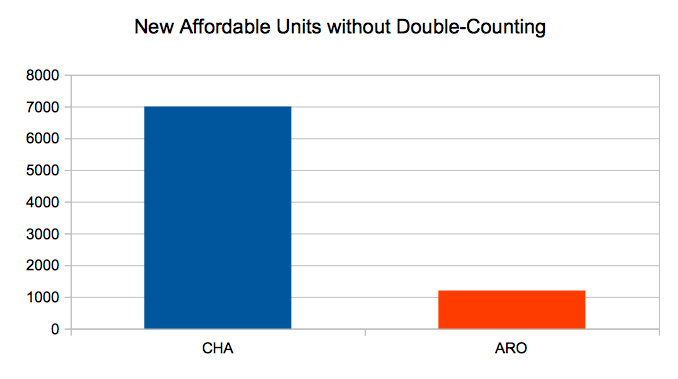
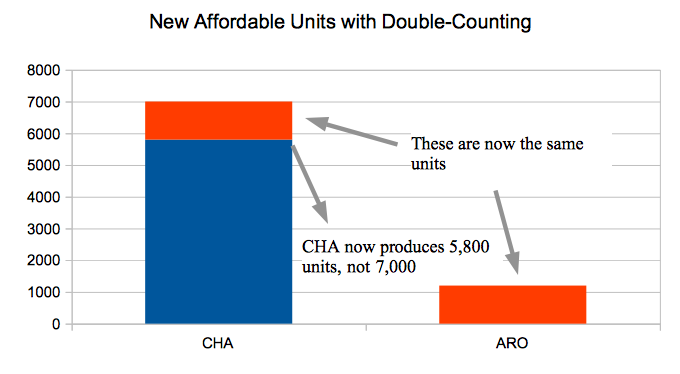
But what that means is that we’ll be double-counting. And in the extreme (though possible!) scenario that the CHA buys all 1,200 ARO units, instead of 8,200 new subsidized housing units, the city will get only 7,000 – because every unit the CHA buys from the ARO is a unit they don’t have to produce separately themselves.
Here is this idea in chart form:
Anyway: the stated purpose of the ARO amendment is to improve upon the old ARO, which only produced 189 affordable units over 7 years, or something like that. But double-counting, by creating the possibility that every new ARO unit will simply displace a CHA unit that would have been created, also makes it possible for the new ARO to have zeronet impact on the total number of affordable units in the city. That is, if you look at the graph above, double-counting every ARO unit would leave the city with 7,000 new units – the same number the CHA would be obligated to provide if the ARO didn’t exist at all.
Now, caveats: I’ve asked around about this, and haven’t yet heard any reason that would prevent the CHA from buying up all the ARO units, but it’s possible that such a reason exists, and I’m just not yet aware of it. If you know of that reason, tell me!
It’s also possible that, even though the CHA has promised 7,000 new units, the CHA’s pants are on fire, and there’s no way they’re actually going to deliver that any time soon. In which case the ARO isn’t displacing CHA units, because the CHA can’t/won’t produce new units on its own. Maybe. That seems like a pretty unsatisfying answer, though: if you’re the City Council (or, say, the mayor), why not just find a way to force the CHA to live up to its promises?
Am I getting this wrong somehow? Or does there need to be some safeguard in the new ARO?
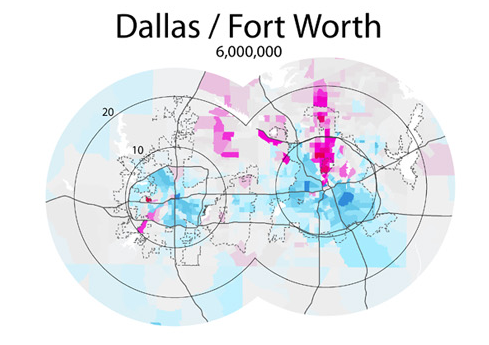
Since my last post, I was reminded of the existence of this, from Radical Cartography. One point Bill Rankin makes there, which is really important, is that the “donut model” of economic geography, with concentric circles of high- and low-income areas, is really not the American standard. More common is the “wedge model,” with a “favored quarter” radiating out from the city center like an especially privileged slice of pizza.
For example (in Rankin’s maps, pink = rich and blue = poor):
If you take another look at my maps for Chicago…
…you might reasonably ask: how sure are you that the growth of a high-income zone in the central city is following the donut model, versus the wedge model? After all, it seems to be growing mostly towards the already super-wealthy northern suburbs. Maybe the endgame is a wedge, after all.
To which I would reply: yes, I think there’s something to that. But what matters, I think, is what’s at the center. Going back to the rent gap theory, a building’s potential rents will only be high if it’s close to jobs or amenities that make the area valuable. In all of the extreme wedge examples above, the downtowns don’t really serve quite the same central economic or cultural role for their respective metropolitan areas as does downtown Chicago, and so areas adjacent to them – say, the southern end of downtown Atlanta, or the areas to the north of downtown St. Louis – aren’t especially close to a major job or amenity center. Instead, those centers are further out in the suburbs, and high rents revolve around them, following major transportation corridors.
In other words, northern Bronzeville’s position, I’m guessing, really isn’t anything like whatever neighborhoods are a mile or three east of downtown Houston: it’s actually in close proximity to the region’s largest amenity hub, and they aren’t.
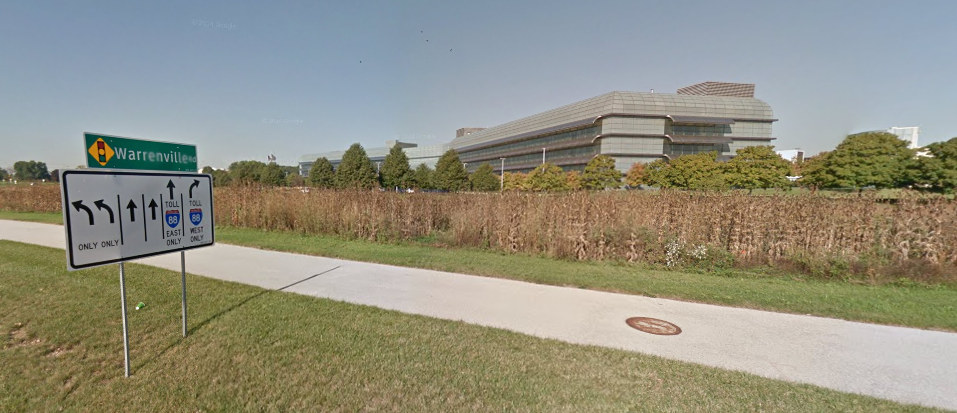
Now, what gives the wedge model a bit of weight in Chicagoland is that the Loop isn’t the only major employment center. In fact, even if you know nothing about the Chicago area, you could easily pick out the other employment centers just by looking at the map: they’re in the northern suburbs and along a corridor running along I-88 in second- and third-ring suburbs southwest of the Loop. They are, not coincidentally, close to the two largest other major high-income areas. (Though the high-income areas near I-88 continue to move away from where the actual jobs are, which is something that should maybe trouble people with a vested interest in keeping those jobs there.)
Who could say no to working here? Naperville, Illinois. Forgive my urban snobbery.
Anyway, the point is that things are complicated, and basically every major metropolitan region in the world is polycentric, which does weird things to potential rents, and thus the prospects of disinvestment and reinvestment. You don’t even have to go outside the city to see that: though it’s much less dramatic, Hyde Park – the little patch of white along the south lakefront – has seen a very small ripple of reinvestment expand from its major employment center, the University of Chicago. The problem there, of course, is that Hyde Park is surrounded entirely by black neighborhoods (and South Kenwood, a mixed neighborhood, beyond which is North Kenwood, and almost entirely black neighborhood), which, as we discussed last time, makes the reinvestment stage difficult.
Oh, the backlog of things I want to write! To work:
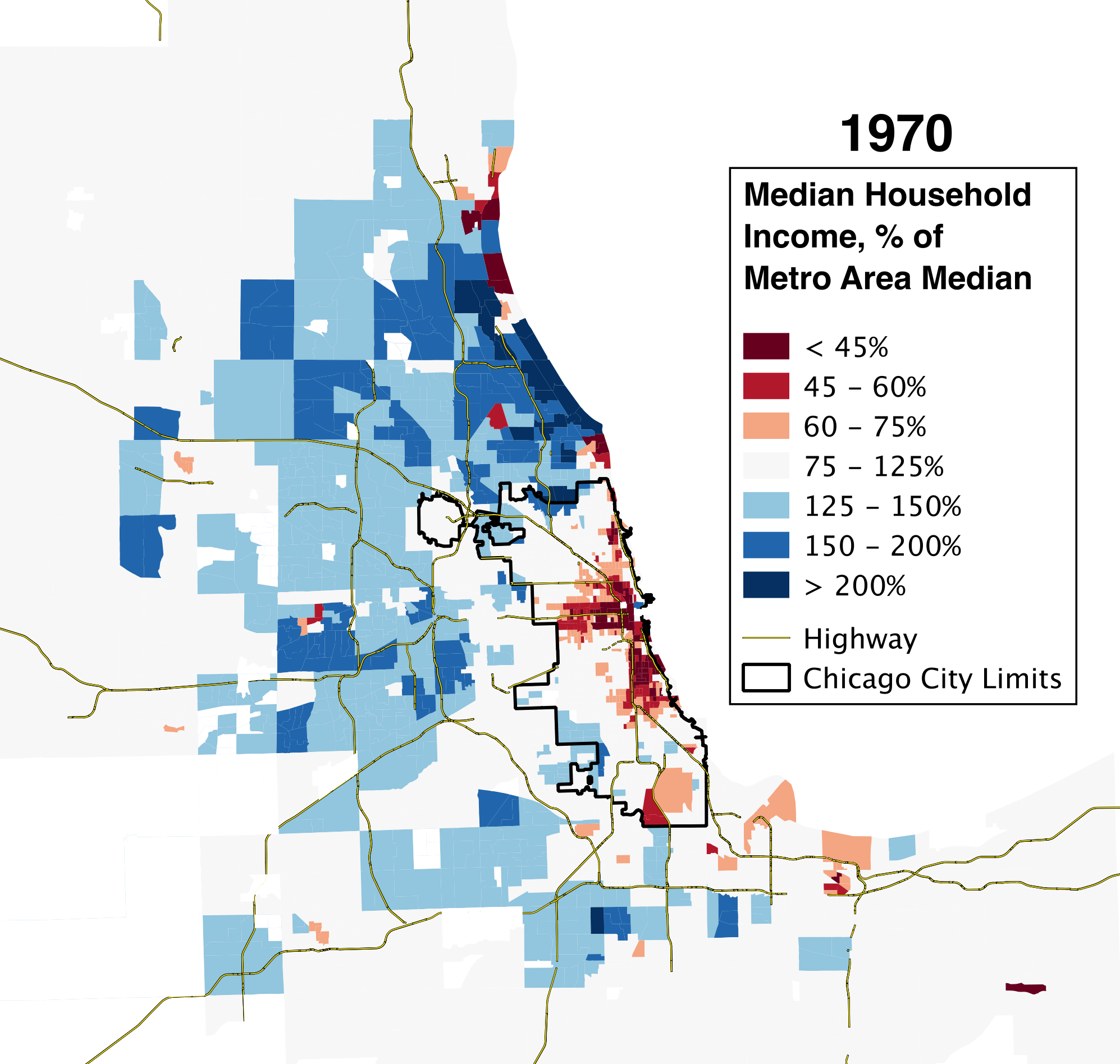
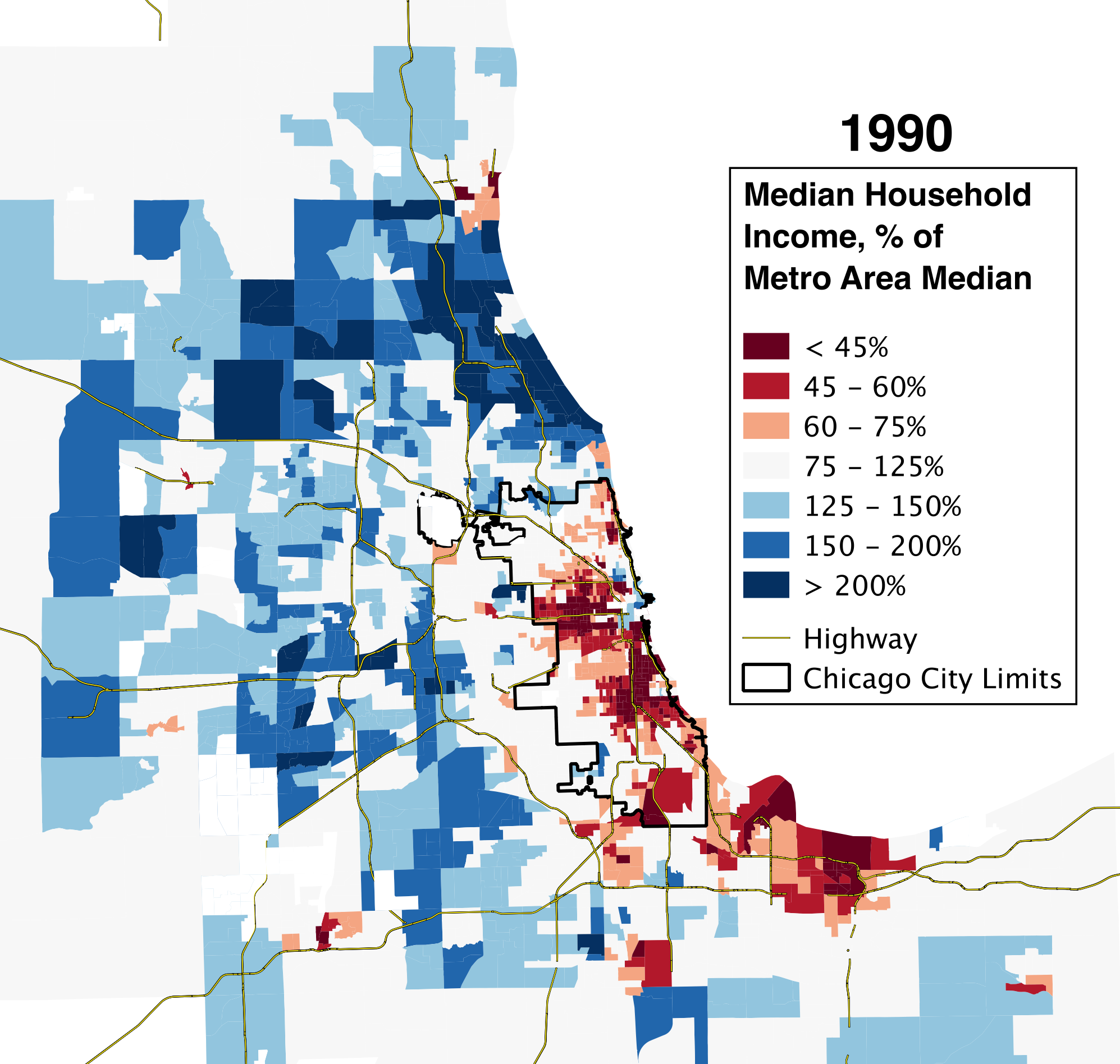
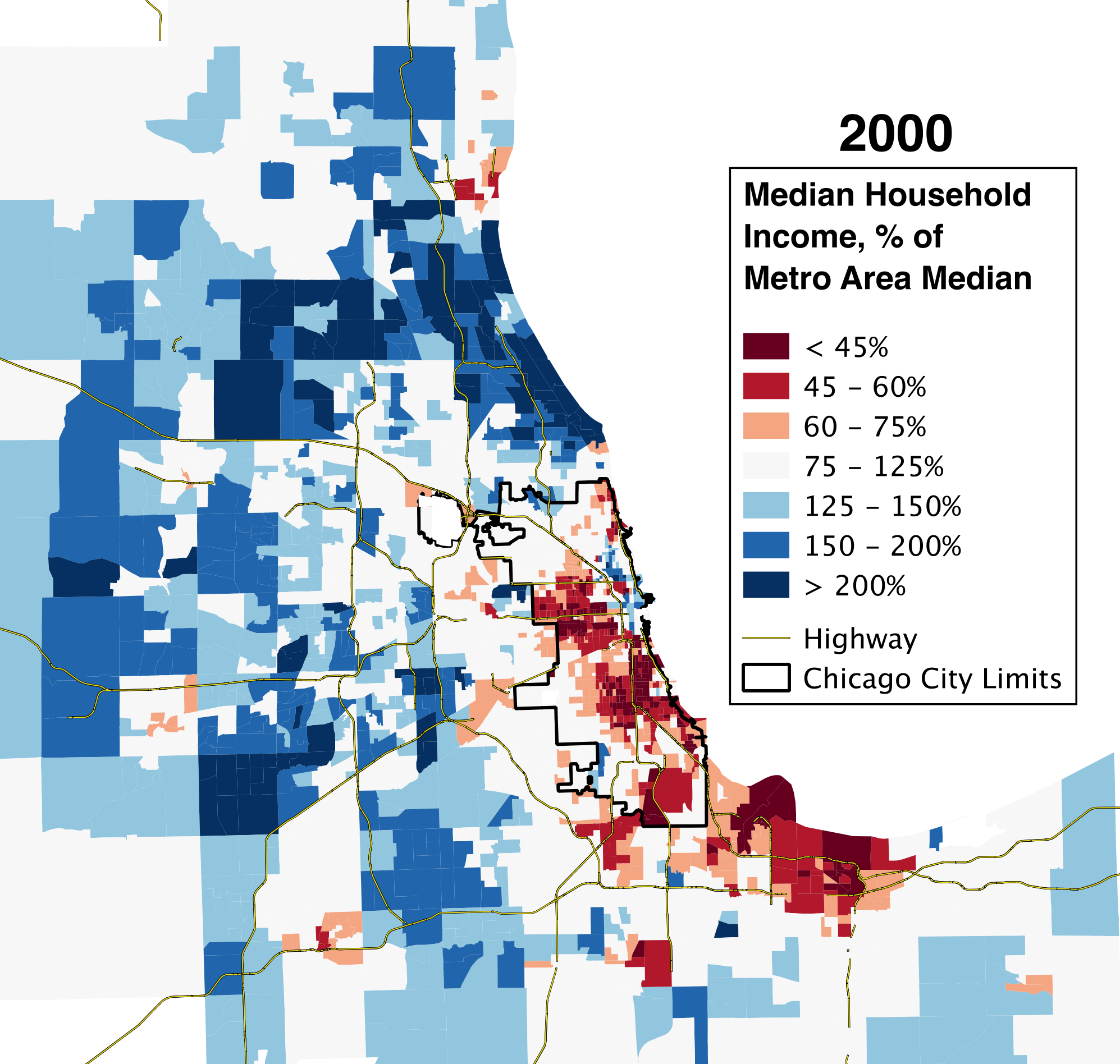
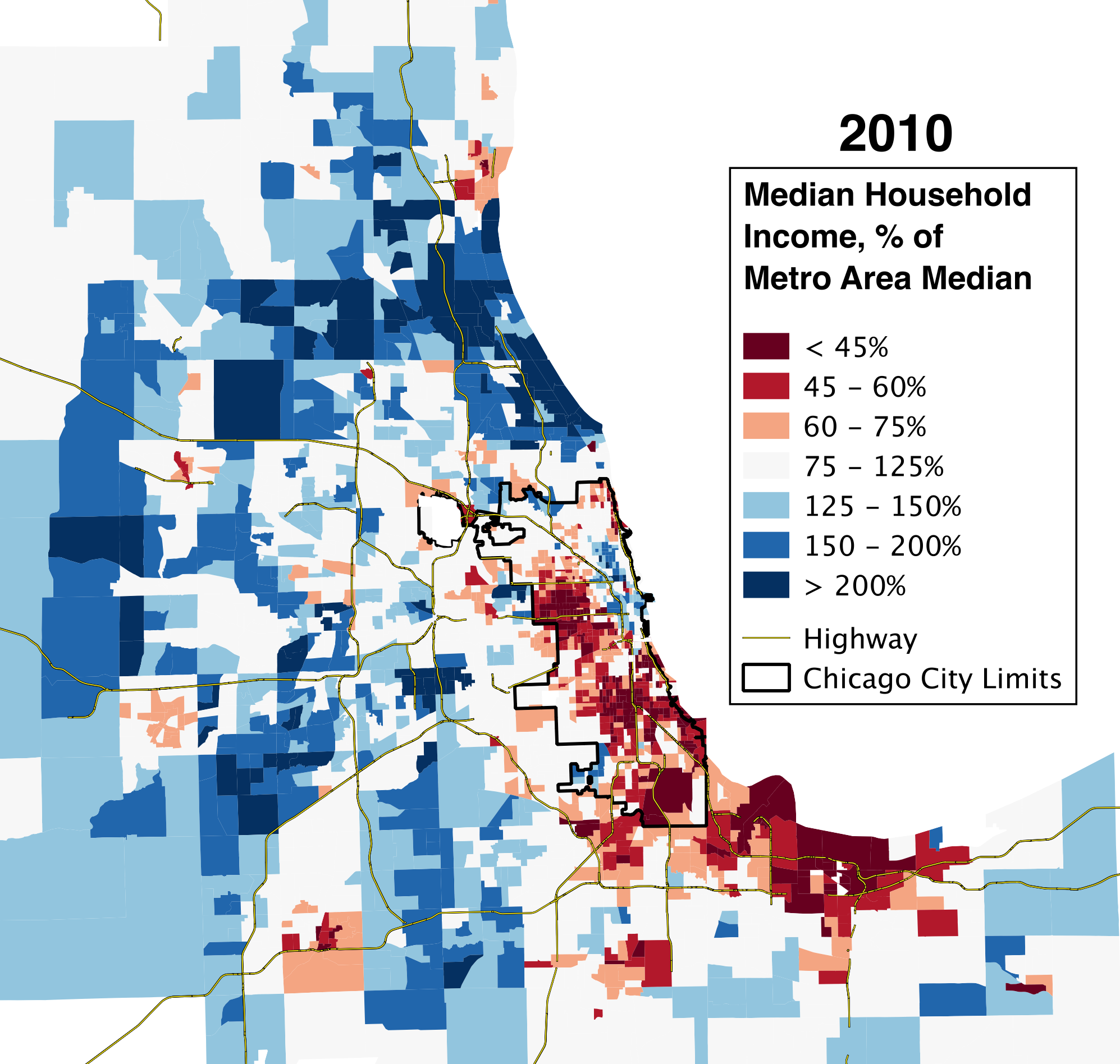
Other than “oy,” one of the most common reactions I got to the “vanishing middle class” maps I made several months ago was that focusing on the city proper necessarily missed the very important shifts occurring in the suburbs, where something like two-thirds of the people in the Chicago region live. In fact, it missed what was maybe one of the more important stories about the changing economic geography of the region over the last 40 years, which is a shift in the balance of economic power between the city and suburbs.
That’s true, so I’ve finally made equivalent maps for the entire Chicago metro area. (The researchers who provided my original data, Sean Riordan and Kendra Bischoff, made their own maps a little bit ago, and Whet Moser made some valuable graphs from their data. I’m going to use my own maps, though, from Brown’s Longitudinal Tract Database, so I can show the data in a way that’s most consistent with how I did the previous post.)
Here they are:
I think, on the one hand, that these regional maps show something very much like what Aaron Renn has described as a “new donut” pattern of urban wealth: a rich center, a ring of disinvestment, and then another outer ring of wealth in the outer suburbs. Importantly, though, I think these show that there’s nothing really “new” about this pattern – instead, the rings have existed since at least 1970, and have simply been moving further and further out from the center of the city.
Even in the first map, there’s a kernel of wealth around the Gold Coast, surrounded by extreme disinvestment, surrounded by middle-class neighborhoods, surrounded by relatively wealthy ones. In each succeeding decade, the general pattern is for the kernel of wealth to gentrify a bit of the surrounding disinvested neighborhoods; for middle-class areas adjacent to disinvestment to decline into disinvestment; for relatively wealthy areas adjacent to the middle-class ring to slip down a bit; and for some parts of the periphery to become more wealthy.
It’s a pattern that, if you’ve read Neil Smith on the rent gap theory of gentrification, makes a lot of sense. The idea is that waves of investment, disinvestment, and reinvestment in urban neighborhoods are driven by the semi-permanent nature of buildings themselves. In the beginning, say, someone builds a three-flat in a neighborhood near downtown. When it’s brand-new, it’s a highly desirable place to live, but over time, things deteriorate a bit, and newer construction further out steals away the high-income residents who can afford housing with better technology and more up-to-date styles. Importantly, the aging three-flat is not torn down or significantly renovated, because the difference between what the owner can actually charge, and what they could charge if it were a brand-new building, is smaller than the cost of demolishing the property and actually constructing a new property (or a gut rehab).
(That is: If you earn $10,000 from a building you own, and could make $15,000 if you rebuilt/rehabbed it, but rebuilding/rehabbing costs $10,000, you won’t do it. Because, you know, you’d lose money.)
As it ages, the building itself becomes less and less desirable, and so the people living there become poorer and poorer; if the surrounding buildings were all built around the same time, then something similar is probably happening in the neighborhood at large. But at some point, the calculation changes: the building becomes so low-rent that the extra income an owner could get if it were brand new is more than the cost of replacing it. (It might also be the case, of course, that the building’s rent hasn’t fallen that much more, but the value of a new/rehabbed building has increased a lot – if, say, the three-flat is in a neighborhood near other neighborhoods that have seen an increase in amenities and jobs.) At that point, since it’s profitable to do so, the owner will do a major rehab or reconstruction, and gentrification begins.
(That is: If, from the previous example, the $10,000 you’re earning dwindles to $4,000, all of a sudden rebuilding/rehabbing becomes profitable. Alternatively, if you’re still making $10,000, but a rebuilt/rehabbed building would give you $25,000 – again, rebuilding/rehabbing becomes profitable.)
For example: these townhomes in Logan Square. Credit: YoChicago
As I said, to a large extent, I think this describes what’s going on here. But anyone familiar with Chicago’s racial geography will have already noted that there’s something else, too. (If you’re not: basically all of the deep-red areas are segregated black neighborhoods. A few are predominantly Latino.) Namely, black neighborhoods seem both to suffer much faster disinvestment than you see elsewhere, and to be less able to reach the reinvestment part of the cycle. Neither of those things are news – there have been several reports about how “black neighborhoods don’t gentrify” already this year – but I think it’s particularly striking in this context. It’s not just that black neighborhoods don’t gentrify: it’s that anti-black racism is so strong that it overcomes, and arrests, the regional pattern of disinvestment and reinvestment.
Or consider the problem from a different perspective. Some people have described gentrification as a process of “racial arbitrage.” Arbitrage, more commonly, refers to someone profiting by taking advantage of the fact that the same good has different prices in different places. (For example, you might buy cheap cigarettes in Indiana and sell them at a markup in Illinois, where taxes make cigarettes much more expensive.) In this view, some disinvested neighborhoods aren’t just cheap because their housing has deteriorated; they’re cheap because most of the people who live there are non-white, which makes white people not want to live there. Since white people make up a large number of buyers in the housing market, that means demand crashes, and so do prices.
But that also means that if you’re one of the few white people who doesn’t care about living around people of color, you can save a bunch of money by moving to a non-white neighborhood of roughly equal “quality”(whatever that means for you). Each additional white person who does so, however, makes the neighborhood that much whiter – and as a result, that much more comfortable for the majority of white people. At some point, the neighborhood is white enough that most white people are willing to live there, which brings up both actual and “potential” housing prices, inviting a wave of reinvestment and more gentrification.
It appears, though, that anti-black racism is so strong that there are virtually no white (or other non-black) people willing to move into black neighborhoods, even if it means saving a lot of money. In other words, regardless of whether you think this is good or bad, racial arbitrage doesn’t work in black neighborhoods. Even in places – northern Bronzeville, say – where proximity to jobs and transportation would make you think that it would be an attractive option, there is vanishingly little evidence for it. As a result, potential rents depend entirely on the purchasing power of a disproportionately poor quarter of the population, and stay relatively low.
Chatham demonstrates racial arbitrage fairly well: these bungalows would cost a good deal more in a similarly far-flung non-black neighborhood. Credit: YoChicago
These two concepts – the rent gap theory and the racial arbitrage theory – are both, I think, really helpful in understanding how Chicagoland’s economic geography has changed over the last 40 years, and how it’s likely to change in the future. The foundation is a tendency for an expanding donut-shaped ring of rich and poor neighborhoods as a result of cycles of investment and disinvestment in housing. On top of that – no less powerfully – are the consequences of racism, which have a number of effects. First, they accelerate disinvestment as white people and their resources flee non-whites, and as new non-white residents are discriminated against in the provision of retail outlets, public safety, functional schools, and so on. Second, they open up the possibility of racial arbitrage: that is, another way for “potential rents” to rise and attract reinvestment and gentrification. Third, for black neighborhoods in particular, they can freeze an area in the disinvestment phase by acting as a sort of ceiling on potential rents.
Finally, of course, zoning laws can act as an accelerant on the reinvestment/gentrification phase by effectively capping population in neighborhoods where lots of people would like to live, forcing some of those people to move to adjacent communities, and raising actual and potential rents there.
There’s obviously quite a bit more to say about all this; hopefully I’ll find the time to do so soon, and hopefully I’ll also hear from other people who have thought of things I haven’t. But, as I’ve said before, neighborhood change is easy to experience – and is too often talked about – as a kind of capricious, unpredictable thing. In reality, it appears that it’s heavily influenced by certain patterns and rules. To the extent that we’re unhappy with what neighborhood change looks like, understanding those rules, so that we can change them, seems important.






 Daniel Kay Hertz
