The Simplified Chicago Residential Zoning Map

Click to go to the interactive map!

One of the most under-appreciated aspects of Chicago’s housing system – although, thankfully, it’s becoming more well known – is how radically the city restricts the kinds of housing that can be built in the neighborhoods. Forms of housing that are traditional all over the city, and that provide subsidy-free affordable housing for working class people, are illegal nearly everywhere outside of downtown and the lakefront. In fact, the vast majority of Chicago neighborhoods are zoned so that the only legal form of new housing is the single-family home – which in many places will necessarily be out of reach for moderate-income people. This is true even in neighborhoods, and on streets, where two-flats, three-flats, and other apartment buildings already exist. Essentially, we’ve imposed classic suburban exclusionary zoning in North Center, West Town, and elsewhere.

But it’s hard to visualize these restrictions, because they come in the form of incredibly arcane and detail-laden laws that no one ever reads, and couldn’t understand if they did. One way that I like to get to the bottom line of what the zoning code means for housing is to measure the number of housing units allowed per standard 125′ by 25′ city lot. That strips away all the various design issues and gets down to a basic measure of density: how intensely can this land be used? By (roughly) how many people?

So, in the interest of zoning readability, I’ve made an interactive map that shows how many residential units are allowed by the zoning code in any given place in the city. Look up your block! Look at streets around L stations! They’re mostly zoned very, very tightly.

For example, this street is literally a block and a half from a Brown Line station, is already build up with 3 1/2 story apartment buildings, and is zoned for single family homes only.
For example, this street is literally a block and a half from a Brown Line station, is already built up with 3 1/2 story apartment buildings, and is zoned for single family homes only.

Now, because this is so simplified, I feel the need to make a few caveats. First, if you’d like to get some more details about what these zones allow, but in a more readable format than the actual city code, go to Second City Zoning. Second, here are some things you should know before you use the map:

1. The Simplified Chicago Residential Zoning Map is residential. That is, it doesn’t show zoning in places that only allow non-residential uses, and it won’t show non-residential uses on lots that allow both. Especially along major streets, many zones allow, say, one residential unit above a storefront. If you see that a lot is zoned with a code that begins with B or C, you can mentally add “stores” to the list of uses allowed, in addition to however many residential units.

2. Zoning in Chicago is extremely ad hoc. In practice, that means that virtually every sizable development involves a zoning variance or planned development process that goes beyond the zoning you’ll see on the map. In one sense, that’s good, because it gives the zoning code some flexibility; on the other, it means that development doesn’t follow any kind of plan, and each new development must relitigate the battle over density with the neighbors. That deters an enormous amount of construction – especially the sort of small-bore densification that should be the bread and butter of a healthy city. A developer working on a 200-unit project is going to make enough money to justify going through several public meetings over the course of months; someone who just wants to build a four-flat on a single-family-home-zoned parcel is probably not.

3. Not all units are created equal. Depending on other regulations in the zoning code – height, floor area ratio, parking – as well as, of course, the market, a new building might be made up mostly of studios or three bedroom units. Unit size, in turn, will obviously determine how many people live in each unit, and thus the whole building. So it may be that a 10-studio building has fewer people than another building with four three-bedroom units.

4. It’s interesting to note which parts of the city aren’t tightly zoned, outside of downtown. Mostly, it’s black neighborhoods on the West and South sides. Of course, with the exception of parts of Bronzeville, there isn’t enough demand to warrant new construction in most of these places anyway – but that, I would like to suggest, is part of the point. It hasn’t come up. Historically, downzoning on the North Side has followed the arrival of denser building.

I think that’s it. Enjoy!

The changing rules of segregation in Chicago: or, a Chinatown grows in Bronzeville

NPR's Code Switch
NPR’s Code Switch

A letter published last summer in the Chicago Tribune asked for a second look: “When you see us coming, you might hurry and get in your car and lock your door. Then speed through these streets at 60 mph like you’re on the highway, trying to get out of this ghetto. [But] we want you to know us.”

The authors were a class of fifth graders from the South Shore neighborhood, just a few miles down the coast of Lake Michigan from the University of Chicago. Like many Rust Belt communities, South Shore has its share of problems. But it also has ornate Jazz Age apartment blocks and large, stately homes; it has skyline views from its beaches, and the brilliant ballrooms of the Cultural Center, where Barack and Michelle Obama held their wedding reception. By express bus or commuter rail, it’s just over half an hour to downtown jobs.

If South Shore were in New York or DC, in other words, it would be exactly the type of place you’d expect to be suffering from too much attention, rather than too little.

But just a few weeks after the Tribune letter was published, two Harvard researchers confirmed statistically what many residents had known, or suspected, for a long time: in Chicago, black neighborhoods like South Shore just don’t gentrify.

South Shore Drive. Credit: Eric Allix Rogers

In fact, it goes much farther than that: they don’t undergo any kind of ethnic change at all. Robert Sampson, one of the researchers, coined the term “white avoidance” to describe the phenomenon of whites simply refusing to move to neighborhoods where more than 40% of the residents are African-American. (Though it’s worth noting that there are actually quite few Chicago neighborhoods at that 40% level: most have either small African-American populations, or are over 90% or 95% black.) But Chicago’s rapidly growing numbers of Latino and Asian-American residents have been steering clear, too. Between 1980 and 2000, the only majority-black neighborhoods to see significant integration were Cabrini-Green – where a major public housing project began transitioning to mixed-income developments that included high-end condos – and the South Loop, whose train yards, warehouses, and convention centers presented more of a blank slate for redevelopment than a cohesive neighborhood.

At the same time, Chicago’s white neighborhoods underwent a profound racial transformation. The far Northwest Side neighborhood of Jefferson Park is typical. In 1980, it was as homogeneously white (97%) as South Shore was black. But by 2000, nearly one resident out of five was a person of color. By 2010, that was up to almost one in three.

These trends – demographically frozen black neighborhoods and rapidly integrating white ones – changed a city that had been profoundly and neatly segregated into one defined by asymmetrical segregation. While Asians, Latinos, and whites are far from perfectly mixed, there are many neighborhoods where they live together. For black households, on the other hand, ethnic isolation remains the rule.

On both counts, though, those trends may be changing.

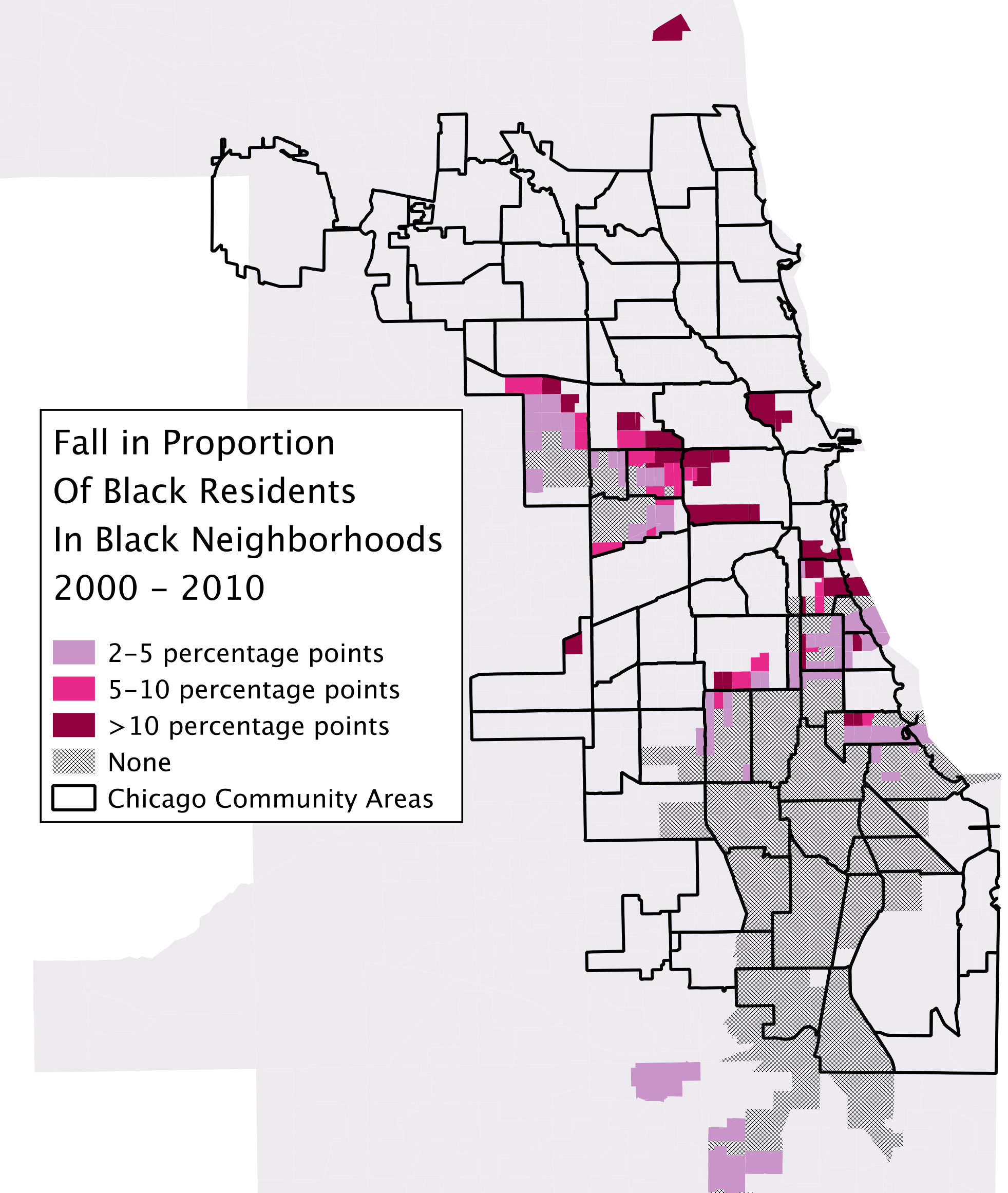
BlkInt80BlkInt90BlkInt00

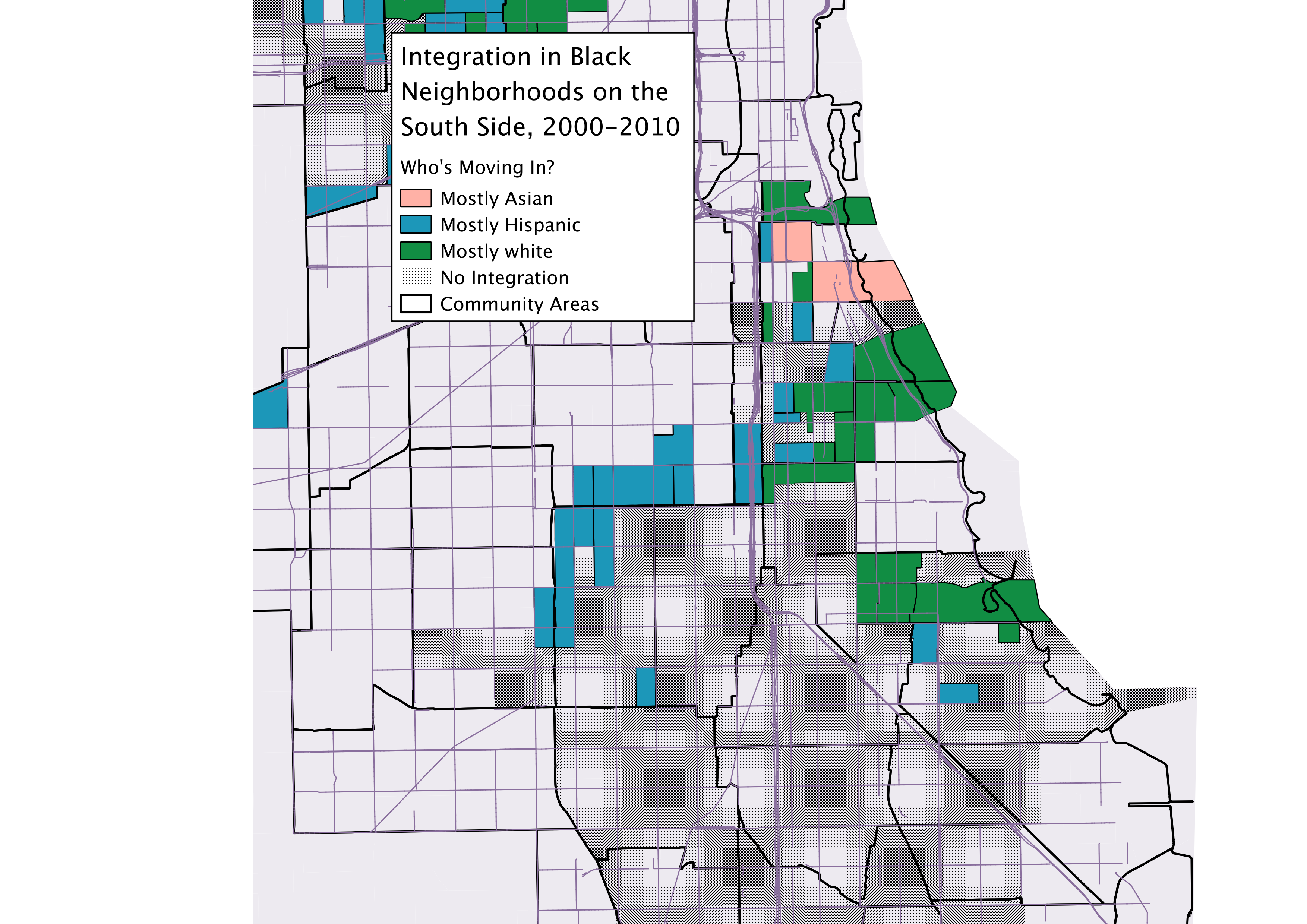
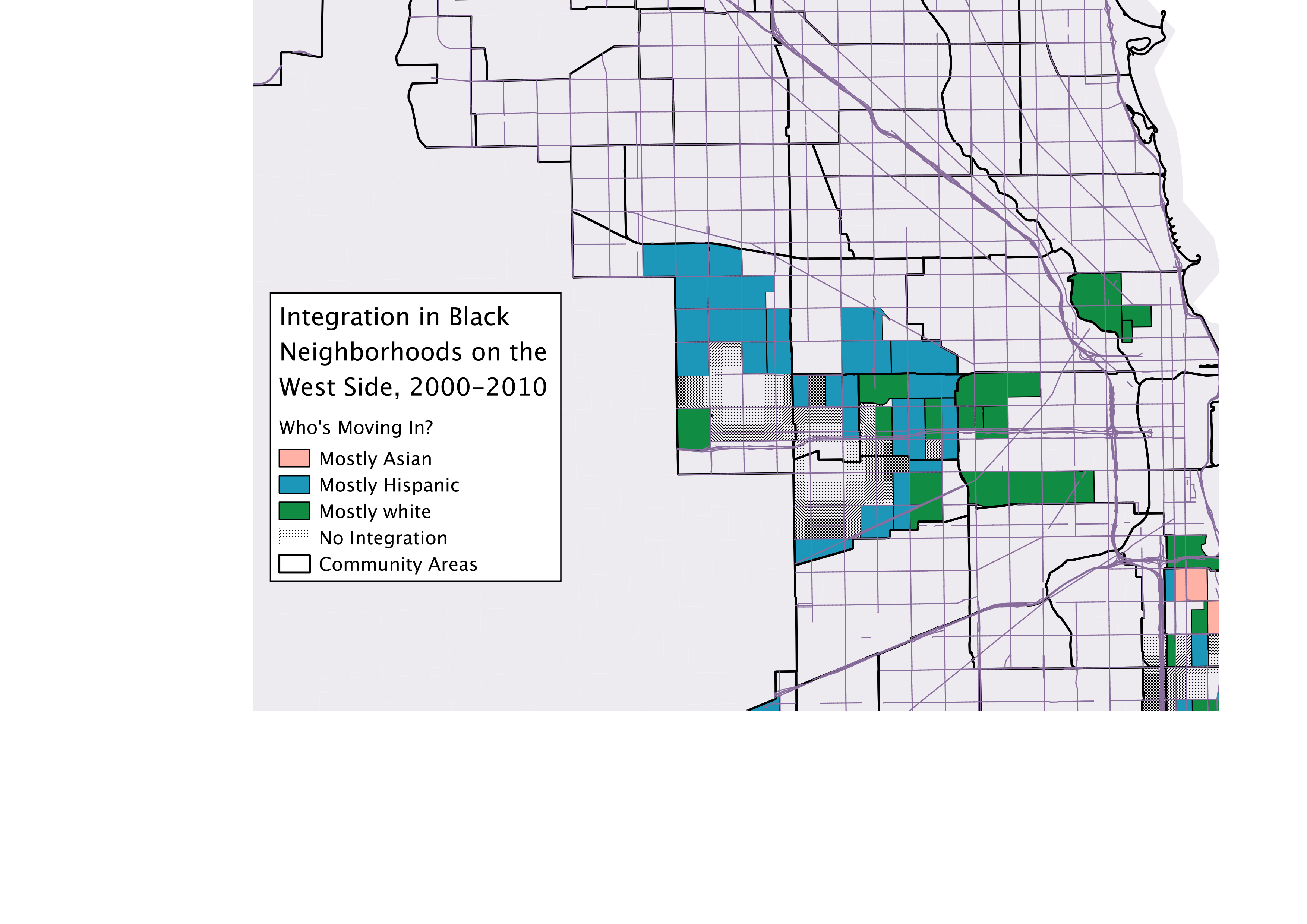
Since 2000, for the first time in Chicago’s history, people of other ethnic backgrounds appear to be moving into black neighborhoods in nearly every region of the city except the far South Side. To be clear, in many cases the change amounts to just a few percentage points of a neighborhood’s overall population: notable only because the previous rate of change was zero. But dramatic transformations in other places began with a trickle, too. If one of the cardinal rules of residential migration in Chicago is actually weakening, it may open up the possibility of broader demographic change across the city’s South and West Sides in the medium to long term.

Moreover, the changes are much more complex than the familiar narrative of white-led gentrification. As often as not, the newcomers are Latino or Asian-American. Not surprisingly, this seems to depend on the demographics of the neighborhood next door: on the West Side, where black communities bump up against Mexican and Puerto Rican districts to the north, these new residents are mostly Latino. Northern Bronzeville, close to Chinatown, has a rapidly growing Asian-American population. And the communities around Hyde Park – a racially mixed neighborhood with a large number of white residents – are, in fact, getting slightly whiter.

BlkIntSouth3 BlkIntWest3

But while Chicago’s black neighborhoods take a few tentative steps away from extreme segregation, some of the city’s white neighborhoods are moving in the opposite direction. Over the last 30 years, as a broad swath of the North Side has gentrified, it has also become disproportionately white. It now seems that nearly as many white North Side neighborhoods are becoming more segregated as are becoming less – a dramatic reversal from recent trends.

WhtSeg80WhtSeg90WhtSeg00

At first blush, this seems like a contradiction: why would some parts of the city be getting more segregated as others become somewhat more integrated? Most likely, however, they’re both part of the same broader phenomenon.

For the last few generations, Chicago’s economic geography has resembled a growing donut. In the center is a small, but quickly expanding, core of wealth. As the core grows, a surrounding ring of low-income neighborhoods gets pushed further out. And those neighborhoods, in turn, elbow aside a suburban ring of wealthier communities, which also move away from the core.

For various reasons, including the racial income and wealth gaps, neighborhoods that get absorbed into the rich core become much whiter, explaining the growing segregation there. But as that disproportionately white sector expands, it also helps to push the residents of neighborhoods in its path further out – and, in some cases, into black communities.

Still, that’s probably not the whole story. Ethnic communities, from Poles to Mexicans, have been moving increasingly far from the city center for many generations; only recently have some of them ventured into black neighborhoods. While research like Robert Sampson’s shows that “white avoidance” remains a powerful force, other academics have found evidence that white tolerance for black neighbors has (very slowly) inched up over the last few decades. That might also help to explain the sort of very tentative integration along the boundaries of black neighborhoods that Chicago is now experiencing.

The eastern and northern sides of East Garfield Park, on the West Side, have been seeing a notable amount of demographic change. Credit: Eric Allix Rogers

It’s harder to guess at whether these trends – if they grow and continue – are likely to make a famously unequal city a bit more just. Of course, the increasing racial and economic segregation of the core is a huge problem. Would declining segregation in historically black neighborhoods provide a counterbalance? Maybe. But longtime residents who have grown accustomed to living in a neighborhood with a particular community and culture have every reason to be wary of losing those things. And particularly where the newcomers are white – mostly along the borders of Chicago’s growing wealthy core – gentrification may eventually become a reality, and integration may be a passing phase.

Perhaps the most promising trend, then, is the movement of Latinos and Asian-Americans into black neighborhoods – particularly ones that have been losing population as residents move to the suburbs or southern cities. For many shrinking white neighborhoods around the Rust Belt, Latino and Asian immigrants, and their American-born children and grandchildren, have brought a much-needed economic and demographic shot in the arm. If black neighborhoods in Chicago can enjoy those benefits too, it may provide a path towards community development that doesn’t require rapid gentrification.

At the moment, of course, this all remains conjecture. A few bricks may have come loose from the structure of Chicago’s segregation, but the fortress remains. It will be a very long time before it’s gone.

Return to the shrinking North Side

Almost every time I publish, I have a very unpleasant, very intense fear that despite my best efforts, I have written something wrong and stupid in some obvious way. The most pleasing part of the writing cycle for me, then, is when either a) no one argues that what I wrote was wrong or stupid, or b) someone argues that what I wrote was wrong or stupid, but is clearly wrong themselves. (Of course, it’s also deeply satisfying to see someone respond critically in a way that expands my understanding of an issue without making me feel that I’ve somehow embarrassed myself or offended someone.)

My recent post on the wasted demographic and tax-revenue potential of Chicago’s North Side, which was republished last week in Crain’s, received two sustained counterarguments: one from Joe Zekas at YoChicago, and one from the real estate broker Eric Rojas. It’s fair to say that I find neither of them very convincing.

Joe’s argument is essentially that Lincoln Park isn’t really losing people, because a) it was growing up until 2000, b) its decline in the 2010 Census was small (about 200 people), and c) the small loss is turned into a small gain if you don’t count the emptying out of CHA’s Lathrop Homes on the far western edge of the neighborhood. To which I would reply that a) is pretty weak, given how long ago the 90s were, and I guess b) and c) are fair as far as they go.

But the argument was never about whether Lincoln Park’s population trend was slightly above or slightly below zero. It was, rather, that there is room for lots more housing in Lincoln Park, given that its population remains roughly 40% below its peak, and that it had fewer housing units in 2010 than it did ten or twenty years earlier; that there is obviously a desire for that housing; and that by refusing to allow the construction of that housing, we’re starving the city of people and money that it desperately needs. Nowhere in his response does Joe Zekas address any of those points, which makes it hard to even see his post as much of a rebuttal.

Eric Rojas’ post is not much stronger. His first objection is that, you know, life’s not fair:

The Crain’s author makes a lot of assumptions, and in my opinion, is unrealistic in terms of accessibility of real estate in general.  It is unrealistic for anyone to be able to afford any community they desire at any given time. This goes for tony suburbs and vacation spots as well.

Which may be true! And yet it’s also a bit odd, given that I was proposing not a utopian community in which we exchange luxury rental units for hugs, but a tweak in the zoning code to return to a level of restrictions on building that prevailed within the lifetime of a middle-aged person. Moreover, as I’ve pointed out before, the issue is not simply that, on a fair playing field and an impartial, “free” market, some people happen to be doing better than others, and so they can afford better real estate. The issue is that the playing field is tilted against those of more modest income, and the zoning laws of the last 40 years make housing more expensive than it has to be. Life may be unfair, but in this case, it’s unfair because we’re cheating.

Rojas continues:

There are no statistics cited correlating Lincoln Parks population “decline” (again, it’s actually increased from 1980-2010 by 12% and has lost only 206 people from 2000-2010 according to YoChicago.com) with a decline of tax base or sapping resources for the entire city.  There are no statistics cited that suggest Lincoln Park was better off when it’s population was around 100,000 in 1950 rather than with today’s steady 64,000. [emphasis in original]

One by one:

  • Hiding the decline/stagnation of the most recent decade by combining it with the two previous ones is not super honest. Moreover, a 12% increase over 30 years represents a growth rate of something like 0.4% per year, which is hardly breakneck speed, and considerably below the growth rate of the metropolitan area as a whole. And, again, the most recent numbers we have put the current growth rate much closer to zero. And, again, Lincoln Park’s population remains 40% below its peak, despite the fact that it is among the most desirable urban neighborhoods in the country.
  • If Mr. Rojas really doesn’t think that more people and housing leads to more tax revenue, I’d refer him to the recent battle in Crain’s over TIFs, which explains how new development deposits money more or less directly into the city’s, and CPS’, bank accounts. (In short: the city can receive more money with the same tax rate, and CPS can go above state-mandated caps on its tax collections if it does so by taxing new development.)
  • Finally, the last sentence would be relevant if I were proposing to bring Chicago back to the 1950s, or if the only thing that had changed about Chicago between 1950 and 2015 was that Lincoln Park had lost population. But obviously neither of those things is true. Lincoln Park was much less segregated by income in the 1950s, which was good; it also had a lot of other problems, all of which were tied up in the broader urban trends that dominated America at the time.

In conclusion, I stand by my original piece and its argument.

Unnecessary population loss on the North Side is a problem for the whole city

Here’s one way to put Chicago’s demographic problem: Since 1950, the city has lost more people than currently live in all of San Francisco, Boston, or D.C. After finally increasing its population in the 1990s, the 2010 Census found that Chicago – unique among the large, relatively prosperous cities we consider our peers – had declined by 7%, or around 200,000 residents.

Indeed, just a couple miles from the heart of the Loop lies a neighborhood that, despite a rich history, beautiful architecture, and quick access to the second-largest business district in America, has lost 40% of its population since the middle of the last century. An area that once held 102,000 people is now home to barely 64,000.

That area is called Lincoln Park.

For a long time, most accounts of Chicago’s lagging population have focused on parts of the South and West Sides where many residents, largely African-American, have decided to decamp for the suburbs or the South in search of better schools, less crime, and more jobs.

But the under-appreciated flip side of population loss in those parts of the city is that places that ought to be growing like gangbusters are stagnant, often sitting 25% to 50% below their peak populations. Lakeview, for example, was once home to 124,000 people; its population is now 94,000. North Center is down from nearly 49,000 to under 32,000. West Town, which includes Wicker Park and Bucktown, has fallen from 187,000 to 81,000.

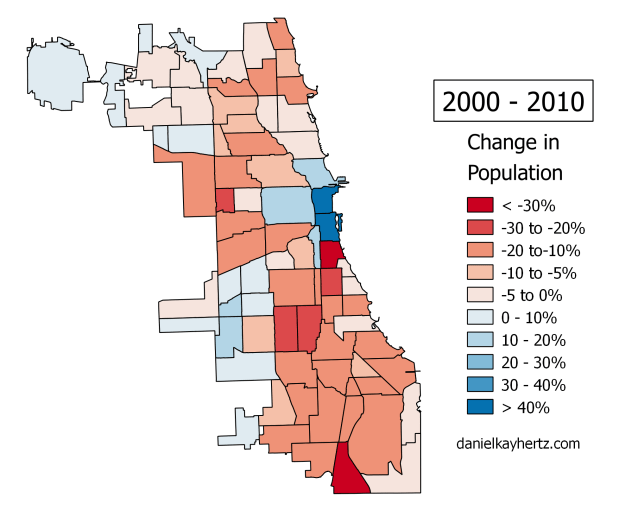
Decline5010


Seg12aCompare the maps: many of Chicago’s wealthiest neighborhoods are dramatically below their peak populations.

Even more startling, these areas aren’t necessarily gaining back those people. Lincoln Park, Lakeview, and North Center all actually lost population in the 2000s. Logan Square, whose rapid ascent as a “hot” neighborhood picked up steam during that decade, was home to 11% fewer people in 2010 compared to ten years earlier.10

The problem, obviously, is not that people don’t want to live in these neighborhoods. Home prices and rents have skyrocketed over the last ten to twenty years; average incomes have climbed with them, as more and more of the well-to-do decide Chicago’s North Side is a place they’d like to call home.

So what’s going on? And why should we care?

One reason is that over the last few generations, Americans all over the country have spread out a bit: apartments that used to hold a family of five or six now contain a family of three or four – or maybe a childless couple who have turned a bedroom into an office. Or maybe just one person, living alone. This is especially true in wealthier areas, where people can afford to buy themselves more space. As a result, if a neighborhood has roughly the same number of housing units it had fifty years ago, it probably has a significantly lower population.

But that doesn’t explain why these neighborhoods, which have become so popular, haven’t seen the construction of more housing units. For most of Chicago’s history, when a neighborhood became more popular, builders created more housing, turning houses into three-flats, and three-flats into courtyard buildings. In a few really high-demand areas, like right along the lakefront or near downtown, they might even have built highrises.

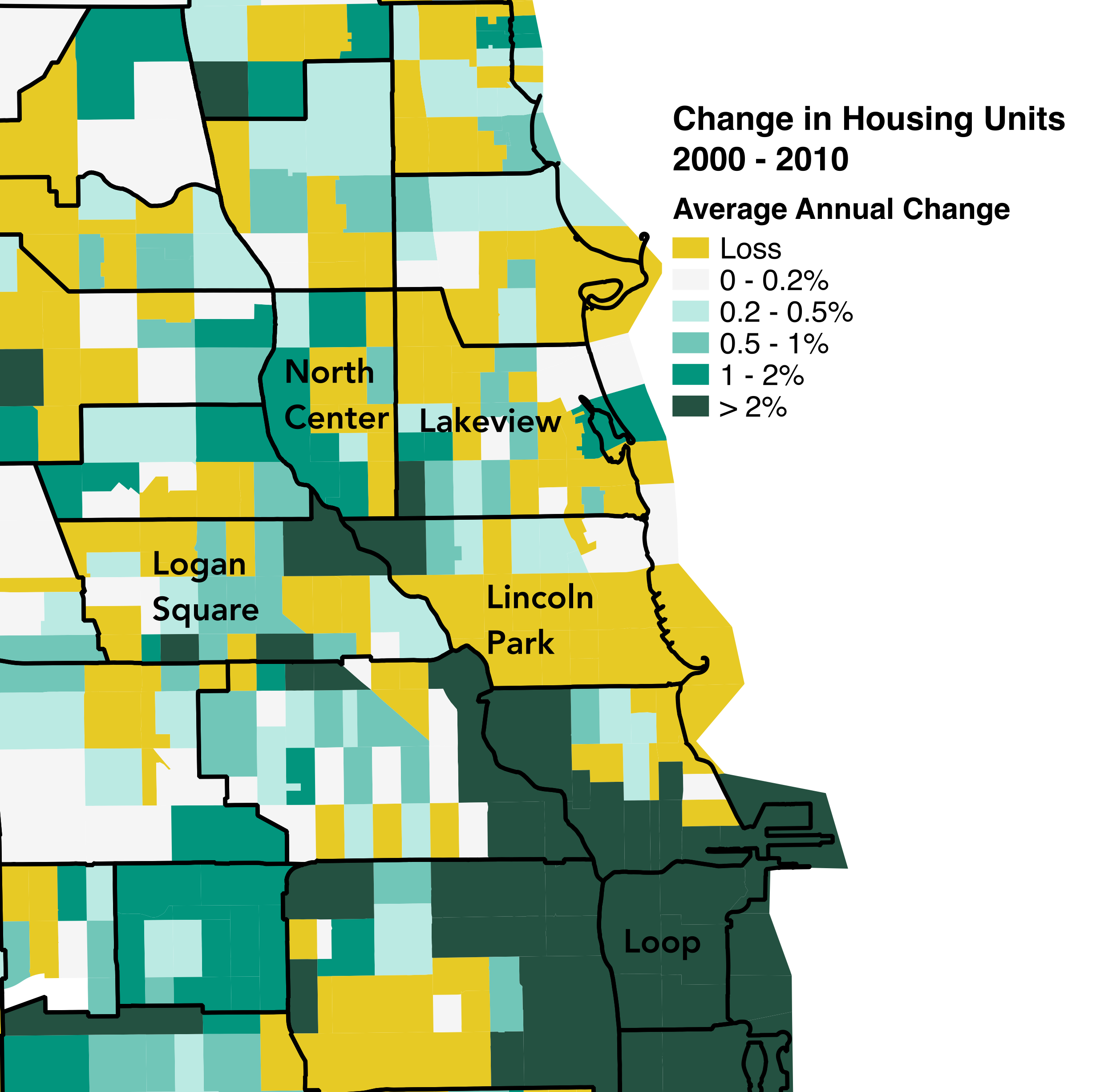
Note that outside of the central area, high rates of housing construction exist mainly along the river - along the western border of Lincoln Park and North Center. Many of those areas were formerly non-residential. Small amounts of new construction translated to high percentage growth.
Note that outside of the central area, high rates of housing construction exist mainly along the river – along the western border of Lincoln Park and North Center. Many of those areas were formerly non-residential. Small amounts of new construction translated to high percentage growth.

But for the last several decades, increasingly strict zoning laws have outlawed this kind of gradual build-up. Instead, Chicago’s laws allow a massive boom in parts of downtown – mostly where there weren’t enough white-collar residents to complain – while putting a tight lid on the neighborhoods.

Since replacing a couple two-flats with a courtyard building is now illegal, developers make money by tearing down an old two-flat and building a luxury two-flat in its place. Or they build a mansion, and the neighborhood actually loses a housing unit. As a result, as a neighborhood becomes more attractive, the city encourages fewer people to live there.

And that’s how we arrived at the bizarro-world reality that Lincoln Park actually lost roughly the same number of housing units as Englewood between 2000 and 2012.

You can see how dramatic the effect is by looking at population growth around the borders of downtown: where relatively loose downtown zoning holds sway, the number of residents boomed. But instead of gradually tapering off as you get further away, there are sharp drop-offs all around the central area. Often, a few blocks where the population grew by 50% or more are right next to a few blocks where population actually declined. In most cases, zoning plays a crucial role in those disparities.

But so what? Why does any of this matter?

For one, it matters because if the number of housing units in a neighborhood is capped, as that neighborhood becomes more desirable, affluent new arrivals will outbid existing residents and people of moderate income, pushing up housing prices and creating newly segregated enclaves. If we want regular people to be able to live in some of our safest, most transit-accessible neighborhoods, allowing the supply of housing to grow with demand is a crucial part of that affordability.

Second, as places like Lincoln Park become forbiddingly expensive, some people decide their next best option is, say, Wicker Park or Logan Square. When they arrive, they open coffee shops and hipster bars, attracting people with more money, who then bid up housing prices there, expanding the parts of the city where the working class simply can’t afford to live.

But most potential residents will just decide to move to the suburbs. And, once there, they won’t be supporting neighborhood businesses. They won’t be contributing to the city’s tax base. In other words, by pushing people to the suburbs, we’re giving up neighborhood jobs and money the city desperately needs to provide services in every neighborhood in the city, including – especially – the ones that are actually struggling, far from Lincoln Park.

The fact that Chicago’s affluent North Side communities have lost so many people, and aren’t gaining them back, is a huge problem for many local businesses, current residents of moderate means, and anyone who would like to move there but can’t afford to.

But even if none of that describes you, it’s also a problem for those of us who’d like to see City Hall have more resources to invest in other parts of the city, from policing, to schools, to transit, to road repair. It’s a problem for those of us who’d like to see more jobs created within commuting distance of Chicago communities where unemployment is endemic. It’s a problem, in other words, for all of us.

Power and Interests

A few days ago, Pete Saunders wrote a post on “gentrification management”:

I’ve come to the belief that gentrification can be managed.  Its benefits can be harnessed; its costs can be mitigated….

Some six months ago I detailed the efforts of Oak Park, IL, an inner ring suburb adjacent to Chicago’s West Side, as it was faced with racial transition and resegregation during the 1950s and ‘60s.  Unlike the vast majority of communities that warily accepted its fate in the face of changing conditions, Oak Park sought to directly confront the issue….

Perhaps Oak Park’s experience can be a template for a gentrification management program.

Perhaps! But, since Pete asks for comments, I will give a few, and they are mostly pessimistic.

My pessimism comes from two things: power, and interests.

Oak Park is miraculously integrated. Credit: theoakparker.com

The white middle-class and affluent residents of Oak Park had much more power over their situation than the lower- and working-class, generally non-white residents of gentrifying neighborhoods do today. More to the point, Oak Parkers had more power than the people who wanted to move into Oak Park, which is the opposite of the dynamic in gentrifying areas. To start with the obvious, Oak Parkers had more money, which is useful if you’re going to launch a campaign that will require many, many person-hours of work. The fact that Oak Parkers had money also meant they weren’t in danger of being priced out of their neighborhood; the challenge, rather, was to keep their neighborhoods the kind of places they would choose to live, so as to avoid voluntary mass exodus.

Second, Oak Parkers had the kind of social capital that allowed them to do things like set up equity insurance programs to protect homeowners from potentially falling real estate prices during integration. The social power that came with their racial background also allowed them to get away with “encouraging African American dispersion” throughout Oak Park to avoid ghettoization. Imagine the response of middle-class whites being told by some Pilsen neighborhood council that they would be instructed as to which apartments they were allowed to rent so as to avoid too much white clustering: it would not be pretty.

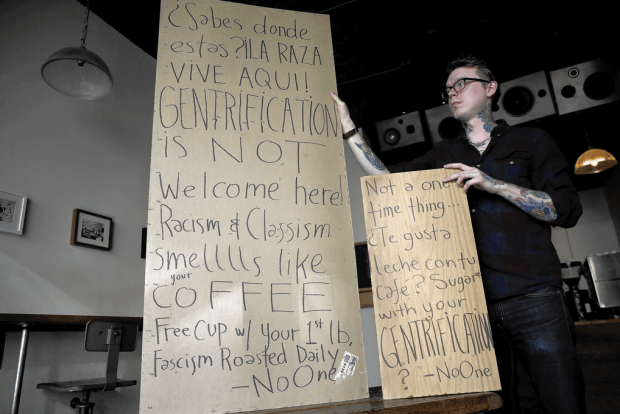
Anti-gentrifiers can make posters. Chicago Tribune.

Third, Oak Parkers had the advantage of their own government. Unlike, say, Logan Square, which is governed by a city whose constituents include both longtime Logan Square residents and many of the wealthier potential gentrifiers, Oak Park’s municipal government was responsive only to the interests of a small, relatively homogenous group of educated, liberal whites with, apparently, broad agreement about what the future of their suburb should look like.

Finally, Oak Parkers had the benefit of policy levers that could accomplish what they wanted to accomplish. Without downplaying the real risks they took, and the real novelty of a white neighborhood successfully implementing planned integration in the mid 20th century, by that time American cities had been managing the residential movement of black people, and lower-income people, for many generations. If part of Oak Park’s goal involved making sure the inflow of black families wasn’t too fast, and that it didn’t create new segregated clusters, they had reason to believe that was, if not exactly a slam dunk, definitely achievable. On the flip side, there are no policy levers I’m aware of that can keep relatively wealthier people out of a low-priced neighborhood that don’t also have serious negative consequences for the existing residents of that neighborhood.

What makes this power differential even more important is that the interests of the more powerful party in each situation – that is, existing Oak Park residents and gentrifying newcomers – are very different. Oak Park residents were interested mostly in maintaining their neighborhoods’ “stability”: keeping racial change slow, and keeping property values at their already-high levels. Once an all-out fight against any black in-migration had been ruled out – because they thought it wouldn’t work, or because they thought it would be too costly, or because it offended their political ideals – both their social and financial interests pointed towards slow, controlled integration.

Conversely, gentrifiers have little incentive to promote “stability,” in the sense of minimal change in their new neighborhood’s demographics and real estate values. Even if they have an abstract commitment to “diversity,” gentrifiers are primarily interested in living as close as possible to the middle-class social networks, jobs, and amenities they want access to, while staying within their budgets. (This is obviously not something I can really prove. But A. I have a lot of experience moving in gentrifiers’ circles, and B. the pattern of gentrification in Chicago, clearly moving out from the largest hubs of those social networks, jobs, and amenities, gives a pretty strong indication of what people are trying to get.) That means they will move to the working-class neighborhoods on the edge of more affluent regions of the city.

Importantly, each individual college-educated white twentysomething may prefer that other white twentysomethings stay out of those neighborhoods, but they have every reason to want to move there themselves. If they were kept out, after all, they very likely would be farther from their friends; face longer commutes (or maybe not be able to get to their preferred jobs at all); have worse access to public transit and grocery stores; pay much more for housing and/or transportation; and/or face a much higher risk of crime. This is why Adam Hengels’ point that gentrifiers move where they do because those represent the “best” neighborhoods they can afford is so crucial: it suggests that you can’t get them to stop moving in without seriously diminishing their quality of life. And people rarely, if ever, voluntarily diminish their own quality of life.

And, to close the circle, the residents of gentrifying neighborhoods don’t have the power to force them to do so. Which is why I’m pessimistic that, absent major housing policy reform, gentrification can be successfully managed.

Quick thoughts on the Market Urbanism approach to gentrification

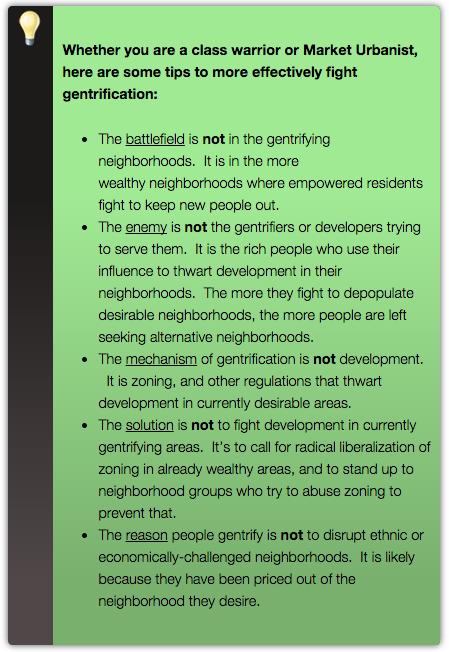
Over at Market Urbanism, Adam Hengels has written a mini-manifesto on gentrification. (In which, by the way, he graciously cites this blog. Thanks!) It’s a strong articulation of why anti-gentrification politics centered on opposing new development can’t work, though I think Adam is a bit too hasty in presenting zoning deregulation as a complete fix, or the only possible approach.

Anyway, this is his Twitter-friendly takeaway:

Adam Hengels, Market Urbanism.

In the interest of time (my own and yours), in bullet points:

  • The battlefield is both in the gentrifying neighborhoods and in the wealthy neighborhoods. The battle is also, for that matter, in the poor neighborhoods that are not being gentrified, since their gradual or rapid disinvestment sets the stage for reinvestment later on. (See the rent gap theory.) In a narrower sense, Adam is right that the engine of gentrification – that is, growing demand for housing in a system that will only accommodate that demand through rising prices – is churning both in Logan Square and Lincoln Park (or Bed-Stuy and Greenwich Village, to use a New York example). We focus on Logan Square and Bed-Stuy because they are going through a process not only of rising rents, but of dramatically transitioning social networks, from generally lower-income, mostly blue-collar people of color, to generally higher-income, mostly white-collar white people. That represents a shifting of some of the most important social-spatial boundaries that exist in American cities, and so is extremely notable. But Lincoln Park and Greenwich Village have also been changing over the past, say, 15 years – it’s just that the shift from upper-middle-class white professionals to even wealthier white professionals is a less dramatic redistricting of social geography.

    Nevertheless, I don’t think it’s productive to tell the residents of Logan Square and Bed-Stuy that their observations about the changing character of their neighborhoods aren’t valid. The fact that the outcome of the Logan Square battle depends on the outcomes of other battles around the city doesn’t mean it’s not a battle.

  • I think this is basically right, if by “enemy” you mean “the people with the power to change what you don’t like.” That said, again, I think it’s worth acknowledging that for people who are opposed to gentrification for reasons of culture or community, gentrifiers can be the people who are directly undermining the things you wish to preserve. Moreover, the fact that they are moving next door to you only because they can’t afford the trendier neighborhood two subway stops closer to downtown doesn’t mean that they won’t also be inconsiderate neighbors. And even if they’re considerate neighbors, it doesn’t mean that they aren’t undermining what you value just by their very presence. Which, as I’ve said before, is not necessarily a problem with a solution.
  • This seems like it’s leaving some stuff out. Zoning is one really big reason why shifts in demand translate into big changes in prices, as opposed to changes in the amount of housing stock. The things that drive the shifts in demand are different. Another reason, potentially, is that housing is priced by the market to begin with. Many New York City neighborhoods have bulwarks of economic and racial diversity in the form of non-market housing, which makes up something like half the city’s units (combining public housing, subsidized housing, and rent-controlled or stabilized units).
  • Again, this is one approach. Another would be nationalization (insert tongue-in-cheek emoji), or at least the large-scale removal of housing units from the market. That said, a quick evaluation of our political and financial situation suggests that such a removal is not really possible at anything like the scale that would be required. So yes, zoning deregulation really ought to happen. But that’s not exactly politically popular either, even if it doesn’t come with anything like the financial requirements of creating non-market housing. Which is to say: we need both as much zoning deregulation as possible, and as much non-market housing as possible, because we’re not likely to get anywhere close to solving the problem with either of them.
  • Yes. Yes! The greatest insight of a market-based analysis of gentrification is that the actors who are given agency, who are treated as first movers in virtually all narratives about this kind of neighborhood change, are in fact pawns. They may be pawns of greater means than some other pawns, but at bottom their choices are also about constraints: Where can I be closest to my friends, potential employers, and the amenities I want, while staying within my budget? Which is why Adam’s first point, even if incomplete, is still important. In a real sense, the battle begins outside the “gentrifying” neighborhood. Mangling the old line about immigration, a gentrifier might say: We are here because they [richer people] are there [in the neighborhood where I’d rather live].

Gentrification and the Wealth Gap

The Washington Post
The Washington Post

A bit ago, I wrote about how conversations about neighborhood change often paper over very real conflicts of interest among members of “The Community”:

A very common refrain in gentrification debates is that “the community should decide,” or that changes should “benefit the community.” But as Michael Kendricks points out, “the community” is always made up of many different people, with many different interests. Virtually any decision that’s made about a new housing development, or store, or transit project, will benefit some members of the community at the expense of others. That is politics, and anyone who has been to a neighborhood meeting about anything, large or small, has seen firsthand that neighborhoods are not above, or below, politics.

It’s far from an original observation to note that homeowners tend to benefit from gentrification, since rising property values directly increase their wealth. (Of course, they may also be squeezed if their property taxes increase much faster than their income.)

But we rarely acknowledge just how huge those stakes are. A new series from the Washington Post on the black professional class suburbs in Prince George’s County, Maryland (and Pete Saunders’ astute take on it) helps to quantify what happens to black wealth when home values don’t increase. The massive wealth gap between whites and blacks – several times larger than the income gap – is driven in large part by the difference in home values in mostly white neighborhoods compared to ones that are mostly black. And, as the Post explains, the extremity of that gap is in large part a result of the collapse of home values during the Great Recession:

The recession and tepid recovery have erased two decades of African American wealth gains. Nationally, the net worth of the typical African American family declined by one-third between 2010 and 2013….

Overall, the survey found, the typical African American family was left with about eight cents for every dollar of wealth held by whites….

Many researchers say the biggest portion of the wealth gap results from the strikingly different experiences blacks and whites typically have with homeownership. Most whites live in largely white neighborhoods, where homes often prove to be a better investment because people of all races want to live there. Predominantly black communities tend to attract a narrower group of mainly black buyers, dampening demand and prices, they say.

And the only obvious way to rebuild this wealth in the short to medium term is to raise property values in black neighborhoods. Which, whether or not that’s accompanied by racial change, is likely to price some renters and prospective buyers out.

This is not a “gentrification is clearly good, so stop complaining” argument. According to the Post story, only 43% of black Americans own their own home, so even strong gains in to property values would only go so far. But the issue of wealth deserves a more central place in the story of changing real estate values, and anyone whose knee-jerk reaction is to condemn rising home prices in non-white neighborhoods ought to have something to say about how else we can close the wealth gap.

The problem

From Chicago NPR affiliate WBEZ’s series on gentrification:

James Rudyk says affordability doesn’t mean housing values have to remain stagnant or that certain people or businesses should stay out.

But…by definition, it kind of does, doesn’t it? If housing values don’t “remain stagnant,” then they’re growing. Another way of saying that housing values are growing is that housing is getting more expensive. In a neighborhood (Belmont Cragin, in this case) with home prices already above the city average – in a city where something like half of all residents are paying more than 30% of their income for a place to live – that suggests that every increase in housing prices is going to stretch the budget of some people who live in the area, and put the community beyond the reach of other city residents who might like to move there for better schools, safer streets, etc.

In other words, affordability will suffer.

This is the fundamental problem with using housing as our country’s main vehicle for wealth accumulation: as soon as you buy a home, you have an enormous incentive to see its value grow. But that interest, of course, is directly opposed to the interests of any people who might want to buy, who want – in many cases, need – housing prices to stay flat or even decrease in order to find a place to live. In a place where the vast majority of homes are not subsidized for the low- or moderate-income – and Chicago will be that kind of place for the foreseeable future – that means that strong returns to housing are directly opposed to affordability.

It also means that statements like this are really hard to take from theory to reality:

“If residents on Diversey and Laramie really do want a Starbucks, then let’s put in a Starbucks. If they really do want a Trader Joes, then let’s put in a Trader Joes. If they’re really fine with the fruit market, let’s leave the fruit market. So the question is, who makes that decision?,” he said.

Rudyk hopes it’s the people who live here, and not outside investors. He says that may determine whether Belmont Cragin redevelops or gentrifies.

This imagines that there are two groups of people: Belmont Cragin residents, and “outside investors.” But that’s not really true.

A very common refrain in gentrification debates is that “the community should decide,” or that changes should “benefit the community.” But as Michael Kendricks points out, “the community” is always made up of many different people, with many different interests. Virtually any decision that’s made about a new housing development, or store, or transit project, will benefit some members of the community at the expense of others. That is politics, and anyone who has been to a neighborhood meeting about anything, large or small, has seen firsthand that neighborhoods are not above, or below, politics.

It’s tempting, in this as in any situation, to try to find a way that everyone – or everyone you consider a “good guy” – can win. Unfortunately, I think there’s a lot more conflict here among the “good guys”* – conflict that isn’t about misunderstandings, but about real and immediate self-interest – than we’re willing to admit.

* I say “good guys” because I don’t think there’s anything nefarious about a middle class family in Belmont Cragin wanting home prices to increase in their neighborhood so they can have some financial security for retirement. The point, though, is that the consequences of that totally benign goal – multiplied by hundreds of thousands of homeowners – are anything but benign for people caught on the wrong side of affordability.

Concern: Will Chicago’s new inclusionary zoning law allow double-counting?

Warning: this post gets a bit into the legislative weeds.

So as I wrote at Next City, Mayor Emanuel’s affordable housing commission just announced their recommended amendments to the city’s inclusionary zoning law, or ARO. (Affordable Requirements Ordinance.) Mostly, this involves closing or tightening loopholes that allowed developers to push new subsidized units out of wealthy neighborhoods, and into poor ones.

But one other provision gives me pause:

On page 9 of the ARO proposal. Click for a link to the document.

To summarize: the Chicago Housing Authority (or other “authorized agencies”) can buy ARO-produced units and run them as their own. In fact, not only can they do that, but the city is giving developers a financial incentive to sell. If someone builds a 40-unit building on the North Side, the new ARO says they’re responsible for four subsidized units, or an equivalent fee; one of those units has to be on site. If the developer chooses to pay the fee for the remaining three, that’s $375,000 (at $125k per unit). But if the developer sells the one unit they built to the CHA, they save $25,000 in fees per remaining unit – meaning $75,000 in all.

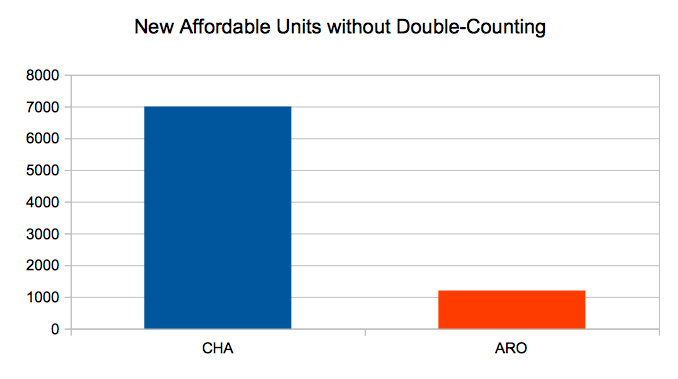
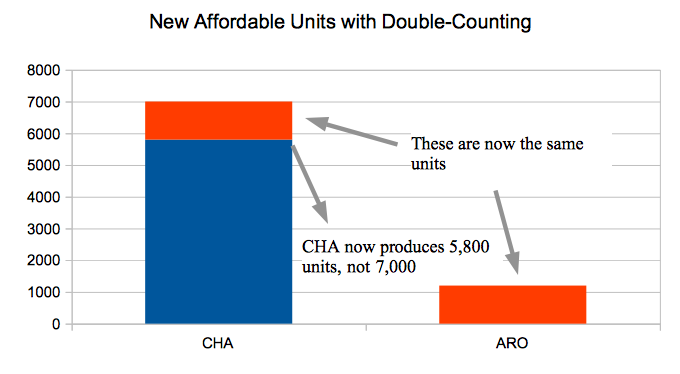
Anyway, at first blush, I don’t see any reason why converting ARO units to CHA units is a problem. Except for this: Rahm Emanuel has announced that he wants the ARO to create 1,200 units of affordable housing over five years. The CHA, separately, has a longstanding commitment to maintain 25,000 units of housing, of which it is short about 7,000. In other words, it appears that we currently have a commitment from the City of Chicago and its partner agencies for 1,200 + 7,000 = 8,200 new units of affordable housing over the near term.

The issue is what happens with units that are produced by the ARO, and then bought by the CHA. Presumably, Emanuel – or whoever is mayor at the time – will want to tout those as “ARO units,” since they would have existed without the law. Presumably, the CHA will also count them as “CHA units,” because, you know, they’ll be CHA units.

But what that means is that we’ll be double-counting. And in the extreme (though possible!) scenario that the CHA buys all 1,200 ARO units, instead of 8,200 new subsidized housing units, the city will get only 7,000 – because every unit the CHA buys from the ARO is a unit they don’t have to produce separately themselves.

Here is this idea in chart form:

Screen Shot 2014-12-16 at 11.58.10 AM

Screen Shot 2014-12-16 at 11.58.01 AM

Anyway: the stated purpose of the ARO amendment is to improve upon the old ARO, which only produced 189 affordable units over 7 years, or something like that. But double-counting, by creating the possibility that every new ARO unit will simply displace a CHA unit that would have been created, also makes it possible for the new ARO to have zero net impact on the total number of affordable units in the city. That is, if you look at the graph above, double-counting every ARO unit would leave the city with 7,000 new units – the same number the CHA would be obligated to provide if the ARO didn’t exist at all.

Now, caveats: I’ve asked around about this, and haven’t yet heard any reason that would prevent the CHA from buying up all the ARO units, but it’s possible that such a reason exists, and I’m just not yet aware of it. If you know of that reason, tell me!

It’s also possible that, even though the CHA has promised 7,000 new units, the CHA’s pants are on fire, and there’s no way they’re actually going to deliver that any time soon. In which case the ARO isn’t displacing CHA units, because the CHA can’t/won’t produce new units on its own. Maybe. That seems like a pretty unsatisfying answer, though: if you’re the City Council (or, say, the mayor), why not just find a way to force the CHA to live up to its promises?

Am I getting this wrong somehow? Or does there need to be some safeguard in the new ARO?

Donuts and wedges

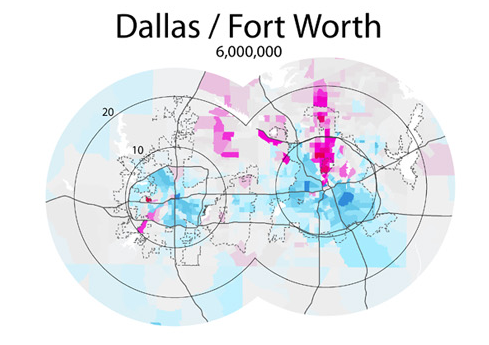
Since my last post, I was reminded of the existence of this, from Radical Cartography. One point Bill Rankin makes there, which is really important, is that the “donut model” of economic geography, with concentric circles of high- and low-income areas, is really not the American standard. More common is the “wedge model,” with a “favored quarter” radiating out from the city center like an especially privileged slice of pizza.

For example (in Rankin’s maps, pink = rich and blue = poor):

Screen Shot 2014-12-08 at 11.07.01 PM Screen Shot 2014-12-08 at 11.07.09 PM Screen Shot 2014-12-08 at 11.07.22 PM Screen Shot 2014-12-08 at 11.07.32 PM

If you take another look at my maps for Chicago…

IncGIF

…you might reasonably ask: how sure are you that the growth of a high-income zone in the central city is following the donut model, versus the wedge model? After all, it seems to be growing mostly towards the already super-wealthy northern suburbs. Maybe the endgame is a wedge, after all.

To which I would reply: yes, I think there’s something to that. But what matters, I think, is what’s at the center. Going back to the rent gap theory, a building’s potential rents will only be high if it’s close to jobs or amenities that make the area valuable. In all of the extreme wedge examples above, the downtowns don’t really serve quite the same central economic or cultural role for their respective metropolitan areas as does downtown Chicago, and so areas adjacent to them – say, the southern end of downtown Atlanta, or the areas to the north of downtown St. Louis – aren’t especially close to a major job or amenity center. Instead, those centers are further out in the suburbs, and high rents revolve around them, following major transportation corridors.

Downtown St. Louis (background) has more jobs, but suburban Clayton (foreground) has higher office rents and half the vacancy rate. Credit: http://s29.photobucket.com/user/jeffvstl/media/downtownfromclayton1.jpg.html

In other words, northern Bronzeville’s position, I’m guessing, really isn’t anything like whatever neighborhoods are a mile or three east of downtown Houston: it’s actually in close proximity to the region’s largest amenity hub, and they aren’t.

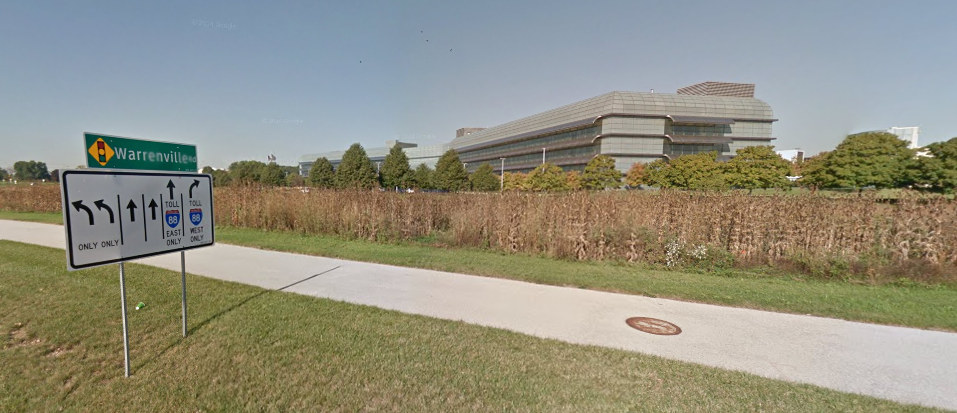
Now, what gives the wedge model a bit of weight in Chicagoland is that the Loop isn’t the only major employment center. In fact, even if you know nothing about the Chicago area, you could easily pick out the other employment centers just by looking at the map: they’re in the northern suburbs and along a corridor running along I-88 in second- and third-ring suburbs southwest of the Loop. They are, not coincidentally, close to the two largest other major high-income areas. (Though the high-income areas near I-88 continue to move away from where the actual jobs are, which is something that should maybe trouble people with a vested interest in keeping those jobs there.)

Who could say no to working here? Naperville, Illinois. Forgive my urban snobbery.

Anyway, the point is that things are complicated, and basically every major metropolitan region in the world is polycentric, which does weird things to potential rents, and thus the prospects of disinvestment and reinvestment. You don’t even have to go outside the city to see that: though it’s much less dramatic, Hyde Park – the little patch of white along the south lakefront – has seen a very small ripple of reinvestment expand from its major employment center, the University of Chicago. The problem there, of course, is that Hyde Park is surrounded entirely by black neighborhoods (and South Kenwood, a mixed neighborhood, beyond which is North Kenwood, and almost entirely black neighborhood), which, as we discussed last time, makes the reinvestment stage difficult.