The author of “Sprawl” returns

Generally speaking, I find the kind of broad “Cities: Yea or Nay?” culture-war debates pretty exhausting and pointless. And it is, for the most part, a culture war, fought by people who disdain or feel threatened by the social influence of others. Data point: the subhed on Robert Bruegmann’s recent op-ed in Politico, which reads: “Why urban yuppies have it all wrong.” It’s a tempting rhetorical trap, because so many people have chosen sides – or have had their side chosen for them – and because reducing transportation policy to a culture war allows everyone to feel like all they need to know about it is their own personal experience and feelings. It’s also, obviously, a totally symmetrical phenomenon: for every “urban yuppies” jab there’s an urbanist who makes some throwaway reference to suburbanites being fat, or rich, or whatever. It’s all very stupid, and as a general rule we should all stop judging each others’ choices. (We should also be more aware of the extent to which people don’t get to choose what kind of community they live in.)

If you want to live in a weird giant circle, that’s cool.

Anyway, I clicked on and read Bruegmann’s piece mainly because he’s the author of Sprawl: A Compact History, the reading of which I attempted to liveblog last fall. (See parts one, two, and three.) And I’m writing something about it partly because I’m too busy to write the longer thing I’ve been working on for a while, but also because I think there’s a really basic flaw to the column that’s both extremely important and not at all obvious to the casual reader.

Basically, Bruegmann’s argument is that sprawl is fine – good, even – because car travel is more efficient, timewise, than public transit, and so Atlanta shouldn’t be worried about its recent designation as the most sprawly city in the country. It certainly shouldn’t attempt to fix its problems with sprawl and congestion by building more public transit:

In any case, the remedy for the problem of traffic congestion is not some massive transit-building program… Atlanta, like virtually every American city, would probably benefit from an expansion of the transit system, particularly to accommodate those who cannot, for one reason or another, drive. Even a major expansion, however, is unlikely to alter in any fundamental way the fact that most people except for those traveling to or from a few very dense nodes are going to do most of their travel by private automobile because in greater Atlanta, as in greater New York or greater Paris, the automobile is simply so much faster and more convenient everywhere except at the very center. [my emphasis]

This is a really remarkable paragraph for a person who is an emeritus professor of urban planning to write, and then publish, without immediately requesting a retraction or addendum or something.

The reason, if you think about that bolded part for a just second, should be pretty clear: what Bruegmann is referring to as “the very center,” where “the automobile is simply so much faster and more convenient,” varies a crazily huge amount between New York, Paris, and Atlanta, both in absolute size but also more importantly as a proportion of the entire metropolitan area. That’s obvious to anyone who has been to these cities, or is even casually familiar with them, but we can get a pretty good estimate of how big each “very center” is by looking at each metro area’s mode share: the percentage of people who choose to take public transit to work. Presumably, after all, people choose transit mostly because it’s the most efficient way to get where they’re going, with some consideration also for the fact that it saves a ton of money.

In the Atlanta area, about 3.7% of people take public transit to work; in the New York area, it’s about 30%. Paris is skewed somewhat because a huge percentage of people walk, but the drive-transit split works out to about 67-33. So we can very roughly estimate that the “very core” makes up, respectively, 4%, 30%, and 33% of these cities.*

Why the huge difference? Because a much larger percentage of the New York and Paris metropolitan areas are built at a reasonably dense, pedestrian-friendly scale where it makes sense to walk to the nearest bus or train stop, and where, when you get off that bus or train, you are likely to be able to walk to your job without too much trouble, either. In those cities, what Bruegmann refers to as “a few very dense nodes” make up, in fact, a continuous fabric of urban neighborhoods that are home to a huge percentage of the metro area’s residents.

In other words, Bruegmann forgot to talk about land use. At all. He forgot to mention that Atlanta, like basically everywhere else in the country (including metropolitan New York!), has basically made it illegal to build neighborhoods that resemble the transit-friendly nodes that, in Atlanta as elsewhere, are some of the most popular parts of the metropolitan area. As a result, as greater Atlanta has grown over the last few decades, it has failed to produce the kind of neighborhoods that allow people to choose not to drive, regardless of the quality of the public transit network.

Midtown, an attractive neighborhood with a thriving retail, restaurant, and housing scene, as well as a decently-used MARTA station, is one of the only parts of the Atlanta region that has been allowed to develop like this.

Which makes the whole finger-wagging at urbanists pretty silly. It may be the case that Atlanta needs more roads; I don’t know. It seems very clear – as Bruegmann himself admits, pulling the kind of rhetorical underhandedness that bugged me in his otherwise thoughtful book – that Atlanta needs better public transit. But without spending hardly any money at all, it could make what transit it already has much more useful simply by changing its land-use laws and letting people build more housing and jobs around major bus and rail lines.

It’s a measure of just how invisible land use policy is, though, that Politico would publish an op-ed on urban form and transportation choices without thinking that it needed to spend a single word on the subject. It is my hope that one day this will not be possible.

* Obviously the Paris number is ridiculously low, since it’s unlikely that the 40% of people who walk, if they had to choose between driving and transit, would mostly choose to drive. But whatever, the broader point stands.

Something is missing here…

One goal of beating the housing supply drum over and over again on this blog is to get to the point where general interest Chicago media outlets understand the relationship between new development and housing prices and explain it to their readers. Which is why I was incredibly excited yesterday to see a headline in Crain’s called “Why Rents Are Rising on the North Side.”

And why are they? Because there’s no new supply in neighborhoods like – surprise, surprise – Lincoln Park and Lakeview!

As more construction cranes sprout in downtown Chicago, they remain rarer in neighborhoods such as Lincoln Park and Lakeview. Stuart Handler likes it that way.

With few apartment developments going up in North Side neighborhoods, landlords like Mr. Handler have more freedom to raise rents than do owners of downtown high-rises, which are starting to feel the impact of a major construction boom that shows few signs of ebbing.

Incidentally, here is Mr. Handler’s photo in Crain’s:

 - Stuart Handler, CEO of TLC Management Co., steered clear of downtown Chicago. “I didn't want to battle it out with new high-rises.” He's glad he did.

So, um, all the social justice folks who think fighting development equals fighting gentrification, this old white guy in a suit sitting in front of a gold-plated fireplace just wants to say thanks.

Anyway, this is grade-A stuff so far, since it’s pretty rare for mainstream outlets – even business-oriented ones like Crain’s – to so directly make the link between a widespread shortage of housing supply and rising prices. I’ll be even happier when it gets in the Tribune, but I’ll take this for the moment.

But then the author gets to why, exactly, there’s so little supply in the neighborhoods and so much downtown, and it seems like there’s something missing:

Yet construction has been limited in the neighborhoods because it’s hard to find land for big projects, and rents in many places are not high enough to justify a new building, Mr. Kiser says.

In general, rents must hit around $2 per square foot, at a minimum, to justify the cost of a new building. Many existing structures on the North Side aren’t getting that, while downtown apartments are fetching $3 per square foot or more.

It may be true that there are fewer large empty lots in Lincoln Park than there are in, say, the West Loop, but anyone who’s taken a walk around knows that there are more than a handful of empty or dramatically under-utilized spaces. As for the idea that rents aren’t high enough: I’m not a real estate expert, but Zillow reports that the average rental price per square foot is currently at $2.07 in Lincoln Park. A number of other neighborhoods are quite close to an average of $2/sq. ft., which suggests there ought to be a fair number of spots that hit the magic number. Moreover, where huge empty lots have forced the issue of redevelopment – at Children’s Memorial Hospital, for example, or the New City lot near North and Clybourn – private developers have been more than eager to build, and build big.

In any case, it’s remarkable that Crain’s did not see fit to mention, at least in passing, that a notable constraint on adding lots of supply to places like Lincoln Park is that it’s illegal to do so. Or that, unlike downtown, any building over four stories or so is subject to the veto of powerful and wealthy local residents who are opposed to any new development, often explicitly on the grounds that it might promote more affordable housing.

In conclusion: Lots more articles about the link between housing supply and housing prices, please, but don’t ignore the role of zoning next time.

Transit failure in action

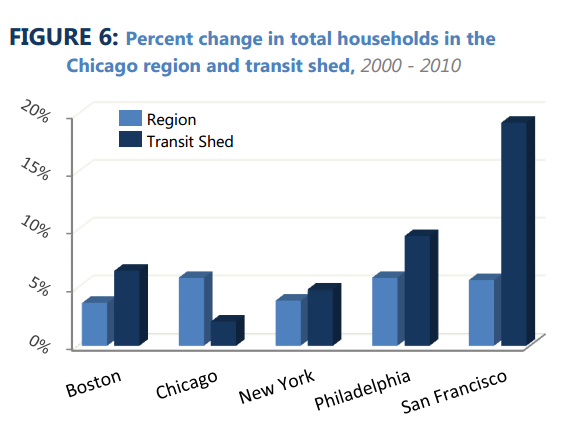
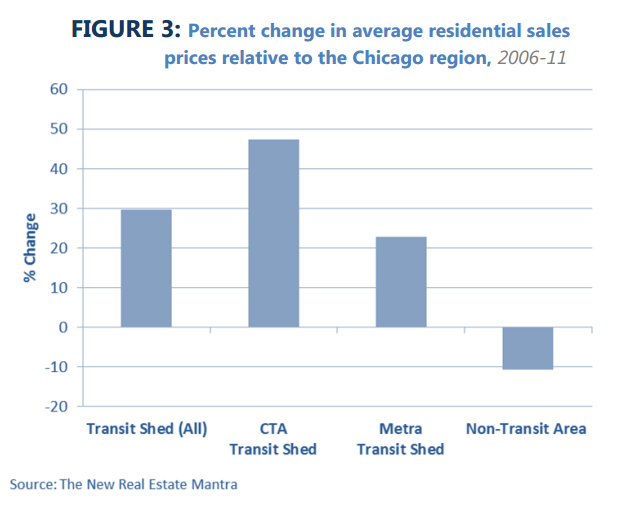
There’s a lot that’s notable in the Governor’s transit task force report (one major takeaway: Metra is just the worst), but me being me, I’m going to pick out these two graphs:

graph1 graph2

We’ve seen before that Chicago’s zoning laws essentially create a situation where the more people want to live in a neighborhood, the harder it is to actually let more people live there. As the top chart shows, more and more people want to live near public transit, especially El stops. So, in the logic of Chicago’s housing laws, that means lower growth in the number of households who can actually do it.

(I’ll disclaim here that yes, of course, some neighborhoods around public transit on the South and West sides lost population because people wanted to leave, not because of zoning, and that’s certainly a part of Chicago’s underperformance in household growth near transit. But two things about that: 1) The fact that overall housing prices near transit went up much faster than in other areas even despite stagnation in large parts of the South and West sides suggests that there is, in fact, huge demand to live near transit in most of the city; and 2) As I’ve said before, if your defense of a city’s affordability rests on highly segregated neighborhoods with relatively high crime, poor schools, and poor access to basic amenities like grocery stores, I think you’re missing the point.)

This is a huge problem for equity, of course, since forcing people of moderate and lower incomes away from transit forces them to pay more for transportation than their wealthier would-be neighbors, which is pretty perverse. But it’s also a problem because a train station is only useful to people who can get to it. Chicago has an enormous rail infrastructure that is, on the whole, massively underused, largely because we make it illegal for very many people to live near our rail lines. This is an especially egregious problem with Metra – a topic I will be taking up at some point in the future – but it’s also the case with the El.

As a result, the many hundreds of miles of railroads we have – railroads that are quite expensive to serve and maintain – aren’t doing nearly as much for us as they could be. It’s wasteful both in a monetary sense – not only because a given dollar spent on rail could be transporting way more people, but because we’d have more money if more people bought fares – and in all the social, economic, and environmental ways that having a relatively higher proportion of people taking public transit is helpful.

Anyway, I read those charts yesterday, and then this morning Steve Vance forwarded me an email from Gold Coast/Lincoln Park alderman Michelle Smith:

Dear Friends,

I am writing to inform you of a recent local zoning change in the Gold Coast I enacted on your behalf. This change resulted in a significant down-zone of the property located at 20 E. Scott Street, located at the intersection of Scott and Astor Streets.

The prior zoning classification for this parcel was “RM6.5,” which has no height restriction. Area residents, the Gold Coast Neighbors Association, and the Near North Preservation Coalition requested my assistance in adjusting the parcel’s zoning classification as a preventative measure against future overzealous development in the neighborhood.

I therefore introduced, and City Council has recently approved, a re-zoning of the property to an “RM5” classification, meaning that any new development at this site would be limited to a height of 47 feet.

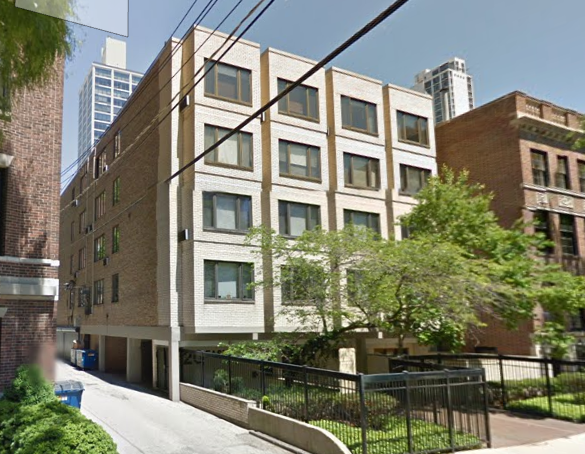
My first thought was: well, maybe this is one of those gorgeous old Gold Coast townhomes. I’m not necessarily for protecting all of those, but I don’t think it’s ridiculous, either.

But no, 20 E. Scott is this beaut:

20escott


…which is apparently so integral to the Gold Coast’s character that the government must step in to make it illegal to build anything denser.

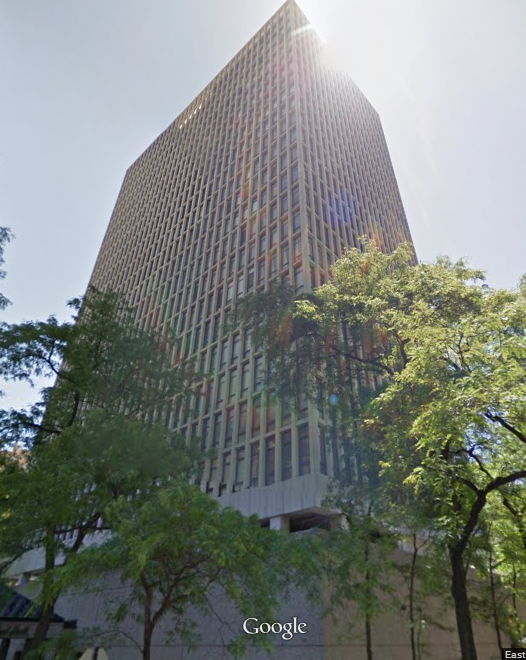
Despite the fact that the building literally across the street looks like this:

20escott1

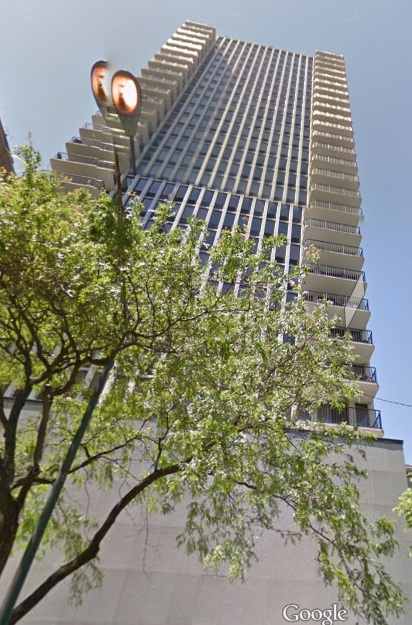
And one block down there’s a building that looks like this:


20escott2

…and so on. It’s interesting that even when the character of a neighborhood is already highrises, local well-to-do people find a reason to argue that highrises are inappropriate. Sorry! they say. I guess we’ll just have to enjoy our proximity to downtown jobs, grocery stores, the lake, good schools, safe streets, and so on, all by ourselves! Rats!

Oh, right, and it’s a five-minute walk to the Red Line.

I should make clear that I don’t think the issue here is really Michelle Smith. She’s responding to clear pressure from her constituents, which is what elected officials are supposed to do; moreover, if she enacted zoning policies that I liked, she very well might be thrown out of office in favor of someone who didn’t.

No, the issue is 1) that there needs to be some sort of organized constituent groups arguing on behalf of all the people who would benefit from denser development, because that’s how democracy works; and 2) that the system of giving individual alderman spot-zoning powers in their wards really needs to be reformed, because it almost guarantees that these decisions will be made by the people who benefit most from downzoning (the well-to-do who already live there), and will leave out the vast majority of people who benefit from upzoning (basically everyone else). As a result, even though the latter outnumber the former by quite a bit, the downzoners almost always win.


Watch Chicago’s middle class vanish before your very eyes

Note: I owe both the concept for this measurement of income segregation and much of the actual data – all of it, except for 2012 – to Sean Reardon and Kendra Bischoff, who wrote a series of wonderful papers on the subject and then were kind enough to send me a spreadsheet of their data from Chicago a while ago. The maps, however, are mine, as is all the data from 2012, and any mistakes in them or in the interpretation of the data is entirely my responsibility.

I think one reason I’ve felt less than compelled by Chicagoland, CNN’s reasonably well-made documentary series, is that its tale-of-two-cities narrative is so worn, so often repeated, that it’s become a little dull. Not the actual fact of inequality – which only seems to cut deeper over time – but its retelling.

In fact, I think the point has long passed at which simply repeating the story of Chicago’s stratification is equivalent to fighting it. For a lot of people, in my experience, it’s the opposite: an opportunity for distancing, for washing of hands. It’s a ritual in which we tell each other that this is the way it’s always been – The Gold Coast and the Slum was written about already well-entrenched institutions, after all, over three-quarters of a century ago – that these facts somehow seep out of the ground here, as much a part of the city as the lake, and that as a result there’s really nothing we can do about it.

But this obscures much more than it clarifies. Inequality has always been a part of Chicago – as it has always been a part of the United States, and a part of humanity – but the forms it has taken, and the severity of those many forms, have changed in truly dramatic ways. Take, for example, today’s monolithic segregation of African Americans: at the turn of the last century, black Chicagoans were less segregated than Italians, and not because Italians were then hyper-segregated.

Moreover, decisions made by people in the city have played, and continue to play, a huge role in determining what those changes look like. Had Elizabeth Wood received any serious support from white residents or their elected representatives – instead of meeting Klan-like violent resistance – the history of racial integration, economic integration, and public housing in this city would be very, very different. This isn’t to say that national and global factors aren’t important, since they obviously are. But neither do we lack responsibility.

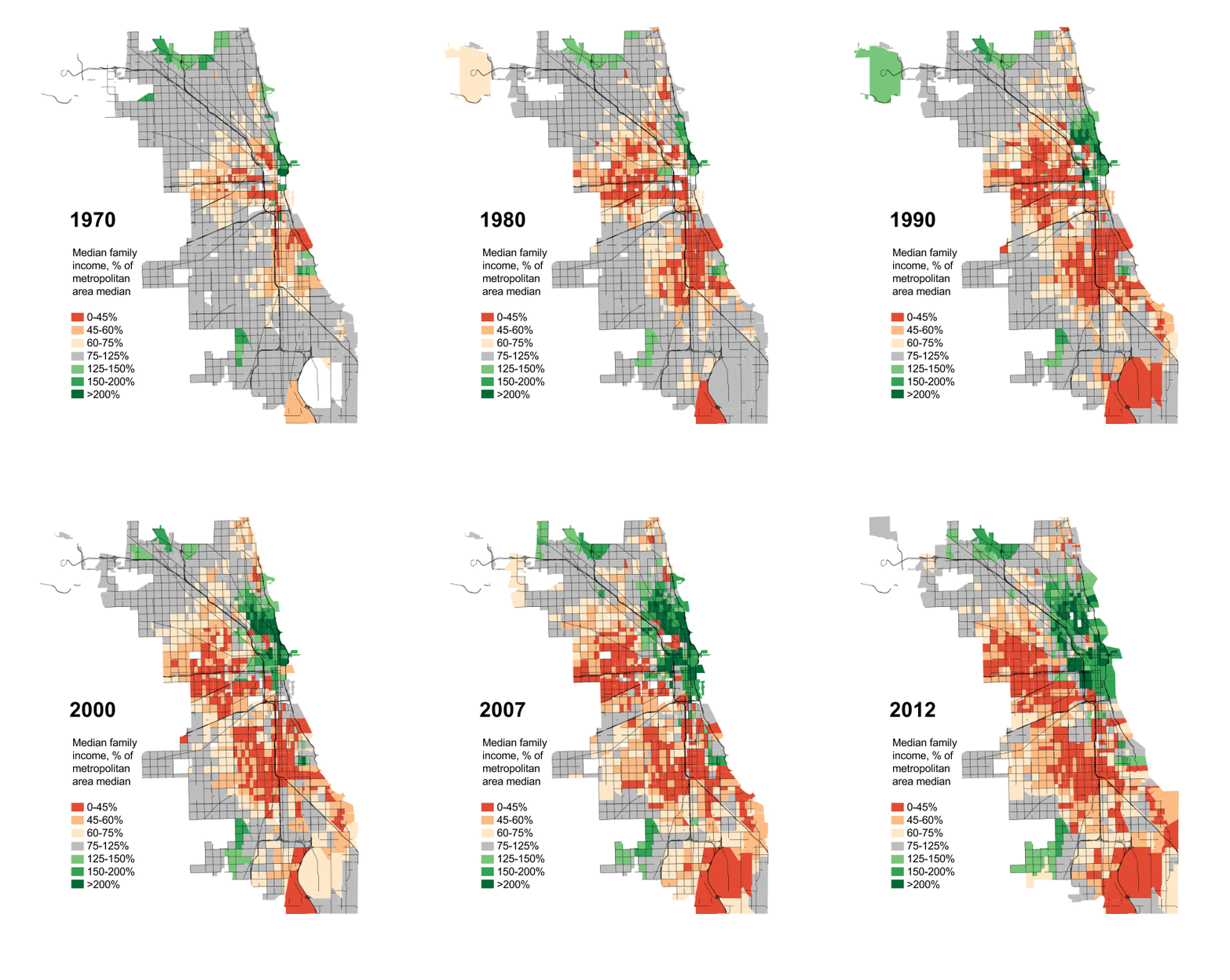
Anyway, this is all by way of introducing the following maps: their goal is not merely to depress you (you’re welcome!), but to suggest just how dramatically the reality of Chicago’s “two cities” has changed over the last few generations, how non-eternal its present state is, and that a happier alternate reality isn’t just possible, but actually existed relatively recently.

I feel relatively comfortable telling the story of how Chicago came to be so segregated by race; I’m much humbler about my ability to explain this, except inasmuch as the ever-widening ghetto of the affluent could not exist without, yes, radically exclusionary housing laws, and I will take that up separately in another post. In the meanwhile, I’ll take a page from Ta-Nehisi Coates and ask you all, if you have some background in this, to talk to me like I’m stupid: what does the literature say about growing economic segregation? Who and what should I be reading?

One last piece: the obvious and immediate reaction to these maps is to see them as a direct consequence of rising income inequality. There is some truth to that, but the researchers from which much of this data came have already discovered that income segregation has actually risen faster than inequality. So that’s not the end of the story.

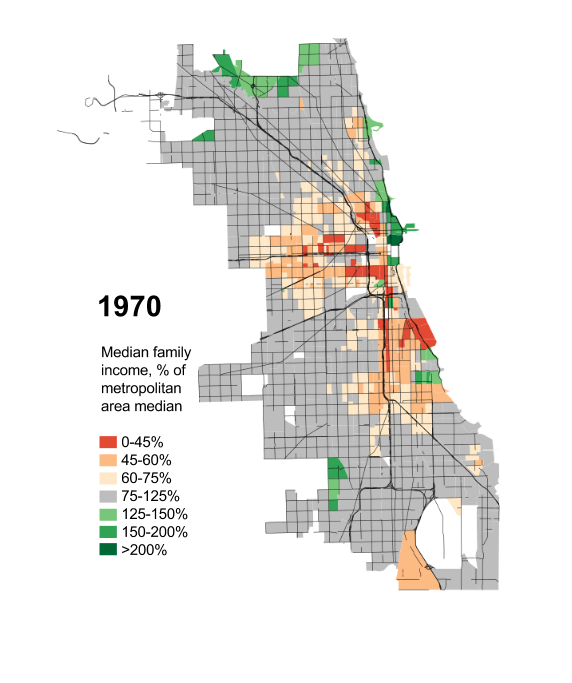
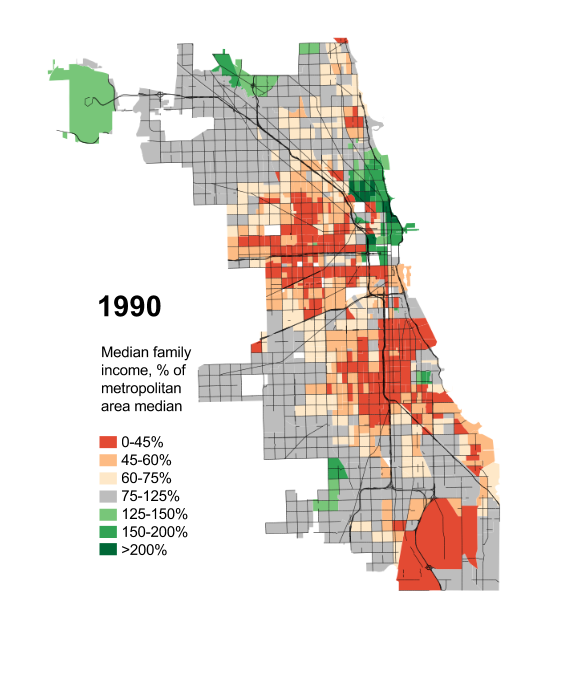
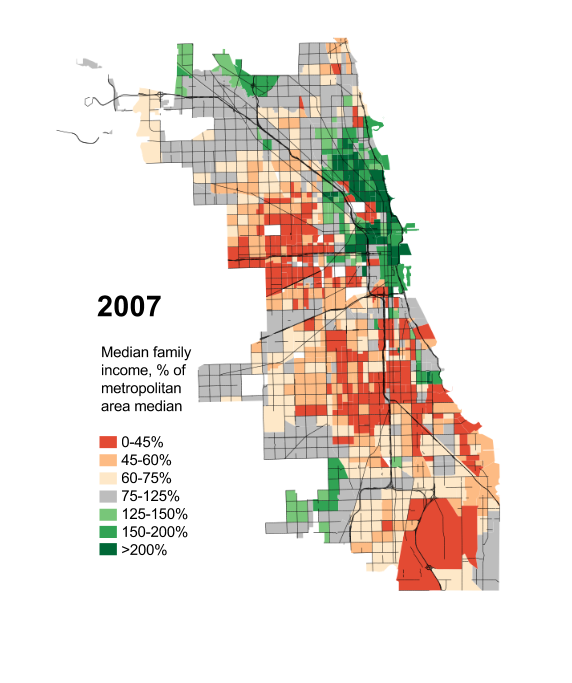
Anyway, here you go: the disappearance of Chicago’s middle-class and mixed-income neighborhoods since 1970, measured by each Census tract’s median family income as a percentage of the median family income for the Chicago metropolitan region as a whole.

Seg70aSeg80a


Seg90aSeg00aSeg07aSeg12a


IncSegGIF

Thanks

Last night I had the pleasure of talking to a captive audience about zoning at the Open Gov Hack Night. I had a total blast. Those of you I met: Thank you so much for coming, and I hope we get to meet again soon. Those of you who couldn’t come: Another time!

If you didn’t get to see it, or you thought it was just so wonderful that you want to see it again, the video is below.

The world cooperates with the timing of my blog posts

No sooner do I write a taxonomy of gentrification than a Huff Post story piggybacking on a Tom Sugrue op-ed goes semi-viral in my corner of Twitter. (Sugrue, in case you didn’t know, is perhaps the world’s foremost historian of America’s Rust Belt cities, in particular Detroit, and is featured twice on my Bookroll to the right. If you haven’t read him and you live in America – or if you plan on spending any significant amount of time living here, or even talking about it – please do yourself the favor.)

As online missives about gentrification go, this is definitely better than average. It also, though, seems deeply confused – not because it makes any unreasonable points, but because it moves back and forth between many of the compelling but contradictory arguments I went over yesterday.

To begin with, the title – “Detroit Doesn’t Need Hipsters to Survive, It Needs Black People” – suggests that the author believes in the “intrusion” and “displacement” arguments: Detroit has become a community for black people, and so they should continue to “own” it, culturally and economically.

But then later the author reveals that, actually, she has integrationist sympathies:

Detroit’s population now hovers around 700,000 people. Thirty-eight percent of its residents live under the poverty line, and the city’s median income is less than $27,000. The city has a persistent legacy of residential segregation — metropolitan Detroit is the most segregated urban area in America — which plays a role in many residents’ anxiety about being physically displaced.

She notes with approval that integration is reversing capital’s 50-year racist boycott of Detroit:

Attracting wealthier residents and new businesses to the city is not without its benefits. It’s helping to stabilize the city’s tax base, for one thing, which means more money for essential services like garbage pickup, cops and firefighters.

She also quotes Sugrue on the city’s need to do “things like revamping the public school system,” which – having read his books – I feel relatively confident he thinks is predicated on at least some measure of desegregation.

But then she veers back to intrusion, quoting a U of M sociologist who describes the process much better than I did:

Meagan Elliott, an urban planner and Ph.D. candidate in sociology at the University of Michigan, is studying the ways in which newcomers’ efforts to revitalize Detroit neighborhoods can impact long-term residents. Her focus is on “cultural displacement,” a condition that she defines thusly: “By cultural displacement, I mean a sense of place and community and feeling like you have the right to creating the vision for that community’s future. Even if people are not forced from their homes due to rising rents, they may feel like their community is less their own than it used to be.”

But then Ms. Elliott says that actually Detroiters ought to embrace their new (mostly white) neighbors, who are actually doing some good things for the city. And the article ends by suggesting that maybe Detroit’s new white mayor is going to put things in the right direction.

Remember, the title of this article was “Detroit Needs Black People.”

My point, to the extent I have one, isn’t that this is so ridiculous, but that it would be nice if we were all a bit more self-conscious about where our sympathies and priorities lie. If they conflict – as mine do – that’s totally fine. But recognizing that they conflict is a necessary first step to coming up with any sort of coherent attitude and set of solutions. It’s also the first step to (pardon the editorializing) not talking about gentrification like an asshole, and (for example) using a public forum to call people who move to an interesting neighborhood they can afford “motherfuckers,” or writing an entire column in a national magazine about how racist some guy is for wishing his childhood neighborhood hadn’t changed so much.

Crain’s Chicago…

…has republished a longer version of my post, “Zoning: It’s just insane.” From the new part:

But people have to live somewhere, and the city essentially has made it illegal to build any reasonable amount of new housing outside downtown. Most of us have probably been led to believe that Chicago’s population problems are all about the South and West sides, in neighborhoods where crime and economic issues are driving people out. But the other half of the problem is that the parts of the city among the most desirable urban areas in the country essentially have zoned population caps. Surely, you might think, a neighborhood like Lincoln Park grew its population over the course of the 2000s. But no. Lakeview? No. North Center? Completely flat. Wicker Park? Nope.

As always, the best part of this is the comments. Already someone has decided I’m a “loud-mouthed kid who arms himself with ‘facts.'” I guess I should arm myself with something else. I’m skeptical that anything will top the comment at Atlantic Cities that said, “This article is a joke to which, ‘Daniel Hertz is a masters student at the University of Chicago’ is the punchline.” But here’s hoping.

My first Atlantic Cities piece…

…is up. I’m not in love with the title, which I didn’t choose, but c’est la vie. But you should read it. Excerpt:

As Ta-Nehisi Coates has written, the ghetto is public policy. So, to an amazing extent, is gentrification, which is really only another face of the ghetto. If the market is amoral, casting aside Darwinian losers without regard for human dignity, then the legacy of urban governance in postwar America is deeply immoral, a targeted annihilation and segregation of any and all people — blacks, Appalachians, immigrants, the poor of any color or language — who happened to be of the wrong crowd. Gentrification on the scale we see it today would be nearly impossible without help from exclusionary zoning laws; nor is it clear what would have happened to the major American downtowns around which gentrification now orbits without the government removing hundreds of thousands of undesirables during urban renewal.

Dystopian urban planning in Portland

Next time you hear the word “Portland” wistfully pass an urbanist’s lips, send them this link:

Planners under the watch of then-Commissioner Charlie Hales made wholesale zoning changes to push in higher density. East Portland went on to add more than its fair share of new homes while city leaders let affluent Southwest Portland, which staged a political firestorm against growth, shrug off its burden….

In the mid 90s, Portland decided to upzone large parts of the city to accommodate residential growth. In poorer East Portland, the changes went through smoothly. But when they tried to take it to wealthier parts of town, you can guess what happened.

In September 1996, just eight months after the City Council approved the Outer Southeast plan, officials breezed into the West Hills looking to equitably spread their vision of housing growth to all corners of the city….

Residents were furious….

The pushback was too much. Within a month, Hales, who at the time lived in Southwest’s Hayhurst neighborhood, announced changes “to ensure that we don’t sacrifice the very thing community plans are designed to protect – neighborhood livability.”

Even so, the stripped-down plan continued to evoke anger.

Amanda Fritz, then a planning commissioner who today serves on the City Council, fired off an indignant email to the manager of the Southwest plan in 2001. Fritz, a resident of West Portland Park neighborhood, was upset about an area that planners wanted to zone for townhomes. She thought larger lots would better serve families with children.

Oh, would they, Amanda Fritz? Thanks for the input. And for the people who can’t afford single-family homes on large lots? Where should they raise their children? When they move to a far-flung, car-dependent suburb, will you harangue them for not living in a chic inner-city neighborhood with bike lanes?

At least, of course, those low-income people got denser, more amenity- and service-rich neighborhoods, right?

While city leaders eliminated growth targets for Southwest Portland, new zoning in east Portland ushered a massive influx of homes and people. New services to support the growth never materialized. That made conditions particularly difficult for the residents of Southeast Schiller Street…. Schiller Street is still gravel….

On 122nd Avenue, the tract’s western boundary, city planners justified zoning for as many as 65 units an acre because TriMet’s No. 71 bus line was nearby. But frequent bus service hasn’t arrived. To the contrary, the 71 rumbles north and south 109 times each weekday, down from 121 in 1996.

The tract’s eastern border is 136th Avenue, a two-lane road where city officials increased zoning to as many as 32 units an acre but never installed a sidewalk. One will be built next year following the death of 5-year-old Morgan Maynard-Cook, hit by a vehicle while crossing the street in February.

So the planning process has been entirely co-opted by the privileged. The moral, I think, is that there is a problem with the process. How do you design a democratic planning process that’s harder to co-opt? I’m not sure. More thoughts later.

Classism in zoning and coalitions behind streetcars

1. In Wicker Park, neighbors are opposing a four-story, 30-apartment building on the grounds that it’s too “damn big,” despite being in a neighborhood full of three- and four-story apartment buildings, and being right next to a dozen-story highrise on what is, by some distance, the busiest corner on the Northwest Side.

In Irving Park, neighbors are opposing turning an already-existing church building into apartments. Quoth the neighbors:

“This is a single-family-home neighborhood,” Engel said, questioning whether Sonco had considered another use, such as townhomes, which would be “more simpatico with the neighborhood.”

The size of the proposed apartments — 700 to 800 square feet — “might imply more of a transient nature,” he said. “It’s not quite SRO, but it’s not far from it.”

“Renters don’t contribute to community groups,” which have been instrumental in combating crime in the area, said Caperton. “I’ll do everything I can to keep another rental unit property from coming into that place.”

Your trusty blogger will translate:

“This is a well-to-do neighborhood,” Engel said, questioning whether Sonco had considered building homes for wealthier people, which would be “more simpatico with the neighborhood.”

The economic class of the proposed tenants  “might imply more of a transient nature,” he said. “It’s not quite SRO, but it’s not far from it.”

Poor people don’t contribute to community groups,” which have been instrumental in combating crime in the area, said Caperton. “I’ll do everything I can to keep more poor people from coming into that place.”

I will say, because I guess it needs  to be said, that we live in a free country and everyone is free to tell everyone else what they think they should do, and what their ideal world looks like. If it looks like all the poor people have to live very, very far away from you, fine.

But it is simply morally repugnant for the government to be playing economic segregationist. And that is exactly what they’re doing. This isn’t just about failing to actively create affordable housing; this is about using the force of the law to prevent the private market from creating working-class housing. It’s disgusting, and it needs to stop.

2. The Cincinnati streetcar is saved!

Although this is not the most popular thing to say, the calculus over whether or not this is a good thing is complicated. On the one hand, as I wrote yesterday, the streetcar is close to useless as a transportation project; even if it’s extended to a length where it would be faster to wait and get on it than to walk from one end of the line to the other, it’s a colossal waste of money. The same time savings could probably be achieved for a tenth the cost with improvements to buses, and the chance that “rail bias” will bump ridership on a tourist trolley enough to make up the difference is basically nil. (Of course, at this point, it may be cheaper to continue than cancel the project – but that doesn’t make it better as a poster child for Rust Belt urban planning.)

The generic response to that sort of argument, when it’s made by people like Stephen Smith at Market Urbanist and Jarrett Walker, is to admit that there’s little transportation benefit and then claim that’s not the point: instead, the real purpose of streetcars is to promote development.

But if that’s the case, then I’m not inclined to be any more sympathetic to the project than I am to other enormous public expenditures to boost already-gentrifying districts.  If I think that Rahm Emanuel is halfway criminal for spending $40 million on a basketball stadium on the edge of downtown Chicago, then why is it any better to spend $130 million for tourists in downtown Cincinnati – which, although it’s got miles to go before it reaches the elite-playground status of the South Loop, is clearly one of the few parts of the Queen City with market-based redevelopment momentum?

And yet. And yet I’m still at least 65% happy about how this turned out. Because even if it’s terrible urban planning, the streetcar’s victory is a victory for a coalition of people who believe in making investments in transit and the inner city. That coalition may be skewed in favor of gentrifying neighborhoods and elitist projects, but I still believe that even co-opted urbanism is better than the status quo.