Two notes

1. The news out of Cincinnati and LA reminds me, yet again, how miraculously sensible the Ashland BRT proposal is. At a time when it is in vogue – even in LA, which, despite its reputation, is probably building more and better public transit than any other place in the country right now – to spend gobs of money on vanity transit projects aimed at attracting development instead of actually giving people better transportation options, Chicago’s major transit infrastructure programs are about bringing already-existing lines up to good repair and expanding their capacity, and creating cost-effective large-scale rapid transit along one of the most important corridors in the city.

LA’s downtown streetcar – which would crawl through mixed traffic in a four-mile loop, barely two miles on its longest side, and therefore be practically useless for actual commuting or traveling – is going to cost at least $125 million, or ~ $30 million a mile. Cincinnati’s half-dead streetcar project – also a four-mile loop, also basically pointless as far as transportation goes – is $133 million. Ashland BRT is 16 miles of El-quality transit for only slightly higher cost. I don’t know what else to say about this, except: yay. And: man, does this need to actually happen.

2. I think this is a really important post at Austin Contrarian:

Brian mainly advocates policies that increase human capital (let’s give our young people better schools/education) and income (let’s draw better paying jobs).  Or put more simply (perhaps too simply), he thinks the affordability problem is mainly about making people wealthier. He’s “skeptical that we can ‘build our way’ to greater affordability in Austin, especially without an equally ambitious strategy for human capital development–i.e. investing in people so they can afford to live and raise families here.”

[But f]reezing the housing supply while raising wages will attract higher-skilled workers and push out lower-skilled workers, turning the city’s real estate market into a giant sorting machine.

There is a tendency on the left and the left-leaning center – one that I certainly share – to believe that all of our major problems are about the distribution of resources. Crime will go away when people have legal economic opportunities that are more attractive than selling drugs or stealing. Schools will be better when they’re fully paid for, and the children in them don’t have to worry about money-induced stress at home. Housing affordability won’t be a problem when everyone is paid a living wage.

On crime and schools, I’m pretty much on board. But housing really is different: if there are a limited number of homes within commuting distance of a major source of jobs and amenities, then those homes will go to whoever the richest people are. It’s a zero-sum game, in which a rising tide doesn’t lift your boat unless someone else’s boat sinks. And if the richest people get to congregate in one corner of the city, then they will have the best amenities, job opportunities, schools, and so on – so while a higher wage might make your neighborhood more livable, it won’t get rid of the fundamental problem of inequality: not just of outcome, but of opportunity.

The only way out of that trap is building more housing. No one wants to hear that (except, I guess, developers and the tiny brigade of Gated City-ites), but it’s true.

2.1 We Need to Build More Housing, In One Chart (h/t Austin Contrarian):

TX prices

What you’re looking at is housing prices in the four largest Texas cities. All four are going through major housing booms; Dallas, Houston, and San Antonio allow new development and housing units relatively easily; Austin does not. Starting on the left side of the chart, you can see that new development in Austin is more expensive than the other three cities – about $50 more than Dallas and $150 more than San Antonio. But as we move to the right – to older buildings – the gap gets much bigger. By the time we’re looking at housing that’s at least 70 years old, median Austin rents are at least $100 more expensive than Dallas and $300 over San Antonio.

What’s happening is that with new development, there’s a floor to how cheap rents can be – it’s expensive to build apartments, and no one will build them unless they can get rents that will cover costs. With older buildings, though, all that matters is the cost of maintenance, so they should be relatively cheaper. But if developers are blocked from attracting high-rent tenants to new development, they’ll attract them to older buildings by renovating them to luxury-market standards. This is called “filtering up,” and it’s why preventing new luxury development doesn’t stop gentrification – it exacerbates it.

Is housing about community or commodities?

This is definitely not an original thought, but it is under-acknowledged: We have a conceptual problem with housing. We have a conceptual problem, which is this:

1. Sometimes we think and talk about housing as if it were a communal good – not even a communal good; good is too transactional. We think and talk about housing in terms of communities: communal rights, communal values, communal history, community preservation and protection. We talk about preserving the character of our neighborhoods, about not allowing businesses we consider undesirable, or people we consider undesirable, or types of buildings we consider undesirable. People feel very strongly about this, and the assumption that there ought to be community control of housing and housing development runs so deep that usually no one even thinks to argue in its favor.

2. Sometimes we think and talk about housing as if it were a commodity. Housing units are things to be bought and sold on the open market, like cars or furniture, and like cars or furniture the quality of housing is stratified into many different price points for people of different financial means. And just like no one thinks you’re owed a nice car, no one thinks you’re owed a nice housing unit, so if you can’t afford to live in a place with decent schools or low crime and you complain, it sounds about as silly as complaining that you can’t afford a new Infiniti instead of a beat-up Kia. You’re on your own. But once you do buy your housing unit, it’s yours, and the incursion of other people onto your private property is as much an offense as if someone thought they could repaint your car without asking permission.

I should point out that although Perspective Two is largely the province of conservatives and market-oriented liberals (who, together, make up the vast majority of Americans), Perspective One is promoted by pretty much everyone when it suits them. Leftists and even market liberals appeal to it when they talk about social responsibility with regards to homelessness and fair housing and gentrification; otherwise market-y urbanists talk up building community and placemaking and locally-driven planning; and laypeople (and non-laypeople!) across the political spectrum lean on it to argue for or against any given piece of development in their area.

The problem here isn’t that the cognitive dissonance annoys me, or even that there’s no way to rationalize some combination of these ways of thinking. The problem is that a) the way in which we have chosen to apply these clashing ideas to policy tends to maximize benefits to the already privileged, and b) the existence of two competing definitions of what housing is leaves people who would like to change problem a) on shifting and unstable argumentative grounds.

As far as a) goes, I marshal these pieces of evidence: We apply communal housing standards to planning and zoning, so that municipalities can ban apartment buildings or even small houses or dense construction or otherwise outlaw the type of housing that moderate- to low-income people might be able to live in, or limit overall supply to preserve the exclusivity of a neighborhood or entire city, thereby raising property values to unaffordable (and, more importantly, non-market-rate!) levels. All these laws rest on the premise that what happens down the block, or on the other side of town, should be at least partially under community control, even if that means putting major restrictions on private property rights. On the other hand, we apply commodity standards when it comes to housing access: even during the triumphant heyday of public housing, those who argued for a broad social housing commitment were defeated by those who believed government ought only to step in with public or subsidized housing as a patch on the most egregious market failures. And, over the past fifty years, even that obligation has been rolled back to ever-shrinking protections for people in a metropolitan scene that is radically more segregated by income – both within metro areas and across them – than it was a few generations ago.

So people who believe that the government should, at the very least, not make things worse for society’s disadvantaged are getting it from both sides. In response, though, fair housing advocates (with some exceptions) overwhelmingly focus their rhetoric and policy prescriptions on communal arguments. This makes sense in some respects, since the vision of housing access as a right is, at bottom, almost impossible to reconcile with the idea of housing as a commodity. But if I have nothing to say about the commodity perspective except that it’s wrong, my arguments are going to fall on an awful lot of deaf ears, attached to people who are primed (when it suits them) to think that talking about the right to live in a decent neighborhood is as ridiculous as talking about the right to drive a nice car. At the same time, focusing all my energy on promoting a communal vision of housing makes it much more difficult for me to attack local community control when it’s used for radically anti-progressive goals – ones that are pretty hard to square with any reasonable conception of legitimate state interests.

What to do about this? It seems to me like there’s quite a bit of hay to be made by turning the usual fair housing script on its head and talking about justice in terms of commodities. To begin with, it allows us to much more effectively attack zoning provisions whose regressive effects on not just the poor, but the middle- and working-class, are massively underappreciated. And, unlike communal arguments, the commodities perspective has the additional benefit of making many (powerful, at least compared to fair housing activists) developers the natural allies of fair housing policy, since they stand to gain if restrictive zoning is lifted. Moreover, it highlights the truly perverse circumstance of the privileged using government activism to protect their interests, rather than focusing on ways in which we would like government activism to support a relatively small but disadvantaged proportion of the electorate. Especially in places where the privileged beneficiaries of exclusionary development law can be made out to be a small elite – San Francisco, very wealthy suburbs, etc. – the former suggests a more natural majority coalition in favor of progressive legal changes.

It’s absolutely true, of course, that government activism is necessary to support those who will never be able to afford market-rate housing; but a) switching between commodity and communal housing arguments is obviously a workable solution – I’m arguing that we ought to be using the commodity perspective more, not necessarily exclusively – and b) there are examples of commodities for which we recognize the imperative of government support: food, for example.

In any case, I was heartened this last week to see the seeds of this sort of thinking among fair housers: in this Nation essay, for example, which argues for more market-based development to drive down prices; and in a recent San Francisco referendum on a large waterfront housing project, lower-income districts were some of the only ones to vote in favor of increased housing supply. I’d love to see more.

Housing affordability: distribution and quality matters.

It’s true that choosing a place to live not only determines your housing costs, but also your transportation costs, and so talking about “housing affordability” ought to include both. It’s also true, I guess, that amenities in a given city might lead people to be willing to spend more of their income on housing and transportation than they would in another city, and so having a given percentage of income – 30%, whatever – pegged as the national “affordability” line is not ideal.

But even so, I feel like this Atlantic Cities piece about an Urban Institute “adjustment” to standard calculations of affordability is missing an awful lot. The problem is basically that most housing is not sold at median prices, and most people do not earn median incomes, and so any index that involves just comparing the median home price with median income isn’t super helpful. The whole point, really, is how both of those numbers are distributed, both in a high-low sense and in a geographic sense.

This is where I think Ed Glaeser’s argument that there are actually two affordability crises in the U.S. becomes really important. Glaeser (in Rethinking Federal Housing Policy) says that the two crises are: A) the crisis of supply restriction in elite cities and suburbs that artificially inflates prices above the point where middle-income people can afford them, a crisis which, absent those restrictions, would not exist; and B) the crisis of income among the poor, who can’t afford market-rate housing no matter what. These median-v.-median comparisons might be helpful for illuminating crisis A, but they clearly have nothing to say about crisis B.

But even so, I don’t know that I would use median housing prices, even on crisis A. Why? Think about a city like Chicago. The median housing price sits below a bunch of supply-restricted, highly-desirable neighborhoods, and also above some neighborhoods with rock-bottom prices plus terrible local schools, no quality retail options, poor access to jobs, and high crime. I don’t find it very instructive, from the Having a Decent Place To Live Is a Human Right, Or At Least A High-Priority Issue For Any Decent Government-perspective, to have a bunch of really unacceptable housing – housing that is not just inconvenient somehow, but which, were you to live in it, would actually drastically worsen the life paths of you and your children – dragging down the median housing price. This applies also to analyses that try to compare the number of housing units affordable to low-income workers to the number of low-income workers. What does that housing look like?

I guess what I’m saying is that housing quality matters. Housing textbooks, as far as I’ve seen, make a big deal of the fact that “housing quality” supposedly isn’t an issue any more, because the number of housing units without plumbing or whatever is very, very low now. But it seems that in an urban landscape where ghettoization and economic segregation have skyrocketed at the same time as “housing quality” has vanished as an issue, neighborhood quality has basically taken its place. And is no less problematic; maybe more so. So when the Atlantic Cities declares that they have a new metric that shows that coastal cities are “less unaffordable” than we thought, my response would be that no, they’re almost certainly much more unaffordable than conventional statistics show.

Of course, there is also some value in having an easily-understood  number that allows laypeople – or legislators, or regulators – to quickly gauge housing affordability. I don’t want to demean this work; it’s obviously important. But people who care about this ought to be working towards some way of better conveying affordability metrics that take into account distribution and quality.

Things about which I have to write, so I don’t get on the train Monday thinking, I really need to write about that

1. Two worthwhile pieces from Aaron Renn: “Well-Heeled in the Windy City” at City Journal, and “My Presence Is a Provocation” at New Geography. The question of what obligations the political class of a city like Chicago, or New York, or wherever, feels towards those residents, and those neighborhoods, that will never be glamorous is an important one, and I think it goes way beyond Emanuel or Bloomberg or Gilbert personally.

2. Moody’s finds that charter schools can cause a fiscal crisis for regular public schools just as Catalyst notes that Chicago’s neighborhood high schools are having an enrollment crisis. Which precipitates a fiscal crisis. Not much to say here other than Oy. Actually, there is, but I already said it: Is this the educational marketplace that charter backers had in mind, or are we just spreading students thin to the detriment of their education?

3. Chicago’s getting an independent budget office! Thank GOD. This is important because in instances when someone wants to, say, lease our parking meters, an independent budget office is pretty much the only outfit that might warn us, with the numbers to back up the claim, that such a lease would be a disaster. Basically, if this thing works, we will be much, much better-informed about the potential effects of future proposals before they happen. Then again, it may not work. It’s apparently getting $500,000 and a staff of six, which is double what Ald. Ameya Pawar initially proposed, but one-sixteenth of what Scott Waguespack seems to think is necessary. I’m not really in a position to evaluate. Although I will point out that New York City’s Independent Budget Office has a staff of 39.

4. A great four-part series on dream public transit reforms at the Beechwood Reporter. Main thing I would like to emphasize: METRA COULD BE SO GREAT BUT IT’S NOT. OY. Metra, and also BRT. Improving the first – getting trains to run at least every 15-30 minutes – and building a moderate-sized network of the second would pretty much revolutionize rapid transit and access in Chicago without digging any expensive tunnels or anything.

“Sprawl, A Compact History”: The Liveblog, part 3

A more curated set of my reactions, because the point-by-point thing can get kind of tedious. This time we cover Bruegmann’s history of anti-sprawl campaigns.

The first is that I have made a certain peace with this book, having realized that what really animates Bruegmann, I think, is less the sort of policy questions that I take to be of major importance, and more a kind of cultural and aesthetic criticism about What We Talk About When We Talk About Sprawl, or thereabouts. And he’s on much more solid ground making those kinds of anti-elitist critiques about the use of the word “sprawl,” tying it to the history of elitist urban reform programs, disdain for the striving mass middle class, and all of that. Then again, there’s a certain amount of “well, yes”-ism, if you get my drift: I have the same thoughts about this as I had about other critiques of urbanism’s progressive cred, which is that the general rule is that basically all ideological and political projects are used by the governing class for their own aims, and pointing out that some particular project has been co-opted isn’t really that interesting or damning. Then again, there are clearly a number of people in the urbanist community for whom this would be news, that many things labeled “urbanist” are in fact very problematic. So okay.

I will say that making this sort of cultural criticism, especially if you are (as Bruegmann is) an academic in a rarified urban setting (Chicago), carries the risk of mistaking cultural power in upper-middle-class social circles for the only, or the most important, kind of power. That mistake seems to drive a lot of Sprawl. Time after time in this section, Bruegmann slips in – as if it were unimportant – that he actually comes down on the side of the anti-sprawlers on their most fundamental criticisms of postwar urban policy. “There are probably good reasons to provide more subsidies to some forms of public transportation in the United States today,” he says at one point. “A very good argument can be made that automobile owners should pay more to compensate for the costs to society associated with their driving,” he says at another point. Really? Then why write an entire book defending the status quo?

The answer, I think, is that Bruegmann and I have very different senses of what the status quo is. For Bruegmann, the status quo is the politically correct thought you would find at a professor’s dinner party in Chicago, or in an academic journal. It’s absolutely true that in those contexts, the anti-sprawl position is pretty hegemonic. Thinking within those contexts – and only those contexts – is the only way it makes sense to write something like, “By the middle of the 1990s the anti-sprawl forces had become quite powerful,” as he does.

Because from almost every other perspective – the laws that govern what development looks like, the policy positions of the vast majority of elected and unelected officials in the United States, the mainstream practices of the development industry – anti-sprawl forces were anemic in the 1990s, and are only somewhat less so today. For Bruegmann, looking at the leftist bons pensants, the country has gone too far in the anti-sprawl direction, and needs a counterweight; for me, looking at public policy and changes in the actual urban environment, we haven’t gone nearly far enough.

“Sprawl, A Compact History”: The Liveblog, part 2

So after the last installment, I actually raced through the next 80 pages or so in two days, and my brain was overflowing with things to say about them, but life has a frustrating way of proving that the things you are excited about doing are, as the government shutdown managers would put it, non-essential.

But here we go. I’m now halfway through the book, and have finished all of Part 1, Bruegmann’s history of sprawl, which is a nice place to stop and reflect before going on to new themes.

These last 80 pages largely pick up where the Introduction and beginning chapters left off, which is assembling the evidence that sprawl is a normal (in the sense that it has occurred in every era of human history, and in nearly every civilization), and healthy, process for economically maturing cities to go through, and that most of the received wisdom in urbanist circles is either exaggerated or entirely false.

It’s an odd and frustrating read, alternating between important and incisive critiques of anti-sprawl motifs – usually cultural or aesthetic – and factual claims that it’s hard to believe the author believes accurately represent reality. It feels a bit too often like the presentation is being shoehorned into the thesis, and there are a few moments when the author sort of winks at the reader – so fast you could miss it if you weren’t looking – to indicate that he knows he’s not being entirely fair. More on that next time. This time, just a few notes on Bruegmann’s “history of sprawl,” which takes up the rest of Part 1.

  • Bruegmann tries to take on the popular urbanist narratives about the causes of urban sprawl; I guess it’s worth reminding people about the big picture, or part of it, which is just economic growth: People consume more resources (i.e., a car, a detached house) because they can. For most people, making the jump to a single family home and their own car is a triumph. B. is right that urbanists who don’t want to be assholes shouldn’t sneer at that, whether or not those are the material things they happen to prize most.
  • But we need to be careful about writing things like: “Another common explanation of…the rise of sprawl is that it was caused by white flight fueled by racism. Although no one would deny that race has played a key role in many aspects of American life, it is significant that urban areas with small minority populations like Minneapolis have sprawled in much the same way as urban areas with large urban areas like Chicago.” First, it is unfortunately characteristic for Bruegmann to dismiss the entire history of race-based urban policy with the single clause quoted here. (This is the sort of wink that suggests B. actually knows the immensity of what he is omitting, but it is not fair to assume that all of his readers do.) Second, this book’s perpetually loose definition of “sprawl” is doing an awful lot of work here. It is certainly true that the growth of suburban-style communities did not anywhere depend on racial animosity. But it’s also true that the counterpoint to the growth of those communities – that is, the collapse of inner-city communities – is highly correlated with racial politics. The parts of inner-city America that have had catastrophic population declines are, in fact, largely those neighborhoods that became segregated black ghettoes during the first or second Great Migrations. Given that Bruegmann has taken pains elsewhere to point out that suburban sprawl has had effects on urban neighborhoods, it’s curious he doesn’t feel the need to make that point here.
  • About claims that government policies – redlining, highway construction, zoning, and so on – have furthered sprawl, Bruegmann says: “None of these arguments are very convincing.” But he brings up arguments about transportation spending and highways during his discussion of federal influence, and dismisses them by pointing out that state and local governments had plans to build even before federal money came; then when he gets around to talking about state and local influence, he forgets (?) to bring the subject up again.
  • Bruegmann claims that “the self-amortizing mortgage…could have benefited any homeowner, whether in the central city or suburbs,” before admitting only a few lines later that in practice, banks refused to lend to “poor and racially changing neighborhoods,” and then justifying it by claiming that “a great deal of evidence [indicates] that property values did tend to drop as neighborhoods got older and experienced ethnic or racial turnover.” Well, yes. But why did those prices decline? Because in the context of mid-20th century America, a “changing” neighborhood meant a place that, in a matter of a few years, would be an all-black ghetto deprived of capital and given inferior city services. Because of, you know, racism. And, in fact, nearly the entire central cities of many American metropolises were redlined on those grounds during that period, up through the 1960s. How exactly does this jive with the claim that race played little role in the decline of urban areas?
  • Staying on the subject of government influence, what is with the admission – again, given a single sentence – that “in city after city across the country, old zoning codes have been downzoned time and again to reduce the ultimate possible population and prevent existing densities from rising”? Should that not maybe come up when we use changing population patterns as the evidence for people’s “preference” for sprawl? If cities have capped their populations, that would seem like a relevant confounding variable.
  • The book continues to suffer from not considering the idea – which is not exactly obscure – that car-dependence is a line, maybe the only one, that very clearly divides one type of development from another. As a result, a lot of arguments get confused. For example, at one points he claims that cars can’t possibly cause sprawl, because “the Los Angeles region has become dramatically denser since the 1950s in an era when the vast majority of people have relied on the private automobile.” It’s true that there isn’t any linear relationship between car-reliance and low population density (look at Houston); but that doesn’t mean cars are irrelevant. There is absolutely an upper limit to the density at which cars can function in any kind of efficient manner, and designing for maximum car efficiency almost always makes it much more difficult to design for efficiency or safety for pedestrians and public transit users. There is absolutely a trade-off involved, and one that has very serious consequences for the low-income and anyone else who can’t or doesn’t want to drive; but Bruegmann’s resort to population density as the ultimate arbiter of sprawl in this case papers that over.
  • Later, apparently deciding that cars are a good proxy for sprawl – this sort of goalpost-moving, depending on what point needs to be made, is annoyingly common – Bruegmann argues that the advent of personal automobiles is a good thing, since it improves mobility and “allowed a dramatic expansion of educational and employment opportunities.” Maybe. But why doesn’t he even mention the difference between mobility (how much physical ground you can cover) and access (how many resources you can get to)? Cars absolutely improve mobility, but highly car-dependent development tends to work against access, since residential, institutional and commercial uses are separated and you have to cover much more physical ground to get to them than you do in an urban area where the pharmacy, grocery store and neighborhood school are all within half a mile of your house. The costs of car-based mobility are also radically higher than any other form of urban transportation, which reduces access to anything that requires the money you just spent on insurance and gas. And none of this applies to people who can’t or choose not to drive because of their age, disability, or income level, whose access and mobility are dramatically cut down by car-dependent development. That’s how you get a situation where the average low-income person in the Chicago metro area can only get to 14% of the region’s jobs within a 90 minute public transit commute.

I don’t mean to be quite so relentlessly negative; this is still a book worth reading, especially if you feel yourself nodding along with most of my criticisms, because it forces you to consider which of your feelings are cultural prejudices, and which are actually linked to some non-aesthetic conception of the good. I’m generally on board with the American liberal idea that the freer people are to choose how they want to live their lives, the better, and my own ideas about the good life shouldn’t matter in those calculations. It’s worth remembering, if you feel the same way, that suburbanization, broadly speaking, enormously increased the average person’s choices about how to live. But it’s also worth remembering – if you find yourself nodding along more often with Sprawl – that car-dependent development has had a dramatically shrunk the options available to many other people. The way forward, I think – and so far I’m disappointed that Bruegmann hasn’t moved this direction – is to acknowledge that the argument should not be between urban elitists and defenders of the status quo. It should be about finding the policies that best allow people to live their lives the way they want. Ultimately, single family homes and decent public transit access are not mutually exclusive. More on that in future installments.

Data Points for Glaeser, Krugman et al

On the train coming home from school today, I came across two headlines on my phone. Headline number one:

“The Great Growth Disconnect: Population Growth Does Not Equal Economic Growth,” at The Atlantic Cities. Upshot: There isn’t really any correlation between metro areas that are becoming richer and those that are becoming more populous. This goes against all sorts of economic theory and common sense and observed history, but is a pretty well-established recent trend, and also is actually a major contributor to the divergence of income across the country.

Headline number two:

“Development Watch: Lincoln Park,” on Curbed Chicago. Here we learn that a developer wants to build a six-story apartment building in the highly desirable neighborhood of Lincoln Park, just north of downtown Chicago, replacing a three-story building and increasing the total number of dwelling units on the property from 43 to 60. But the neighbors – whose annual income, if memory serves, is somewhere in the vicinity of twice the average of the Chicago metro area as a whole – don’t want to have six-story buildings around. And so probably the building will get downsized, and fewer people will get to live in one of the highest-quality-of-life neighborhoods in the city, meaning more people will have to choose between living in a less-desirable neighborhood, or not living in Chicago at all.

Most of us understand externalities, and the need to regulate them. We understand, for example, that a neighborhood’s right to determine its own development patterns does not include, say, building an industrial facility that dumps its toxic waste downriver. Why should it include preventing people who want to live there from living there, when there are national consequences to this kind of behavior if every such neighborhood engages in it?

Book Liveblog in Action

Not actually an update on Sprawl, although I have reams of notes to deliver at some point this week.

BUT: I was walking down Cottage Grove in Woodlawn today, heading to the Green Line, when I realized that I was literally passing through the middle of a very stark example of the sort of New Urbanist Urban Renewal that I wrote about last time. Specifically this:

It is hard to imagine large, invasive, confiscatory government programs to retrofit the suburbs along urbanist lines as long as the residents affected are members of the middle class. It is much easier to imagine that happening to a relatively poor community in, say, an auto-dependent inner-ring suburb along a light rail line and in a potential path of gentrification. In a sense, that precedent has already been set in Chicago, with the demolition of public housing towers and their redevelopment as urbanist-style mixed-income housing. The diagnosis of the towers’ failure, after all, wasn’t just about the sin of segregating poor people from the rest of society; the popular narrative is that the form of the buildings themselves made it impossible for them to house decent communities.

This is the west side of Cottage Grove, right around 62nd Street:

It’s a little hard to see – the light was pretty harsh – but this is Grove Parc Plaza, a 500-some unit public housing complex from the late 1970s. It used to run on both sides of Cottage Grove from 60th to 63rd, but now maybe a third of the project has been torn down. Directly across the street from these buildings is Woodlawn Center South, part of the mixed-income complex that’s replacing it:

Design-wise, Grove Parc Plaza is nothing stellar, although it doesn’t appear as cheaply built as some of the worst of the high-rise projects. In fact, it looks solid, if inelegant; certainly some new paint, a bit of landscaping, and maybe some added details around the windows and doors or a cornice would make the buildings more appealing. Woodlawn Center, on the other hand, is everything modern urban housing is supposed to be: a solid wall addressing the street, human-scaled but dense, bright, lots of windows.

Chicago Weekly, the University of Chicago newspaper, puts it this way: “Technically, the remnants of Grove Parc lie just across the street on 62nd and Cottage Grove, but it now looks so different next to these modern visions of subsidized housing that it might as well be in a completely different world. Shabby and brown, faded signs out front state the now defunct number of the housing manager’s office, a parking lot of cracked-up tar.”

Certainly, the complete reconstruction of this stretch of Cottage Grove makes it look more attractive – or, at least, more truly mixed-income, or, one more step away from euphemism, more middle-class – than it might appear if Grove Parc had just been rehabbed and marketed as mixed-income housing. But it’s also notable that the design excuse, the same one that was used to level huge parts of Bronzeville and other neighborhoods in Chicago and around the country, has the ancillary benefit to the city of removing all of the poor people who used to live there. Sure, the new buildings will also have low-income units. But the process of starting from a blank slate, of uprooting existing residents and physically demolishing their homes, obviously changes the sense of community ownership, and the fact that the CHA loses track of many of those residents before their new homes are ready can’t hurt, either.

It’s also the case that older buildings, in most neighborhoods, are the bread and butter of affordable housing in otherwise desirable areas: most people are willing to put up with floors that creak a bit, or smaller kitchens, in exchange for access to jobs, amenities, and education, if their budgets won’t let them have both. Destroying older buildings because they don’t fit the right design profile, then, reduces affordable housing even outside the context of subsidies.

So: New Urbanist Urban Renewal in action. I’d love to hear any other examples people can think of in comments.

“Sprawl, A Compact History”: The Liveblog, part 1

Can one liveblog a book? Particularly a book that was published several years ago?

I’m motivated to try, anyway, because of the minor blogging fiasco (although even a regular-sized blogging fiasco, I think, is the smallest kind of fiasco that can exist) that became of Rethinking Federal Housing Policy by Glaeser and Gyourko, which was a fantastic book, and about which I’ve been meaning to write for a month. But I haven’t, and when this week I finally sat down to do it, I had forgotten half of what I wanted to say.

So this time we are being proactive.

So far I have only read about 10% of Sprawl, which comprises the Introduction and a few chapters on the history of sprawl up to World War One or so. So let me say up front that I am expecting some of the questions or objections I raise to be answered or ameliorated further on, in the 90% of the book I have not yet read.

But still: particularly the Introduction, I think, contains Bruegmann’s – the book is by Robert Bruegmann, a professor of history at the University of Illinois at Chicago – ideological narrative about what sprawl is, and how we should think and talk about it, and that is important on its own.

What’s immediately obvious after only a few pages is that a) Sprawl is delightfully iconoclastic in its appreciation for low-density environments, and b) Robert Bruegmann is very smart. This is not a New Geography piece about how urbanists hate children, or how feminists want to use cities to emasculate men. It has an agenda, but it pushes that agenda with a great deal of rigor and skill.

The best moment, I think, comes when Bruegmann writes that sprawl “is not so much an objective reality as a cultural concept,” like “blight” before it, and then goes on to draw a straight line between blight and sprawl, as the particular types of neighborhoods most disfavored by the elites of their time and place. Bruegmann isn’t the first person to notice that urbanists have a class problem, of course – there have been tomes written on new urbanist gentrification, and the socioeconomic politics of bike lanes, and so on – but vanishingly few popular urbanist writers so clearly establish the city as an environment that is inherently political, down to the most basic words we use to describe it, and which is purposefully shaped by the interests that compete over it. Interests which may be slightly more threatening than gallery owners or bicyclists.

I hope, in fact, that the few paragraphs that Bruegmann uses to set up those ideas are greatly expanded upon later; they raise an awful lot of questions. The juxtaposition of “sprawl” and “blight” is particularly provocative, especially for someone, like me, who has spent many hours reading about the truly horrific things that happened in the name of blight removal. Of course, the fact that the elite supports a particular idea doesn’t mean it has to be bad for the rest of society. Not only that, but the anti-sprawl crusade has a long way to go before it has the sort of monolithic elite support that anti-blighters enjoyed from, say, the 1930s to the 1960s. There are still many powerful interests – builders, real estate people, not to mention the millions of voters who live in low-density suburbs and the elected officials who are accountable to them – in favor of sprawl. Then again, the anti-blight movement also began with lefties and academics who, in the late 1800s, came up with theories about the pernicious effects of high-density living on health and morality, and whose appeals to the general public eventually won over. Clearly, the anti-sprawlers have already made huge inroads on that front since the 1980s; who’s to say what the ideological landscape will look like in another two decades?

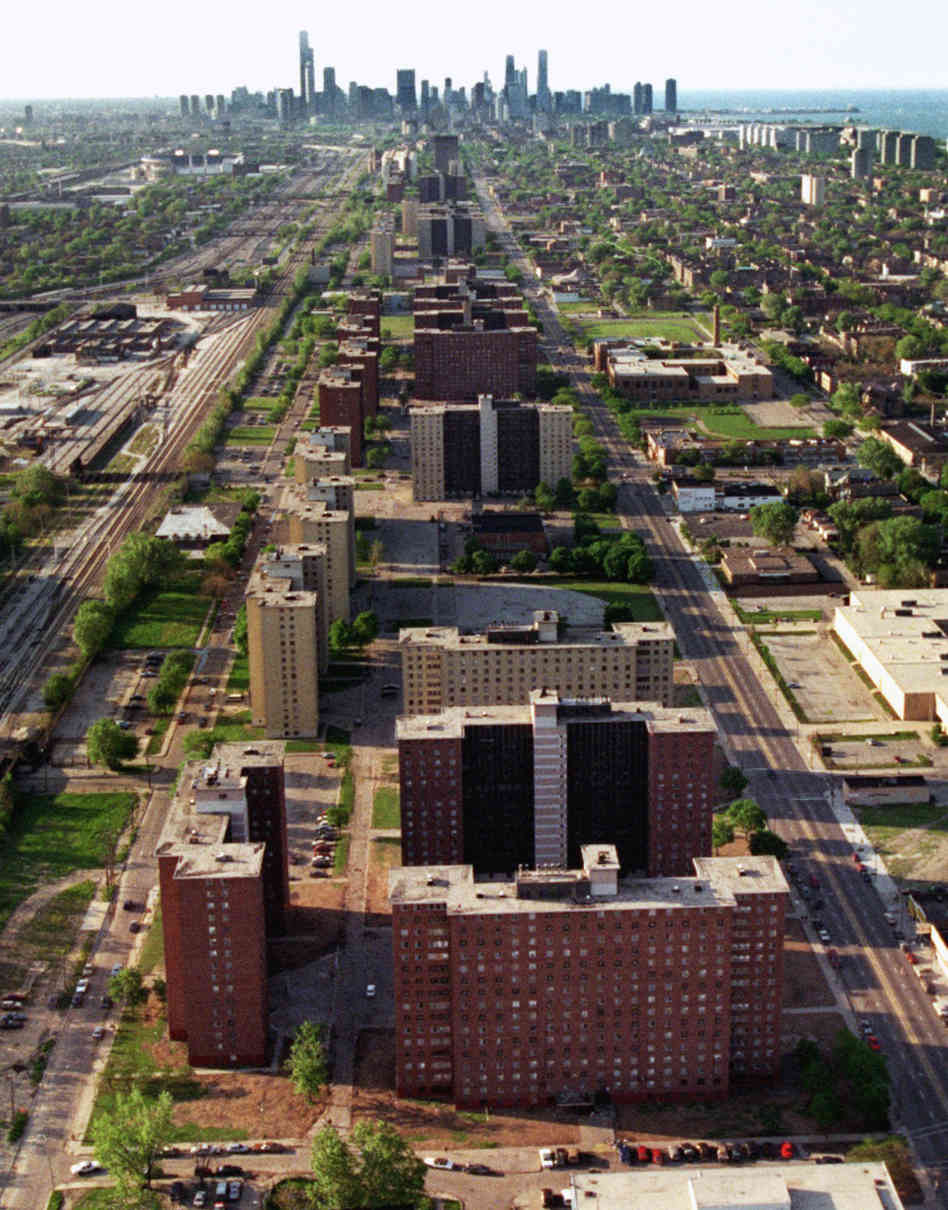
The prospect of anti-sprawl as an anti-blight-style class war is even more troubling in light of the sort of Great Inversion-type demographic shifts going on between suburbs and inner cities. It is hard to imagine large, invasive, confiscatory government programs to retrofit the suburbs along urbanist lines as long as the residents affected are members of the middle class. It is much easier to imagine that happening to a relatively poor community in, say, an auto-dependent inner-ring suburb along a light rail line and in a potential path of gentrification. In a sense, that precedent has already been set in Chicago, with the demolition of public housing towers and their redevelopment as urbanist-style mixed-income housing. The diagnosis of the towers’ failure, after all, wasn’t just about the sin of segregating poor people from the rest of society; the popular narrative is that the form of the buildings themselves made it impossible for them to house decent communities.

Image

Bad midcentury towers in parks

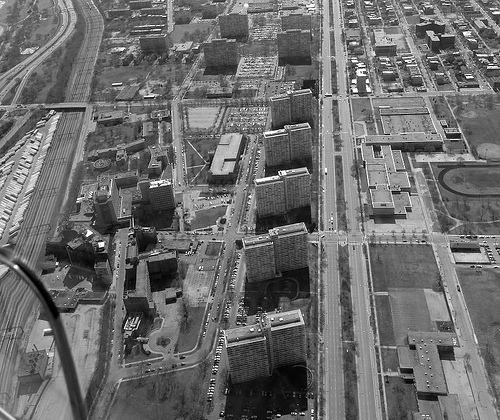
And so, just like the midcentury planners who bulldozed the ghettoes instead of rehabbing existing buildings because they thought the traditional urban form was inherently dysfunctional, Chicago scattered CHA residents and started over in a way that was more attractive to the middle-class and business interests. All this, while just a few miles away, private residential towers built at the same time and in the same form survive as thriving middle-income homes, in defiance of the theory that cities must look a certain way if they are to function.

Image

Good midcentury towers in parks

I am less excited, so far, about Bruegmann’s dissembling about the definition of sprawl. It is one thing to note that the word is used in ways that are colored by class and cultural politics, and that there is not necessarily any obvious red line between what is popularly considered sprawl and what is not. True, streetcar suburbs that are today widely admired by urbanists would have been considered low-density a hundred years ago; true, one person’s comfortable urbanity is another person’s suburban hell.

But it’s an entirely different thing to claim, as the Introduction seems to do, that there is no obvious or important difference between the suburbs produced over the last fifty years and the ones that sprouted up outside gated cities during the Roman Empire or along commuter rail lines in Europe and North America in the 19th century. From all of the perspectives that I take to be the most common and serious urbanist critiques – that is, roughly in descending order according to how much I care, economic justice, environmentalism, public safety, social interaction, and aesthetics – there is a major break that occurs when all local travel must happen by car. That is the point at which lower-income people must choose between an untenable financial burden or a loss of access to jobs, stores, and cultural amenities; when the greenhouse gases produced per household can rise most quickly; when streets become designed so that they are dangerous for anyone not encased in a metal shell; when the sort of spontaneous or casual social interactions that are common in public spaces in cities become much more rare; and when most visual charm usually evaporates. (Making local travel by car mandatory, by the way, also makes non-car long-distance travel incredibly difficult, since it requires sufficiently low densities that the number of people within reasonable distance of any given commuter rail station will be very low. This is part of why commuter rail lines built into car-dependent neighborhoods have generally been such miserable failures.) And until roughly World War Two, those types of communities were vanishingly rare. The invention of the railroad, of course, allowed people to live in suburbs where non-local travel – to downtown, say, or far-off factories – couldn’t be done by foot, and developments in the early automobile era were also planned so that people might drive to a distant central business district. But walking to accomplish local travel – to the nearest school, grocery store, shopping district – was still possible, or even preferred. That’s why in the older suburbs of Chicago or other Northern cities, you often have commuter rail stations every half-mile, so that almost everyone could be within walking distance. That’s why in the older car-based suburbs – here I’m thinking of some place like Dempster Street in Skokie – you have sidewalks, and a street grid, and stores placed behind only very small parking lots, if any.

Dempster: A wide road for fast driving, plus sidewalks, stores reasonably close to the street, and a surrounding neighborhood with single family homes sufficiently dense that a good number of people can walk to these stores.

The failure to make that distinction – that of local walkability – infects several other aspects of his argument. Take, for example, this passage:

Gentrification and sprawl at the edge have been flipsides of the same coin. In a typically paradoxical situation, no matter how much the new, more affluent residents profess to like the “gritty” urban character of the place, so different in their minds from the subdivisions of the far suburbs, what makes the neighborhood attractive today are less the things that are actually traditionally urban but those that are not. The most important of these are sharply lowered population densities, fewer poor residents, less manufacturing activity, and the things that the Lower East Side finally shares with the suburbs: reliable plumbing, supermarkets with good produce, and a substantial cohort of middle-class residents.

This is right, as far as it goes, and in fact dovetails very nicely with what I’ve written before about most people wanting, above all, safe neighborhoods with access to jobs and amenities and decent schools. Here, Bruegmann suggests, correctly, that there is no reason that those things are the natural domain of the suburbs. Whether or not it makes sense to say that urban neighborhoods that have acquired those characteristics have “suburbanized,” it does make sense to point out that having those characteristics is a prerequisite for any place that aspires to house middle-class people, regardless of its urban form.

But if all that’s attractive about these inner-city neighborhoods is their “suburban” qualities, why do people pay such a premium to live in them, not only in American cities like New York or San Francisco, but in central cities around the world? What is the extra desirable quality? All the evidence suggests that it’s the massive access to jobs and amenities which, for the most part, can only exist in cities dense enough that having all local travel done by car is logistically impossible.

Or take this line:

Using the most commonly accepted and objective characteristics attributed to sprawl – that is involves low-density, scattered development with little overarching regional land-use planning – I try to show that…our understanding of urban development is woefully out of date because it is based on old and obsolete assumptions about cities, suburbs, and rural areas. In fact, I argue that many of the problems that are usually blamed on sprawl – traffic congestion, for example – are, if anything, the result of the slowing of sprawl and increasing density in urban areas.

If we don’t believe that sprawl has a real definition – or if we use a mushy one like “low-density,” which Bruegmann spends pages correctly accusing of being a massively subjective and relative descriptor – then I guess this makes sense. If suburbs are densifying, then that must mean that the problems associated with “sprawl” should be declining, right?

But if we realize that the actual issue, again, is the requirement to use a car for all local transportation, then this makes much less sense. Of course, given how much space cars take up, denser car-dependent cities will have worse traffic than less-dense ones. And, I mean, consider the alternative: if cities avoid traffic congestion by making all neighborhoods sufficiently low-density that all travel can be done by car without traffic jams, then you would have to travel quite far to actually get to anything. Which means that either 1) you won’t avoid traffic jams after all, because the number of miles driven per person will rapidly increase as development spreads further and further away from job and amenity centers, or 2) people will only be able to access the jobs and amenities that are very close to them. In other words, they won’t do any non-local travel at all. And that would defeat the entire purpose of living in a big city.

All of this said, I am more excited about reading Sprawl than I have been about any other urban policy book for quite some time. It’s an extremely smart analysis of the issue from a perspective that is woefully underrepresented in contemporary conversation. I’m very much looking forward to writing up the next installment.

Correlation and Causation: City Journal Doesn’t Understand the Difference; Also: The Overton Window of Urban Policy

So George Packer writes that New Yorkers are whispering about whether de Blasio is going to return the city to its hellish 1970s past, and four weeks later City Journal helpfully publishes those whispers, in earnest, in the form of a mostly ill-considered post:

Perhaps the most important question in the looming mayoral race is this: Will the next occupant of City Hall remember the hard lessons that New York has learned over the last 40 years, or will the city revert to a functionally bankrupt metropolis with chaotic schools and dirty, dangerous streets?

By far the worst part is this passage about crime:

During Koch’s three terms, crime rates zigged up and zagged down, but in 1989, despite all that he had done to make the city safer, crack ruled the night, and murders jumped to a record 1,905.

When David Dinkins took office in 1990, hopes were high that the new mayor’s low-key approach and strong support in minority neighborhoods would cool the fevered streets. Instead, the city saw 715,000 felonies committed in 1990, while murders spiked to an all-time high of 2,262. The NYPD didn’t get the tools that it needed until the mid-1990s, when Giuliani adopted the Compstat system of analyzing crime data, along with proactive tactics and accountability throughout the department. Giuliani and the police reduced the number of homicides to 629 in 1998, and all categories of crime fell sharply.

Because Mayor Michael Bloomberg and Police Commissioner Ray Kelly retained and strengthened Giuliani’s reforms, crime rates continued to fall.

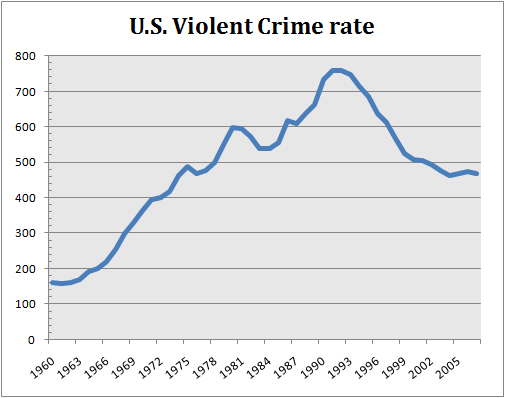
If you know anything about national crime trends over the last 30 years, which presumably someone at City Journal who read this before it was published does, none of what I just quoted makes any sense. To refresh our memories:

Image

Source: Volokh Conspiracy

So crime in New York peaked in the early 1990s, just like it did in almost every city in the country, and fell dramatically during the Giuliani and Bloomberg administrations in the mid-late 90s and 2000s, just like it did in almost every city in the country. Now, we could look at this data and conclude that Giuliani and Bloomberg, far from being New York’s crime-fighting heros, somehow managed to bring down violent crime all over the country. And that would be very impressive. But it’s obviously completely implausible.

So the other, more reasonable, conclusion to make is that the correlation between the change in administrations and the falling crime rate in New York is just that – a correlation – and not, in any major way, a causal relationship, in the same way we might note that homicide rates in Chicago began falling after the Bulls won their first championship, but we have no compelling evidence that one had anything to do with the other.1

This all points to a larger issue with this sort of talk about municipal leaders, which is that it fails to acknowledge that contemporary urban policy in the U.S., at least on the scale of a mayoral term or two, is just not that transformative. Sure, visionary leadership on a particular issue or project can have measurable results, and epic mismanagement can make problems worse, but on the big-picture issues – whether your region is rich or poor, to what extent it’s car- or transit-dependent, whether it will gain or lose residents, how affordable its housing will be – major metropolitan regions and their core cities are mostly following a) national trends and b) path dependency based on earlier policies and national trends. Crime is one obvious example of this. Unemployment, and macro-level economic health, is another: The fact that being a industrial center in the Midwest was highly correlated with being prosperous until roughly World War Two, and since then has become highly correlated with poverty, has nothing to do with a rash of bad leaders replacing excellent ones around the middle of the century in that region, and everything to do with global economic shifts. The fact that Madison, WI, Columbus, OH, and the Twin Cities became economic leaders in the Midwest certainly has less to do with the caliber of their municipal leadership than the fact that they all contain the apparatus of state governments and flagship state schools, which virtually guarantee a huge pot of well-paying jobs that attract highly-educated people.

This isn’t to say that urban policy, at the local, state, or national level, has to be powerless: in important ways, how and to what extent cities provide services can make a huge difference in their residents’ daily lives, and planning decisions can nudge a city’s path-dependency in ways that can become significant over time. And, obviously, in the past, urban planning at all levels of government had serious short- and medium-term transformative power through FHA regulations, transportation subsidies and projects, and so on. In 1963, the Beale Street neighborhood, just southeast of downtown Memphis, looked like this:

Image

In 1968, King was shot there, and city officials became concerned that Beale, which was mostly populated by black folks, was a racial powder keg frightening (white) people away from downtown. So, by 1971, it looked like this:

Image

That was some transformative leadership. But city governments can’t just condemn and raze the homes of tens of thousands of people anymore.

They also can’t radically rezone neighborhoods to allow them to change. The kind of wholesale transformations of the built environment that accompanied economic booms in Chicago, New York, etc., in the 19th and early 20th centuries have been legislated out of existence. Places that approximate it – Phoenix, Houston – mainly accomplish their construction sprees by relegating the vast majority of it to the periphery, where no one lives who can object.

So policies that might actually have radical short- or medium-term effects, like drastically liberalizing density caps, are politically impossible. Transit lines – or, if it’s your cup of tea, highways – through heavily populated areas are similarly verboten. If they’re built at all, they have to be routed in the least efficient possible way to minimize costs and eminent domain claims, which has the effect of making them as useless as possible, which makes fewer people use them, which makes them less transformative to the urban landscape. The Overton Window of urban policy is just too small, too frozen in place, to allow much dramatic change, even in the areas where we know it has the potential.

Now obviously this is not entirely, or even mostly, a bad thing. Our tolerance for Beale-style urban renewal projects, whether billed as slum-clearing redevelopment opportunities or transportation projects, should be extremely low. But as long as we’re unwilling to make much of any substantial change to urban policy, and especially to put any real muscle or funding behind those changes, we should stop talking about individual contemporary political leaders as if they’re the determining factor in what our cities look like, or how they behave.

1 This isn’t to say that there’s no effect on crime from local policies. And one should acknowledge that, in fact, New York saw a much greater decline in its crime rate than the nation as a whole. But it also saw a much greater amount of gentrification, which is highly correlated with lower crime. And the Giuliani/Bloomberg policies most commonly credited with reducing crime, like broken windows and stop and frisk, have been shown to have dubious efficacy.