Buses: they don’t have to suck

Very often when I say the word “bus” out loud, someone will volunteer that they hate buses. The conversation might go like this:

ME: Bus ridership is down. It’s not clear why.

FRIEND: Have you considered the possibility that buses just suck?

I find these conversations frustrating, because the people I’m talking to are wrong, but I can’t actually get into why that is in a casual setting without being pedantic and annoying.

Fortunately, I have this blog, where the cost of being pedantic and annoying is much lower. So here we go: buses don’t suck. They suck because we make them suck.

Let’s take, for example, the boarding situation on the Fullerton bus at the Red/Brown/Purple L station heading west. This is a stop I board at a lot, because it’s the main way to get to Logan Square from the north lakefront neighborhoods. I am not the only person with this idea, though, so there are frequently ten to twenty, or more, people waiting by the time a bus arrives. Each of these people must tap their Ventra card (or, God forbid, pay with cash) before the bus can move on. If each person takes, on average, two seconds, that’s easily 30-45 seconds spent waiting for people to board. If someone has a problem with their Ventra card, or is fumbling for cash, it can take an extra 15-30 seconds.

The Fullerton bus.

That doesn’t sound like a lot, but it’s pretty excruciating to wait through. If you drive, imagine sitting in traffic – not at a red light, but just waiting for no good reason – for 45 seconds. Set a timer, imagine yourself staring at a bumper, and just let the time wash over you.

Moreover, it can cause the bus to miss a green light, which can easily add another 20-30 seconds after everyone has actually tapped their cards.

Multiply this by every busy stop a bus makes – in Chicago, especially any time around rush hour, this is a lot of them – and you go a long way to explaining why buses are so slow. Or why, in the words of my friends, they suck.

But this is not a problem we have to live with. It is simply a result of having decided that everyone has to pay for the bus when it arrives, at one card reader at the front door. Although most people don’t realize it, this is not the only choice. But it’s important: imagine how much more trains would suck – trains, those things that everyone loves – if everybody riding them had to tap their card at one reader when they arrived at your station. It would take forever.

Anyway, one other choice would be to have two card readers: one by the front door, and one by the back. This is called “all-door boarding,” and San Francisco, among other places, does it. As you have no doubt already calculated, this reduces the time required to have everyone get on the bus. Over the course of a ride over a few miles when 50 people or so board, that can make a difference.
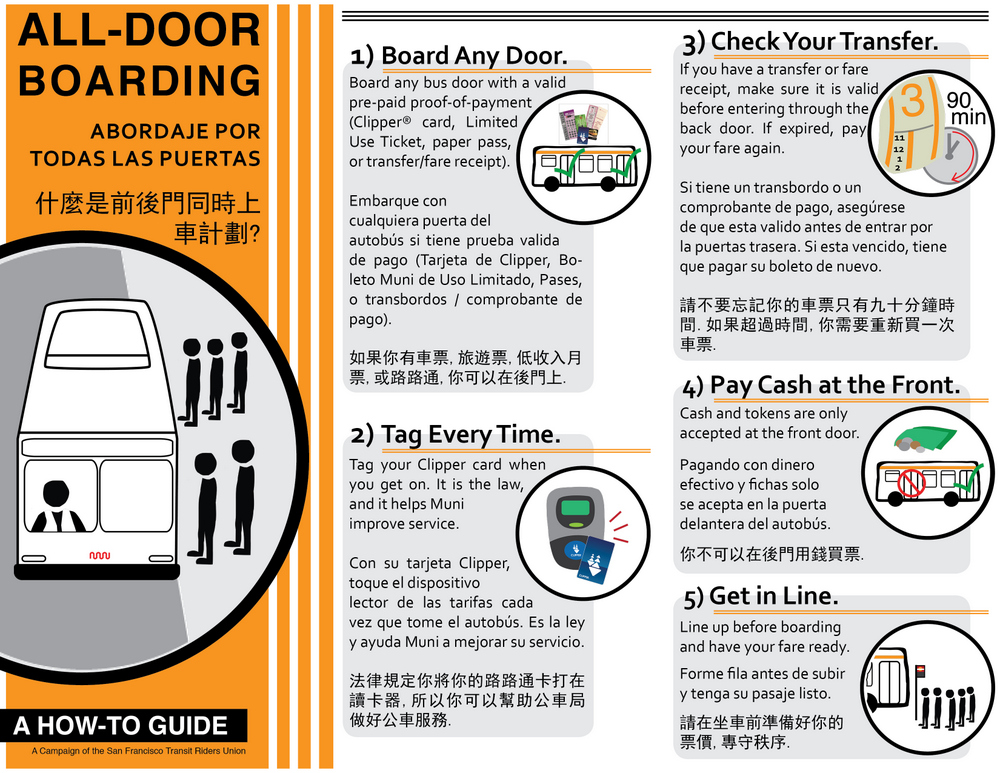
ADB_FinalWebpt1

Another, even more exciting choice would be to have people pay before the bus arrives. That way, there’s no tapping at all! Just get on and go.

Chicago will actually begin using that system at exactly one bus stop in the entire city once the Central Loop BRT project is complete: one of the rail-style bus stations will have rail-style turnstiles that you’ll have to tap your card on to get through. That way, when the bus arrives, you just get on, like with trains now. Ashland BRT, if and when it happens, will probably also use that system. That’s one reason they’ll be so much faster than other buses.
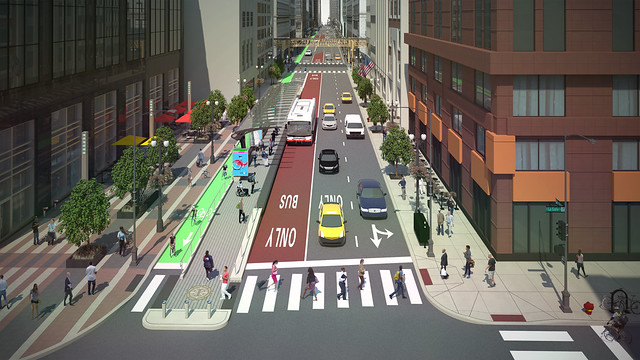
A rendering of a station for the Loop BRT project, due next year.

But you can actually get the same benefit without all the cost of building a station and adding turnstiles. You can do what the MTA does in New York with a few of their bus lines: you can put little kiosks at major stations where people can tap and get a little paper receipt saying that they paid. Then, when the bus comes, they just walk on. No waiting for tapping at all! The downside is that you then need a small security detail to spot-check people’s receipts to make sure they’ve paid, but that turns out to actually not be a very big deal.

This is a pre-pay bus kiosk in New York.

Either of those – all-door boarding, or pre-payment before the bus arrives – can make buses suck much less. But this post was really inspired by Sandy Johnston’s response to WBEZ’s story on bus bunching:

What was really disappointing about the Curious City piece is that everyone interviewed–from bus riders to academics to CTA drivers and officials–seemed to take the the fatalistic attitude that bus bunching is completely inevitable and very little can be done to prevent it…. But…[t]here is, in fact, one policy lever that can help the CTA (and other agencies) avoid bus bunching, but it is politically unpalatable to most actors, especially the city’s auto-oriented elite: dedicating lanes to public transit.

Yes: another way to make buses suck much less is to make the most basic gesture at believing that people who ride buses should be able to get places in less than twice as much time as it takes to drive there, and give them their own lane. When buses and cars share lanes, not only do buses get stuck in traffic not of their own making – sixty people or more regularly squeeze onto a single bus just fine, but that many people in cars could back up a road for blocks – but they have to negotiate pulling out of and into traffic every time there’s a stop, which in Chicago is frequently every block. That also wastes a lot of time.

Sometimes people object to bus lanes on grounds of fairness. On Ashland, say, people on buses make up about 20% of all travelers, I believe. Why, then, should they get a third of the road? (There are six lanes, recall: two currently used for moving cars (with buses mixed in), and two for parked cars.)

That is one way to look at it. Another way to look at it is that Chicago has roughly 2,800 miles of traffic lanes on arterial (main) streets, and at the moment 4 miles of (part-time) bus lanes. (They’re on the J14 line.) That is 0.1% of all arterial lanes. By contrast, 27.9% of Chicago households don’t even have a car, and 26.7% take transit to work, meaning – doing some quick math – roughly 15% of Chicagoans take the bus to work.

Here is that idea in a graph:

Clearly, adding more bus lanes would be horribly unfair.

Meanwhile, car trips do, in fact, tend to be about twice as fast as bus trips – not including wait time – and rail trips are in that ballpark, too. This, despite the fact that between a quarter and a third of our households don’t even have cars, and that the vast majority of households are not located close enough to a train station to walk there. Buses are, in fact, the only viable transit choice for the vast majority of Chicagoans. Too often, they do suck, but they suck because of some combination of: a) we don’t know that they can be better, and b) we don’t care to make them better. But I think there are a lot of people in the city who would be interested in a bus system that we could be proud of, as opposed to felt burdened by. Why don’t we get one?

Maybe one day Chicago will not waste its billions of dollars of transportation infrastructure, but until then, have this Next City article

This is the winter of my Metra-related discontent.
This is the winter of my Metra-related discontent. Credit: Eric Rogers

Service innovations like increased frequency don’t yet appear anywhere in the strategic plan, and a Metra spokesperson confirmed that the agency has no plans to move in that direction. In August, Streetsblog Chicago reported that one board member flatly rejected that kind of service expansion, claiming that running a single extra train during rush hour would cost over $30 million. (Aikins, however, reports that GO Transit spent just $7.7 annually to adopt half-hourly frequencies on its two biggest lines.)

Read it!

Why do we care about mode share, ctd.

A while ago, I pretty much lost a debate in the comments with transit writer extraordinaire Alon Levy. At issue was whether mode share – the percentage of commuters who use transit, cars, biking, etc., to get to work – was the best way to measure the effectiveness of a city’s public transportation. The debate was provoked by yet another ranking of cities by transit mode share, and my discomfort with the triumphant reaction from some quarters.

The argument in favor of mode share is basically that people will do whatever is easiest and most convenient; if very few people are using transit, that’s a pretty good indication that it isn’t easy or convenient for the vast majority of people.

My counter-argument was that mode share measures relative ease and convenience: if 10% of people take public transit, that tells you that transit is more convenient than driving for roughly 10% of commuters, but it doesn’t tell you if, for the other 90%, transit service is perfectly acceptable, but driving is just easier; or if transit service is actually terrible.

I think, though, that the new report on jobs accessibility from the University of Minnesota should reopen the debate for at least as long as it takes for Alon to convince me again that I’m wrong. In particular, Jacob Anbinder’s interpretation of the study at Real Clear Politics, which looks at the percentage of regional jobs accessible by public transit within an hour (the original report focused on raw numbers). And, when you do that, it becomes clear that the massive, older regions with very high transit commute share – New York, Chicago, DC, etc. – have a problem: namely, that getting to jobs outside their dense cores is very, very difficult. At the same time, smaller regions with little to no reputation for public transit – Salt Lake City, Milwaukee, Denver – look much, much better.

Transit access in Chicago: great in the center, not so much elsewhere.
Transit access in Chicago: great in the center, not so much elsewhere. Click for interactive map.

jobspercent

There are a number of things at work here, I think, which all boil down again to the fact that mode share measures relative convenience, not absolute. In the dense centers of America’s largest, older cities, transit is relatively convenient, and driving is relatively inconvenient for reasons of traffic, parking, etc. But as you leave the center, transit becomes dramatically less convenient – especially if you’re not going to the center, which is often served by commuter rail lines – and driving becomes dramatically more so. What that means is that for a relatively large number of people who live in the core, transit is the better option, leading to high mode shares; but outside the core, transit service isn’t just less convenient than driving, it’s actually pretty bad.

In some smaller metropolitan areas, though, transit may be so-so over a much larger percentage of the region, while driving is basically always convenient. These cities lack the cores that give places like Boston a high mode share, but provide decent enough transit service over a large enough portion of the region that if you really want to use transit – because you want to save money, or you’re too old/young, or you just don’t like driving – it’s not a disaster.

Here is this idea in graph form:

hastygraphs

That’s how you arrive at the fact that the average commuter can get to 25% of jobs in metropolitan Salt Lake City within an hour, but only 15% of New York’s.

Now, there are a number of caveats to this. In particular, using total commute time as a cutoff (jobs accessible in an hour) inherently disadvantages geographically large metropolitan areas like New York or Chicago. First, obviously, because the larger the area, the longer it takes to get places, all else equal. But also, as a region expands, the challenge of making any given point-to-point trip doable on transit requires much, much larger investments in infrastructure: while a smaller region might be able to get away with a well-organized bus system, and a medium-sized region with buses and a few radial rail or BRT lines, a region the size of Chicago or LA needs an extensive bus system, radial rail routes, and some kind of cross-town rapid transit service.

More significantly, as a good leftist, I believe that inequality matters. It may be that in Salt Lake City, a 60 minute commute on public transit would take only 20 minutes by car, while in New York, a 60 minute transit commute would be 45 minutes by car. In a region where the expectation is that commutes will be relatively short, transit accessibility that requires dramatically longer trips will probably relegate transit to a sort of welfare service, patronized only by those who absolutely, absolutely have to. That kind of stigma is a problem for all sorts of reasons: to begin with, I’m against stigmatizing people; but also, from a political perspective, it probably makes it harder to lobby for improvements to public transit if it has the reputation as a service exclusively for poor people.

Still, I think this report adds some strength to the idea that mode share is a very incomplete look at a region’s transit effectiveness. Also, happily, the widespread attention it’s received is a pushback against the kind of urbanist lifestyle fetishism that frequently accompanies rankings based on mode share. (See, for example, the story I quote at the beginning of my earlier post.) A functional transit system ought to be about making day-to-day life easier for regular people, and focusing on job access highlights that. Yay.

Teardowns and the Valley of the Small Apartment Building

A new study on teardowns in the Chicago suburbs has been making the rounds on urbanist Twitter, and provides an excuse for looking at the phenomenon of zoning-constrained redevelopment outside the city. In Chicago proper, it’s a little hard to do this precisely, because a) common zoning limits vary from single-family homes to two-, three-, and four-flat apartment buildings, and so a given permit for a three-unit building might represent densifying a lot that used to have a single-family home, or it might represent a “teardown” replacement of an older three-unit building; and b) the huge amounts of development downtown mask the very spare development of large multi-unit buildings in the neighborhoods.

But the suburbs, by having much more restrictive zoning, make this easier. First off, unlike Chicago, the overwhelming majority of existing lots are single-family homes, so a three-unit permit is much, much more likely to represent densification; and second, they’re mostly small enough that the downtown-neighborhoods dichotomy doesn’t matter nearly as much. (Which is not to say it doesn’t exist, as we’ll see with Evanston; just that when the city’s total area is only a few square miles, concentrating development in one area is much less consequential.)

Anyway, just as the city of Chicago’s zoning encourages developers to tear down older single-family homes, two-flats, and three-flats, and replace them with buildings of equal or lesser density built for wealthier customers – because they’re not legally allowed to build a larger number of potentially cheaper units – I strongly suspect that suburban teardowns are encouraged by zoning regimes that don’t allow for densification of single family home areas. In the absence of the option of building more units, it makes economic sense to just build bigger single family homes.

permits
Source: socds.huduser.org/permits

The chart above shows what it says – residential building permits in five suburbs from 2000 to 2013. The bottom four are all identified by the teardown study as being particular hotbeds of teardown activity. Evanston is not, but we’ll come back to what makes it interesting in a moment.

One thing that stands out is that Wilmette and Winnetka have literally not allowed a single new apartment building since the turn of the century.

But what I think is most relevant here about all five suburbs is that there is virtually no construction whatsoever of small apartment buildings of two to four units. In fact, Glenview is the only town that issued enough permits for those kinds of buildings for them to even be visible in the chart.

Fascinatingly, when these suburbs do allow new multi-unit apartment buildings, they are virtually all of the large, five-or-more unit variety – and I strongly suspect, having been to these places, that if we could set the threshold higher – say, ten or twenty or forty units – that we would see that virtually all new multi-unit projects are very, very large indeed. This reflects a peculiar dichotomy in zoning in places like Evanston and Park Ridge: neighborhoods are either zoned for single-family homes, or very large residential buildings. The large building areas in these suburbs tend to be in very high-demand areas that have historically been denser than the rest of the town – downtowns centered on an old commuter train station, say – or some out-of-the-way parcels, often separated from the rest of town by a large road or train tracks, where the town decided they could brook lower-income apartment development.

Evanston's zoning map illustrates the issue: everywhere except for the blue Downtown zones in the center - and the darkest R5 and R6 zones around it - multi-family development is either illegal or requires extremely impractical minimum lot sizes.
Evanston’s zoning map illustrates the issue: everywhere except for the blue Downtown zones in the center – and the darkest R5 and R6 zones around it – multi-family development is either illegal or requires extremely impractical minimum lot sizes.

What that means is that the sort of gradual, small-scale densification that might make sense in a residential neighborhood where rising prices are creating pressure for redevelopment – replacing a single family home with two to four units on the same lot – is ruled out. Instead, developers either have to build big within a very small geographic area, where those areas exist at all, or they have to do a single-family teardown.

Interestingly, Evanston – which, relatively speaking, has taken the build-it-big philosophy to heart, allowing more large residential construction, and thus more added density, than any other mature Chicago suburb – is also not identified as a place with a teardown epidemic, despite having real estate prices that are definitely comparable to places that are. Whether that’s because of regulations that prevent teardowns, or a release of development pressure via huge condo and apartment projects, I have no idea. But it is notable.

I should also note that this dichotomy isn’t necessarily terrible: especially if dense development is focused around transit stations, it’s a perfectly reasonable way to allow housing supply to grow, and thus help keep prices from skyrocketing, while protecting large single-family-home neighborhoods, if that’s a local priority. That, for example, is something like the Toronto model, where skyscrapers are allowed within a quarter mile or so of outlying subway stations, surrounded by a sea of relatively low-density housing. That said, of course, the scale of density that’s required in those islands for it to balance restrictions elsewhere is pretty massive, and it seems clear that even Evanston isn’t close to reaching those levels.

Which means that it’s a shame that smaller-scale densification that might be more palatable to single-family neighborhoods is off the table. There are many examples of neighborhoods throughout the metro area where single-family homes and two- to four-unit apartment buildings coexist quite peacefully; we ought to be creating more of them.

NB: I should note that the city of Chicago also has a “valley” of medium-sized development, but it’s in the sort of four- to ten-story midrise building, rather than three-flats. The basic dynamic is the same, though: zoning allows for either very little, or no, increase in density, or a massive increase in density in a very small geographic area. Gradual densification of the sort that has typified urban development for most of our history is off the table.

Comics journalism and Woodlawn cafes

1. I meant to do this a while ago, but anyone who’s interested in the kinds of things I write about here – cities, Chicago, race, humans – really ought to read “South Shore State of Mind” by The Illustrated Press, the only Chicago-based purveyor (that I know of) of comics journalism. This piece follows a man from the South Side reflecting on the changes he’s seen in that neighborhood, but you should be looking for their other stuff, too.

illpress

2. Completely unrelatedly: I’m writing this at Greenline Coffee, a new cafe that just opened at 61st and Eberhart in west Woodlawn. (For the record: it’s great. If you’re around this area – say, in Hyde Park – it’s a lovely place to sit and read or work for a few hours.)

But what’s really got me distracted from my work is this: I have ridden by this corner most days on my way to the train for the last year. In that time, I have seen exactly zero non-black people on this stretch of 61st. (This section of west Woodlawn is nearly 100% black, and has a mix of attractive, well-maintained blocks and others that are pockmarked by empty lots and abandoned buildings.)

And yet in this cafe, there are no fewer than five white people and two Latinos, along with half a dozen black people. The intersection – at least this corner of it – has suddenly been integrated by the appearance of a single retail business with appeal to a broad base of customers. (Other than this, 61st is pretty empty, retail-wise. Sixty-third has a handful of businesses around here, but mostly of the bargain clothing/drug store/hot dog stand variety.)

I know it’s not this easy, but…man. I don’t often write about this, because I don’t think I have much to say, other than ask questions, but I don’t think it’s going too far to say that the retail deserts in black neighborhoods on the South and West Sides are one of the tip-top most important issues in the city. They’re both cause and effect of so many things: health outcomes, vulnerability to crime, the fleeing of the middle class, and so on. It seems clear that one of the keys to getting people like my commenters to be happy enough to stay – and people of all races from other areas interested enough to visit – places like west Woodlawn is developing stronger retail corridors. And before you think that that’s impossible without more wealth in those neighborhoods, consider that study after study has found that Chicago’s black neighborhoods have far less retail than you would expect, even taking into account local incomes.

Children

Periodically, I get emails (or comments) like this one from last night:

Subject: Just Saw Your Article on Milliken v. Bradley

So do tell: where do YOUR children go to school? And if you don’t have any, do you realistically see any future children you may have going to these “integrated” schools that you champion?

I think there are two things about these emails that are really fascinating. The first is how common the “just wait till you have children!” argument is. Now, to be fair, it is true that I don’t have any kids. I have, though, recently passed from the phase of my life in which zero of my close friends had children to one in which some of my close friends have children, so I think I’m in an okay position to appreciate how significant a shift in perspective it can bring.

But even if that doesn’t count, people like the author of this email seem to have forgotten that I was once a child. I have first-hand experience! And, as a child, the schools I attended (there were four of them) were all between 35 and 70 percent non-white. I did not always enjoy school, but I can confirm that exactly none of the reasons for that were related to excessive racial integration.

Now, it’s true that I was fortunate to attend public schools that either had special academic requirements or in which the majority of students came from solidly middle-class families. But that’s sort of the point (especially the latter): there’s no reason an “integrated” school has to be mostly poor, or have low academic standards. In fact, by far the most troubled American schools aren’t the integrated ones, but the segregated ones.

The second thing I think is fascinating about these emails is how they reveal the worldview of a particular kind of racism: that of white people who hate/fear black people so much that they can’t conceive of other white people who don’t hate/fear black people as much as they do. It’s as if attending school with non-whites was some sort of obviously absurd dare that can be neutralized by turning it around on the dare-er, who will surely reveal themselves to be unwilling to perform the ridiculous act they proposed for you.

We tried busing, and it didn’t work, they say.

I don’t know what else to say about this, except that if you are inclined to send me an email along these lines, please don’t. I have enough.

* I should note that the other issue that I get “just wait till you have children!” emails about is living in apartments. “Wait till you have kids, and see if you don’t want a single family home in the suburbs!” The problem with this, again, is that I was once a child, and as a child I had the opportunity to experience both living in an apartment in a large city and living in a single family home in the suburbs. To the extent that I had a preference, it leaned strongly towards the apartment, where I could go play with my friends without bugging my parents to drive me.

Credit where it’s due

In the continuing interest of demonstrating that reporting on public transit is not as hard as results from CBS and others might suggest, I wanted to recognize John Hilkevitch’s piece in the Tribune today, which not only covered extremely good news – on which more in a sec – but did so by simply presenting the facts of the project. Bus lanes here, restricted right turns for cars there, for this many dollars, serving this many riders. Great. And not hard! Maybe we could have some more quotes – there are no bus riders in this article either, but the only quotes are from CDOT, so it’s not that kind of piece.

Anyway: more of this, please.

As for the content of the news, it’s excellent: the most details yet about the Loop Bus Rapid Transit project, which will use bus lanes, signal priority (special green lights for buses) and enhanced stations to make the trip from Ogilvie/Union Station to Michigan Avenue, and vice versa, significantly faster. That’s a big deal mainly because it makes commuter rail stations on both ends of the Loop (and all the lines that end there) much more valuable: people whose lines end in the West Loop can now get to the eastern side much more easily, and, just as importantly, the South Side Metra Electric and South Shore lines that end at Millennium Station can make it to the western edge of the Loop – where jobs have been increasingly concentrated – without spending twenty minutes stuck in traffic to go the last mile.

It’s also just impressive policy. In a country where multi-hundred-million-dollar streetcars serving a few thousand speculative tourists are a remarkably popular genre of transit, Chicago is going to spend just $30 million – less than the cost of a single El station, or roughly 158 feet of subway* – to radically improve transportation for 25,000 riders a day.

Bus_Rapid_Transit_-_Boarding_Platform
BRT! B still my heart.

Central Loop BRT might also serve as a kind of proof-of-concept for BRT on Ashland and other streets. Buses have such a terrible reputation in Chicago, as in other American cities, that it’s hard for a lot of people to imagine them being anything other than frustratingly slow. A bus that gets to speed by traffic, that has its own rail-like stations, might change a lot of minds – or, more to the point, get them asking, “Why doesn’t my neighborhood bus do that?” It’s particularly exciting that the CTA is going to build one station with fare gates, meaning the standard CTA practice of waiting two or three light cycles for everyone to board and tap their cards at a busy stop will be completely eliminated.

More of that, too. Thanks.

* Based on $1 billion per mile.

Quickly, before I go

On Tuesday I’m flying to Bogota, Colombia, for a quick vacation before school starts up again. I’m not planning on spending any of that time writing – in fact, I’m not even taking my computer – but I wanted to get a few things down in the few hours before I head to the airport.

First Bogota, then Ashland.

1. This is now two weeks old, and Streetsblog has already covered it well, but it’s worth heaping just a bit more scorn on CBS’ “expose” of the Central Loop Bus Rapid Transit project. One can begin, of course, by mocking the idea that CBS did any “digging,” in their words, to uncover an initiative about which CDOT, the CTA, and third party organizations have issued multiple press releases, held meetings, and created public websites. Or the scene in which the reporter gestures to an entirely empty street behind him, and then declares that “traffic has slowed to a crawl.”

But mostly I just want to point out that, yet again, a major Chicago media organization has covered a transit issue without talking to a single actual transit user. As ever, the reporter pitches the conflict, or tradeoffs, not as between people who ride the bus and people who drive, but between high-handed “city planners” and regular people who happen to drive. CBS lets Peter Skosey at the Metropolitan Planning Council and Rebecca Scheinfeld from CDOT represent the pro-BRT side, along with some rando in a bike helmet, and then talks to four people in their cars. Despite the fact that the report was shot in the Loop, where there is a bus station on virtually every corner, it did not seem to occur to anyone that if you are going to interview seven people about a bus project, maybe one or two of those seven should be someone who rides a bus. A-plus reporting, CBS.

2. Not entirely unrelatedly, Eric Jaffe published a piece in City Lab the other day entitled, “If So Many People Support Mass Transit, Why Do So Few Ride?”

Last week, for instance, the American Public Transportation Association reported that 74 percent of people support more mass transit spending. But only 5 percent of commuters travel by mass transit. This support, in other words, is largely for others.

Not to be rude to Eric Jaffe, who I generally like a lot, but this seems like a pretty silly question to me. People don’t ride mass transit because riding mass transit doesn’t make any sense for them. Lots of people also “support” getting in shape – they even spend their own money on diet apps and gym memberships – but very few actually do it, because eating whatever you want and then not going to the gym is much, much more convenient than the alternative. By the same token, a person who must walk fifteen minutes along a street without sidewalks to a bus stop on a line that comes every twenty minutes and would take twice as long to get to work may “support” mass transit, but would have to be kind of insane to actually use it. (Money is a constraint, of course, but even the vast majority of the poor, faced with those conditions, just buy a car as cheaply as possible.) Nor are those kinds of tradeoffs limited to people who live in postwar sprawl: From where I live, in a highly walkable neighborhood with two relatively high-frequency bus lines and a subway stop within a five minute walk, getting to most jobs in the Chicago metropolitan area by public transit is simply not a plausible choice for someone who has other options. And that’s not just true of jobs out in the burbs, far from transit themselves: even getting to, say, Evanston – which by car is maybe 45 minutes – would be pushing an hour and 20 minutes by public transit, simply because the lines aren’t oriented to serve that trip.

Jaffe claims that relatively low ridership on new transit services created by popular referendum is another data point on the “support-usage gap,” but really all it shows is that transit is drastically inconvenient for the vast majority of people in a way that one or two new lines can’t fix.

Anyway, I think the only way this can seem like a hard question is if you’re not thinking of the issue from the point of view of current or potential transit users. Instead, as with CBS, it’s a philosophical question. But for the vast majority of people, transportation isn’t a philosophical issue. It’s a convenience issue. It would be nice if both sides would approach it that way.

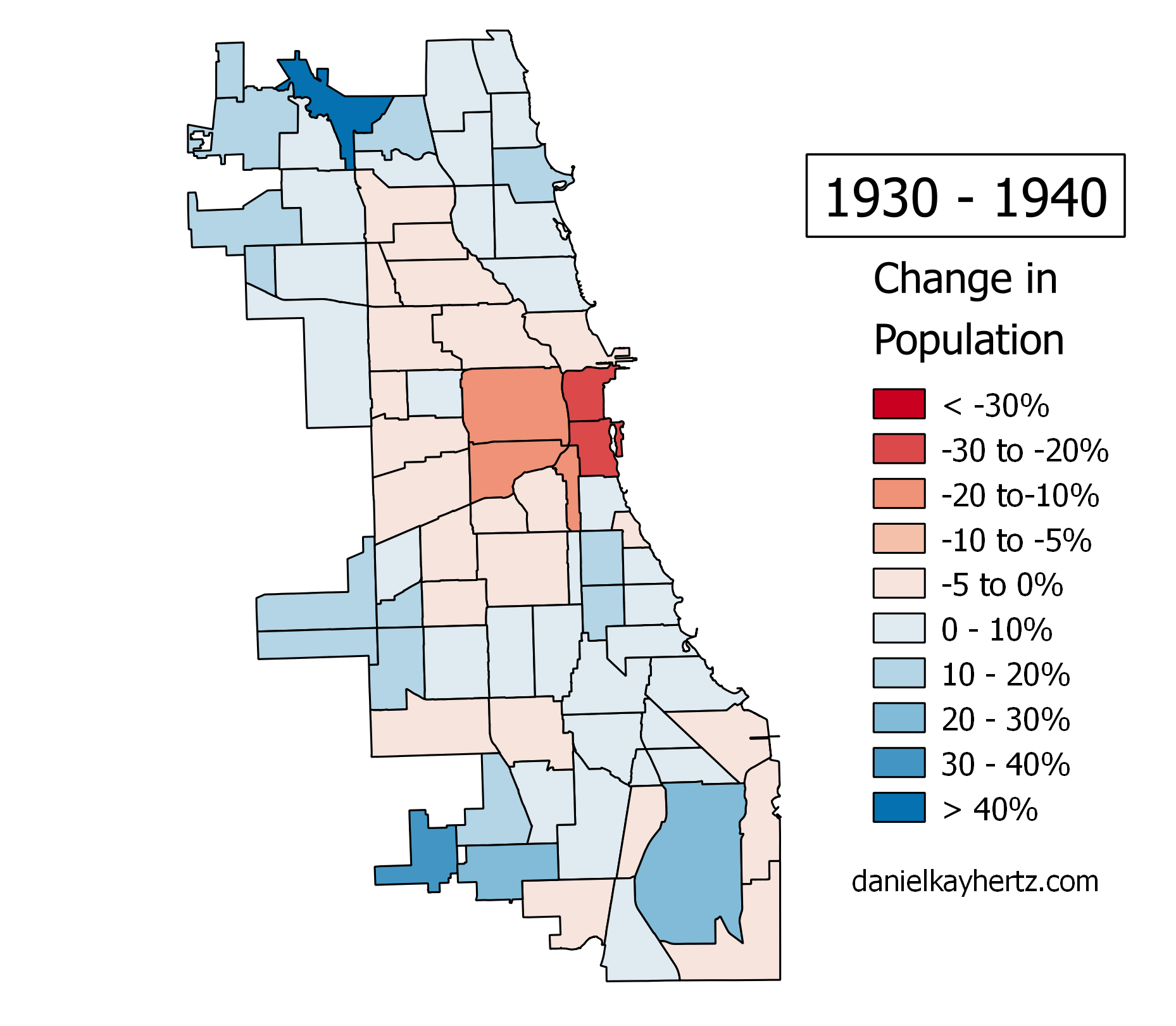
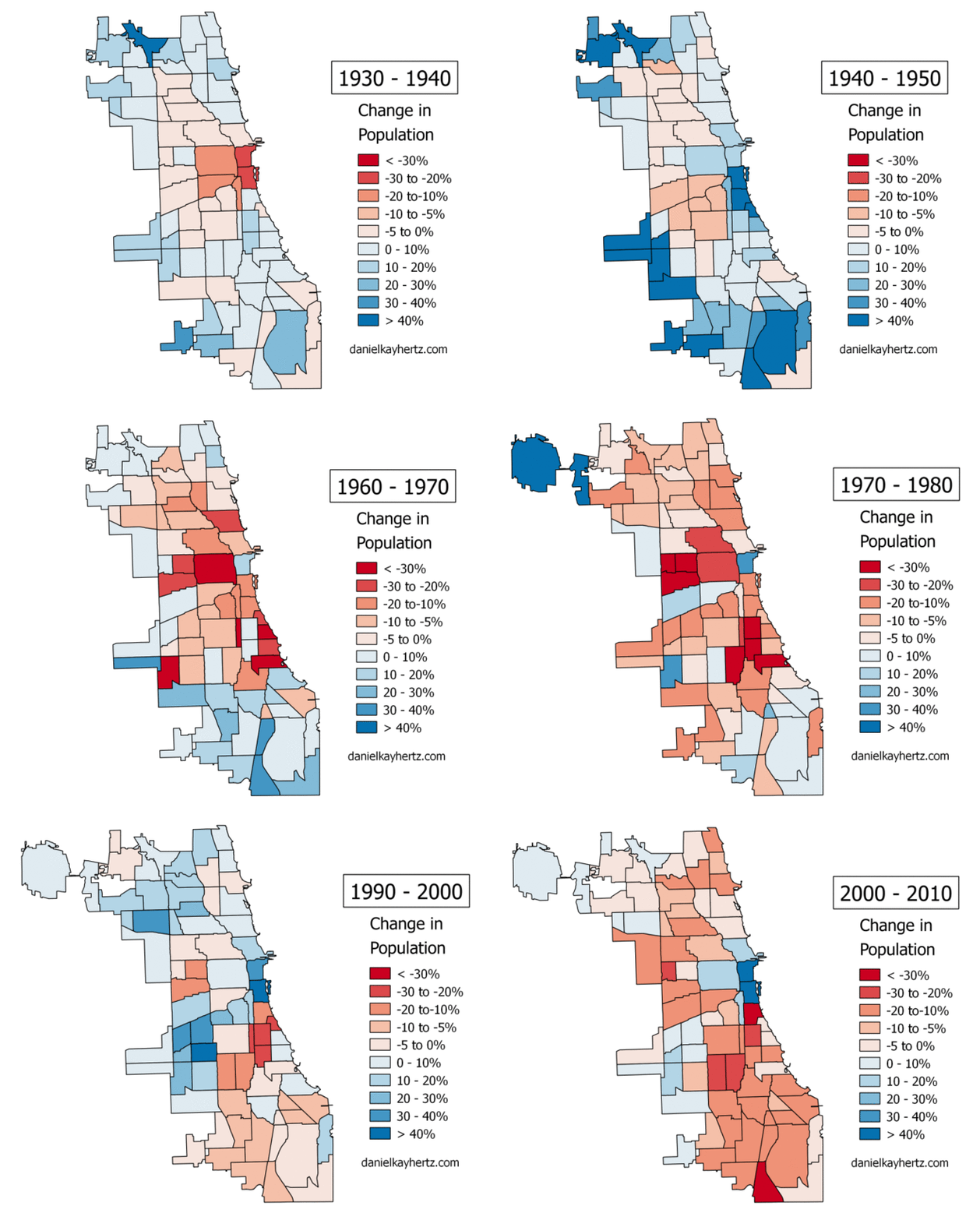
Eighty years of Chicago’s population, annotated

With one caveat: this is not meant to be remotely comprehensive, because I don’t know enough to give a comprehensive overview of Chicago’s population trends since 1930.
401930s. Population at the end of the decade: 3,397,000. Up 20,000.

By the 1930s, the trends that we think of as beginning in the post-WWII era are actually already quite visible: depopulation of the older neighborhoods, and relatively rapid growth in outlying neighborhoods that resemble car-oriented suburbs. The trends are muted, though, because the economic situation means there isn’t much construction. To be honest, I’m not quite sure what’s going on in the Loop and South Loop, which both lost well over 30% of their populations. Comments would be appreciated.

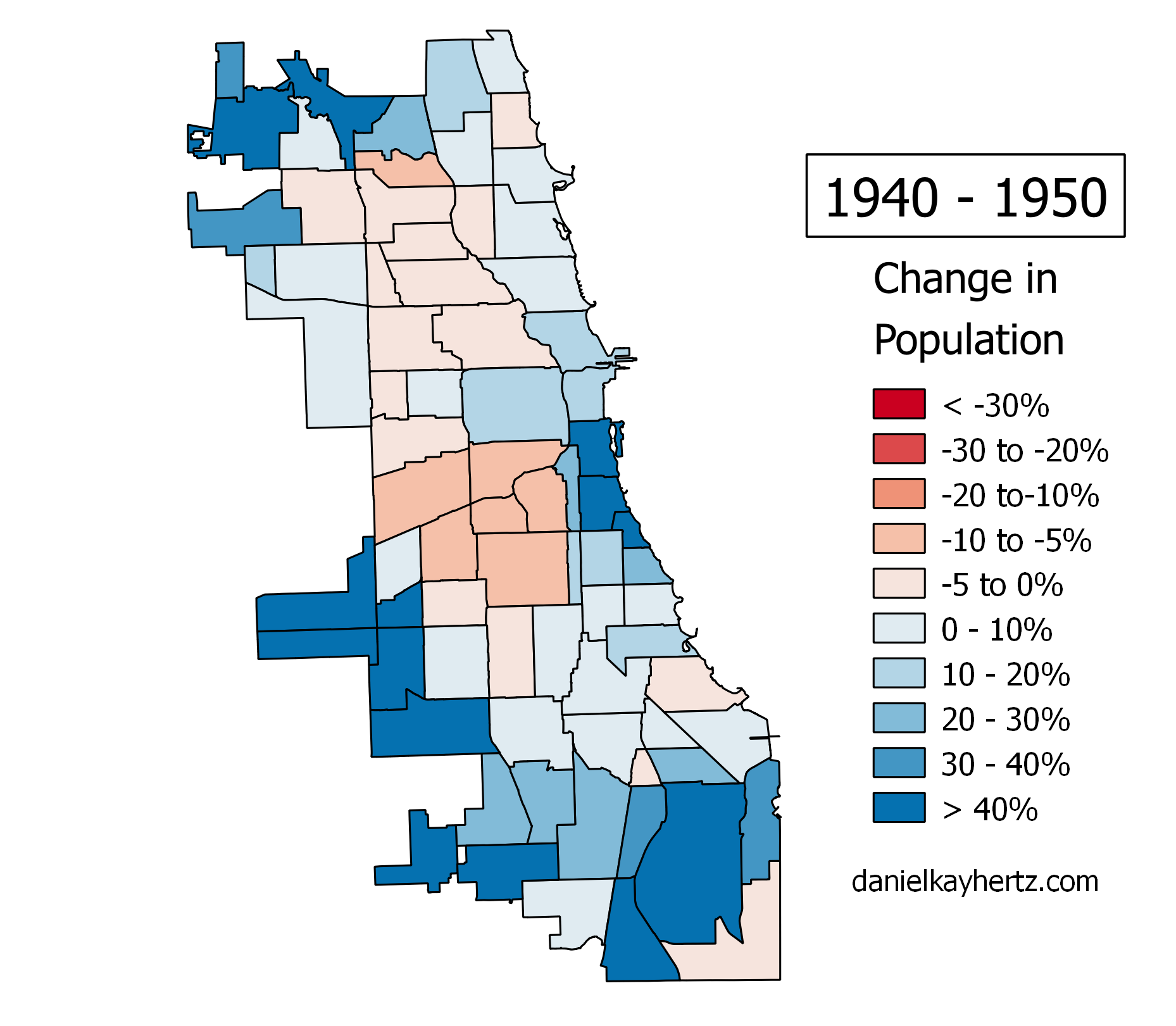
50

1940s. Population at the end of the decade: 3,621,000. Up 224,000.

As the economy comes back, those greenfield suburban-type neighborhoods explode, largely with single-family owner-occupied homes subsidized by the newly created federal mortgage system. Many inner neighborhoods continue to lose population, although interestingly the older lakefront neighborhoods appear to be generally stable. By far the most interesting, and ominous, part of this picture is the Black Belt, or what’s now called greater Bronzeville: the stretch of lakefront neighborhoods just south of downtown, whose populations boomed between 40 and 75% during this decade. That’s because in the 1940s, the Second Great Migration began, and hundreds of thousands of black people arrived in Chicago from the South, only to find that racial segregation – which only a generation or two before had existed in a much milder form – had calcified to the point that their only option was to live in the ghetto. Since the white people around the ghetto weren’t letting it expand at this point – people who tested the boundaries were liable to have their homes bombed – the Black Belt simply became horrifically overcrowded.

Another way of putting that, of course, was that there was an extreme housing shortage for black people, since there wasn’t much new building within the ghetto, either. Those of you who read this blog may guess what comes next: unlike the current dynamic, in which housing in black communities is usually very under-priced thanks to a lack of demand, because non-black people refuse to live there, black housing in the 1940s was radically over-priced. Black families would routinely pay significantly more than white families for smaller, older, less sanitary, and more dangerous apartments.

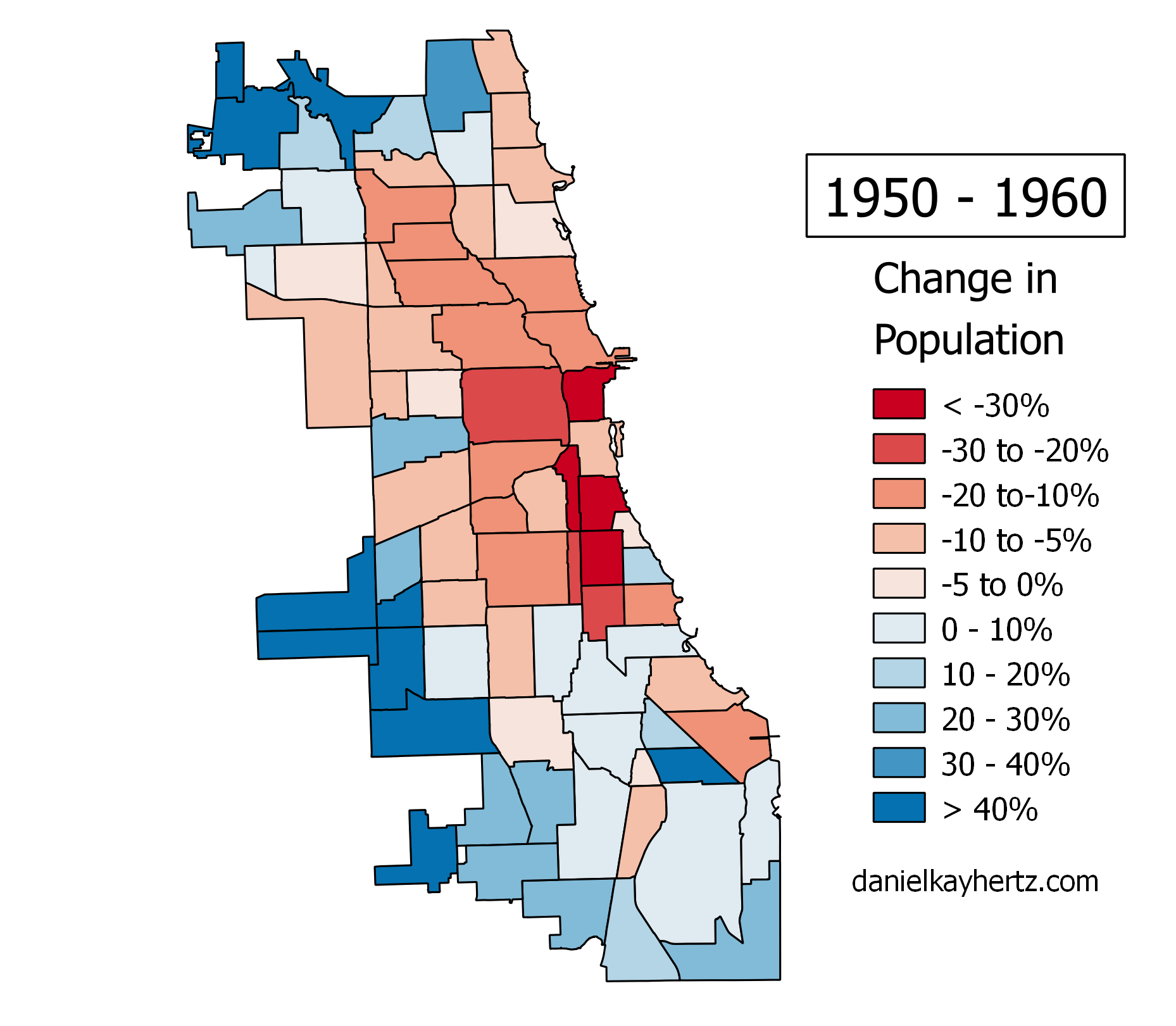
60

1950s. Population at the end of the decade: 3,550,000. Down 171,000.

The ghetto breaks. In part, this is by design: the late 1940s and 1950s begin the era of large-scale urban renewal, which is largely focused on the areas near the Loop occupied by people that City Hall and downtown business leaders consider undesirable. Mostly, this is black people. Massive displacement on the northern end of the Black Belt is actually opposed by whites on the far South Side, who anticipate – correctly – that there’s simply nowhere for those black people to go within the existing ghetto.

The Lake Meadows project began what would eventually be the total destruction of a contiguous mile-long section of tens of thousands of black homes and businesses. This was completed by the early 1950s.

The spread of black families, a pent-up demand for housing because of low rates of construction from 1929 through the end of the war, and the creation highways to the suburbs produced an exodus from nearly every built-up neighborhood in the city. Areas with available sites for new construction along the edges of the city still saw huge population gains.

70

1960s. Population at the end of the decade: 3,367,000. Down 183,000.

Basically the same as the 1950s, except black people had by now been forced into a second large ghetto on the West Side, and white people began fleeing in massive numbers there as well. The two community areas that saw modest growth in the heart of the Black Belt, surrounded by expanding waves of severe depopulation, are where the five-mile-long string of segregated, high-density public housing towers were built.

Also in the 1960s, Mayor Daley bulldozed much of the old Near West Side, including Little Italy, to build the campus for the University of Illinois at Chicago. Residents further west, in Garfield Park, had requested that the university be placed in that large park, which would have a) spared tens of thousands of people having their homes bulldozed, and b) potentially created a social and economic anchor in a neighborhood that was clearly in the path of ghettoization. But Daley declined.

80

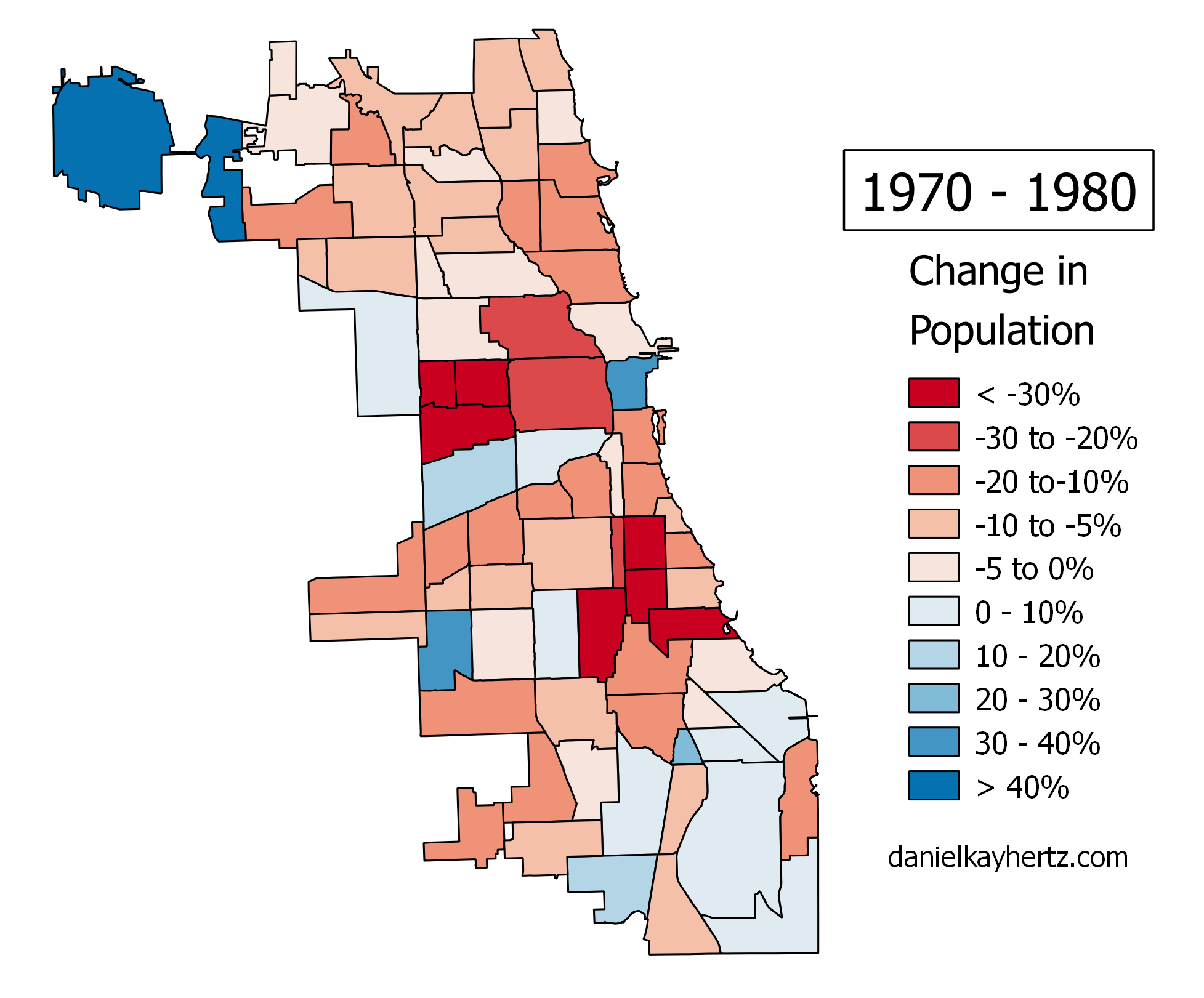
1970s. Population at the end of the decade: 3,005,000. Down 362,000.

The wave of extreme depopulation following ghettoization spreads outward to places like Englewood in the middle of the South Side and West Garfield Park on the far West Side. Also notable, though, that Latino immigration is by now leading to population gains along a sliver of the Southwest Side, through Pilsen and Little Village.

90

1980s. Population at the end of the decade: 2,784,000. Down 221,000.

Depopulation continues on the South and West Sides, especially in and around areas where black people have moved. Latino immigration expands the area of growth on the Southwest Side. Large parts of the North Side are also stabilizing after several decades of decline, especially where there are immigrants.

00

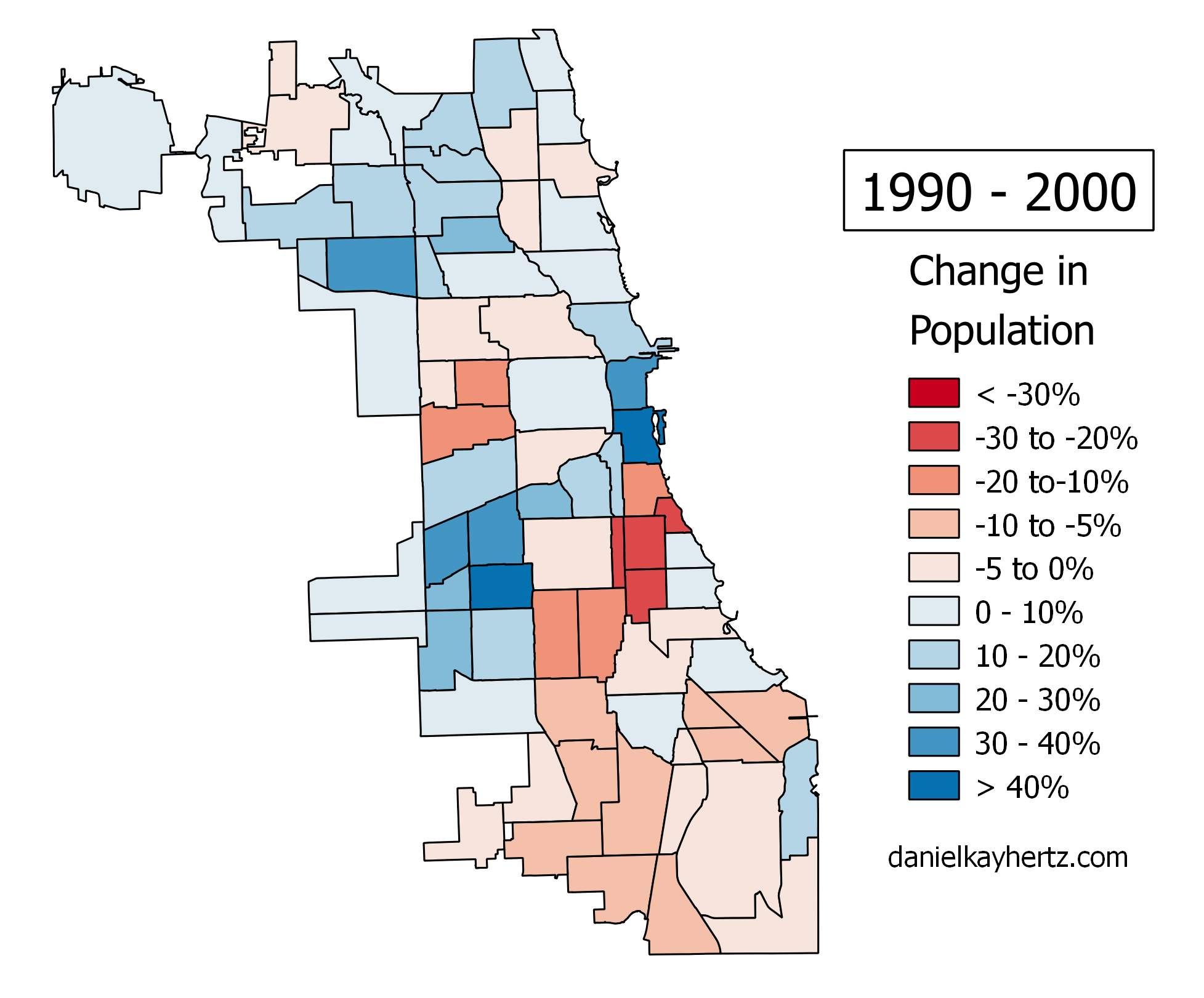
1990s. Population at the end of the decade: 2,896,000. Up 112,000.

The first increase in population since WWII. There’s a huge increase in the number of Latinos, and they move into neighborhoods throughout the Southwest and Northwest Sides. Downtown and the north lakefront neighborhoods see rapid gentrification, although outside of downtown, restrictive zoning prevents that gentrification from turning into significant population gains. Hyde Park and South Kenwood – the light-blue areas along the south lakefront – have also stabilized. Meanwhile, the public housing projects built in the 50s and 60s have officially been declared failures, and the Hope VI federal initiative gives cities an incentive to redevelop those projects as mixed-income housing. The Chicago Housing Authority begins letting the projects empty out before demolishing virtually all of them in the next decade; I suspect that goes a long way to explaining the continuing rapid decline in population in greater Bronzeville. Early this decade is also the peak of the crack-era crime wave, and Bronzeville, not coincidentally, is perhaps the single most dangerous place in the city.

10

2000s. Population at the end of the decade: 2,696,000. Down 200,000.

Massive construction and population growth downtown is more than offset by declines virtually everywhere else in the city. The wave of Latino population growth has crested and begun to move out into the very outer neighborhoods and suburbs. Blacks leave the South and West Sides, including many who are displaced when the last of the public housing towers are torn down, and no one comes to replace them. Meanwhile, restrictive zoning on the North Side means that even as places like Lincoln Park and Lakeview reach all-time highs in prestige and median income, new construction mostly takes the form of luxury buildings replacing older buildings with roughly the same number of units. These neighborhoods remain 20% to 60% below their peak populations.

PopGIF


Where did Chicago’s population decline?

Recently I’ve been doing a bit of digging into Chicago’s population figures, with the general research question being: what parts of the city have seen their population fall the most? There are a number of reasons that population matters, beyond civic pride: tax receipts, for example, as well as a consumer base for local businesses. Because jobs generally follow people, a shrinking center city also means that a larger percentage of jobs will be out in the suburbs, far from public transit, making that transit worth less and less to people who would like to use it to commute. As a result, people either a) just don’t have access to lots of jobs, b) spend a huge amount of time commuting, which they can’t spend, say, taking night classes or caring for their kids, or c) spend a bunch of money on a car, which is money they’re not spending on, say, night classes or caring for their kids.

Anyway, here’s a quick overview map:

Decline5010

A few notes:

1. The historic “black belt” – the area from roughly 26th down to Woodlawn (the neighborhood), from the Dan Ryan to the lake – got hammered. This isn’t surprising for a number of reasons. The first is that the black belt – especially the older parts in central Bronzeville – was horrifically overcrowded in the 1940s. In Making the Second Ghetto, Arnold Hirsch estimates that there were three times more people than were meant to live in the housing that existed. (Why were they so overcrowded? Because black people weren’t allowed to live anywhere else, and a huge wave of migration from the South had dramatically increased the city’s black population. Shortly thereafter, South Side whites began to flee for the suburbs, and Bronzeville began to empty of the relatively better-off black households who could afford to move further south.) Most of the others have to do with urban renewal, and the purposeful removal of people from potentially high-value land near the city center.

2. The difference between North and South Lawndale – the dark red area just above the dark blue area on the western edge of the city – is here, as in so many other ways, illustrative of the effects of public and private disinvestment and shunning on black communities, as opposed to working-class white and immigrant ones.

3. The wealthy north lakefront neighborhoods have lost significant population, contrary to popular belief. Lakeview is down over 20%; Lincoln Park, over 30; and West Town (not lakefront, but home to Wicker Park, Bucktown, and Ukrainian Village) is down over 40%. Why? A combination of a) a dramatic decline in the number of people living in any given housing unit, as large families were replaced by smaller families, childless couples, and people living alone; and b) a decline, or at best stagnation, in the number of housing units thanks to zoning restrictions.

More on all this later.