From the comments: On being part of Chicago’s black middle class

Last week, my post on where Chicago’s black middle class lives was republished at Crain’s. From there, it received many responses making many different points, which I might take on in a separate post at some point. But for the moment I wanted to highlight two recent comments left at the original piece.

DanaC:

My friends and I are all college educated, (many with MAs) Black twenty something’s who are looking to establish roots soon. Most of us have any desire to move to Chicago from the burbs (South Holland, Olympia Fields etc). Personally, despite the great amenities the North side has to offer, I am very apprehensive about living there because of higher rent and racial tensions (and frankly ,in my experience, north siders just aren’t as friendly). However, living on a more friendly (and adorable) south side means no grocery stores, no shopping, no restaurants, no nightlife, no fun. The south burbs aren’t as bad but are still generally lacking in amenities. Here’s an experiment, on google maps, look up your favorite places (Target, Starbucks, Thai food restaurants etc) you’ll find next to none on the south side. So what many (and I mean MANY) of us would prefer is to move out of state all together. That sounds extreme, but I literally feel that I have nowhere to live in Chicago.

Naomi Davis:

I imagine some rationale for lower household incomes for African Americans living north is that a significant percentage could be early career professionals, living single, making modest incomes relative to established families and professionals in their areas. I lived the majority of my years in Chicago as one such professional, only moving to the south side to combat cultural isolation and to pursue my life’s work in a social milieu I assumed would be more supportive to dating, marriage, community-building. People of color in the neighborhoods where I lived/loved for decades – Lincoln Park, Old Town, Uptown, Edgewater, Rogers Park, Bucktown – were either just like me or low-wage immigrants or low-income families, arguably remnants of pre-gentrification, but not necessarily the “public housing/SRO” enclaves referenced in previous entries. I also appreciate this more nuanced conversation around race and household income, core to my work. I bristle at the notion that a prime way to improve life in African American neighborhoods is to import whites – a surprisingly common thought. While my org actively invites blacks with higher incomes to “move back home” to our hard-won legacy communities, I’m always surprised that few consider the complementary alternative of helping lower-wage families increase their household income – again, core to my work. Complicated, of course, by seemingly implacable structures holding poverty in place. Implacable perhaps, but not impossible to transform. Gets me out of bed in the morning, anyway. Many thanks for your thoughts. I look forward to hearing more.

A credit to their race

Okay, I have abandoned not one but *two* draft posts tonight, but this has to be finished because it’s just so amazing.

I’m going to choose to interpret this as a piece of truly inspired trolling on the part of Ms. Preckwinkle, who is extremely smart and not averse to some good trolling now and then.

Who is she trolling? She’s trolling the people that Natalie Moore is talking about at the end of her appearance this week on Chicago Newsroom:

MOORE: I didn’t love [Kenny Williams’ speech at the Jackie Robinson victory rally downtown]. I think telling an audience – this assumption that every black youth is going to pick up a gun. Inspiration is good, but these boys are – you’re preaching to the choir. “Pick up a book, not a gun!” This is the rally for kids who have done that!

It’s not, of course, just about Kenny Williams. The JRW Little League team’s US championship has been mostly reported on through the prism of the boys’ race and fictitiously terrible neighborhoods, because even when black kids excel at the most normal, all-American thing there could possibly be – Little League baseball – we require elaborate storytelling to explain how it’s actually all about how these kids are rising above their broken black communities, not just doing something that’s exceptional by the most universal, mundane standards of American childhood.

Now, that’s more than a little unfair. To begin with, the presence an all-black team at the Little League World Series is not a normal event. Moreover, the South Side does, in fact, have more than its share of problems, and even if the particular areas where these kids are from have fewer of those problems, it’s not unreasonable to see this as a particularly happy thing to happen in that broader context. Certainly, many of the people on the South Side feel that way.

On the other hand, I think it is even less fair to a) tell a bunch of children who have only barely hit puberty that they carry the burden of representing to the world that black kids on the South Side can do something other than shoot each other, and then b) turn around and lecture them at their own victory party about how they really should be sure not to shoot each other.

In short, we have utterly refused to untether from these boys the albatross of being black, and particularly of being black from the South Side of Chicago. At every turn we’ve communicated to them that what they’re doing matters first and foremost because of where they’re from, and what they look like; that excelling at something ordinary is the farthest thing we expect from black children, an achievement that surely requires constant vigilance, lest they revert to their natural state.

In other words, this whole time we’ve been telling the pre-teens on JRW that they’re a credit to their race. If it sounds offensive and outdated when Toni says it, that’s only because we haven’t bothered to listen to ourselves.

Excerpts from “The Formation of American Local Governments,” by Nancy Burns

Scholars have argued that part of the reason for the Salem witch trials was that Salem Town refused to let Salem Village secede to form an independent town. The residents of Salem Village faced land constraints and consequent decreasing income; the residents of Salem Town had access to other forms of income because the male residents there were largely merchants. Salem Village repeatedly petitioned for its own government; just as repeatedly, Salem Town refused. The Salem witch trial accusers were from Salem Village; the accused were from Salem Town. (p. 34)


Exclusionary zeal in various forms has been a part of American local institutions from their beginning…. The earliest tradition is the establishment of towns that create economic homogeneity…. In the seventeenth century this process was led by English merchants who planned the colonization of New England. The resulting communities are exemplified by the founding of Watertown, Massachusetts, in the late 1630s: “Everyone hoped that there would be no poor, and Watertown had made special provisions to exclude them.” To that end, they established that “anyone who ‘may prove chargeable to the town’ could be ordered to leave.” (p. 35)


Church groups in St. Louis decided to purchase twelve acres of land in Black Jack, Missouri, an unincorporated section of St. Louis County, in 1969. The land was zoned for multiple-family dwellings. The groups planned to build racially integrated, moderate-income housing on the site. Almost immediately, the white residents of the area…petitioned the St. Louis County Council to incorporate the area. They succeeded. Immediately upon forming the municipality, they zoned apartments – including publicly funded ones – out of the city. (p. 36)


“The real issue is not taxes, nor water, nor street cars – it is a much greater question than either. It is the moral control of our village. Under local government we can absolutely control every objectionable thing that may try to enter our limits.” – suburban Chicago newspaper editorial in favor of incorporating as a separate municipality, 1907  (p. 37)


“Planners and zoning experts often appeal to their clients, that zoning for height and lot area, and sometimes other items, will protect them from ‘undesirable neighbors.’ In fact, all the arguments adduced to show that zoning protects property values are meaningless unless they imply this important element in the determination of values. No height restriction, street width or unbuilt lot area will prevent prices from tottering in a good residential neighborhood unless it helps at the same time to keep out Negroes, Japanese, Armenians, or whatever race most jars the natives.” – Bruno Lasker, academic, 1920  (p. 57)

Americans have discovered in local institutions effective barriers to racial and economic segregation. Living within particular city boundaries means that schools will not be integrated, that neighborhoods will not be integrated, that offensive industry will not be apparent, and that taxes will not be higher. It also means that the problems of people in other – even, and especially, neighboring – cities will be considered irrelevant to local politics….

Because municipal boundaries can be boundaries between races and classes, boundaries that reinforce homogeneity, the possibilities for transformative public discussion in local politics are severely limited.

Moreover, the space we have created for local political autonomy means that we allow local boundaries to define citizenship, and we allow that definition of citizenship to carry weight in American politics. Boundaries, and the import we give to them, can thus legally impede desegregation efforts, halt efforts at redistribution, and restrict access to services. (p. 117)

The South Side: Not actually an unmitigated sea of misery

As I’ve written before, the South Side is a much more diverse place than people give it credit for. This is true both in the ethnic sense – you can find Asian, Hispanic, white, black, and, yes, integrated neighborhoods there – and in the sense that for each of these ethnic categories, there’s a range of economic conditions.

Pete Saunders has a nice post reminding people of this second fact, by pointing out that the kids on the Jackie Robinson Little League team (and US champions, by the by) mostly come from neighborhoods that don’t actually fit the storyline some media outlets have chosen to put on them. That is, they did not all emerge from broken homes, dodging bullets as they cut through trash-strewn lots to the baseball diamond, which was the one outlet they had to seek relief from their impoverished ghetto.

No, in fact, this is what the houses across the street from Jackie Robinson Park look like:

roseland1

And here’s a random block from a few streets away:

roseland2

If you look at the maps of the black middle class I made a bit ago, you can see the far South Side neighborhoods that make up the area around Jackie Robinson Park lit up in blue:

B45per

Now, that’s not to say that these neighborhoods don’t have problems. Like many, if not most, working- and middle-class neighborhoods in America, they’ve seen significant losses of well-paying jobs over the last several decades. Like most black neighborhoods in America, they’ve been shaped by a legacy of segregation that’s dramatically increased the concentration of poverty there, compared to working- and middle-class neighborhoods that aren’t black, and they have some of the issues that come with relatively higher poverty rates, like relatively higher crime rates. But they’re also, as Pete points out, not generally dangerous in the way that outsiders imagine every black neighborhood on the South Side is.

Roseland – one of the neighborhoods where a lot of the Robinson players are from – also happens to be home to Gwendolyn Brooks College Prep, which Chicago Magazine named the fifth-best public high school in the city, just below the four super-elite test-in academies, and higher than another North Side selective-enrollment school, Lane Tech. Its average ACT score is even with Niles West, a well-regarded north suburban school that serves a significantly more affluent population.

Gwendolyn Brooks College Prep

Near Brooks is Poe Elementary, which that same issue of Chicago Magazine ranked as the fifth-best public elementary school in the city, above many of the neighborhood schools – and even a handful of selective enrollment schools – in places like Lincoln Park and Lakeview that have become the default option for the city’s “global city” class. Three other Far South Side schools made the top ten, two of them in black neighborhoods.

There’s something to all this – to my laying out the case that you should think of the South Side as a place where people live, and where they accomplish things that they and other people find admirable, like keeping tidy lawns, or playing baseball extremely well, or supporting high-achieving schools – that’s very noxious. That is to say, it assumes that a) the personhood, and respectability, of these people is in doubt, and b) that the esteem of the people who doubt it – the North Siders and suburbanites and newspaper writers and readers all around the country – is necessary, that it’s not enough that the residents of these neighborhoods are, in fact, people.

My indignance – not to mention the prospect of freeing up more time to write about things that shouldn’t be obvious – makes it tempting to declare that the esteem (or, at the moment, the ignorance) of the rest of the world doesn’t matter. Unfortunately, that’s plainly not true.

Brooks College Prep, the fifth-best public high school in the city, was at the receiving end of that ignorance last year, when parents from Walter Payton College Prep (number two on Chicago Magazine’s rankings) forfeit a game of baseball because they were too terrified of Roseland to allow their children to go to Brooks’ campus to play.

And if Payton parents – whose views, I imagine, are broadly representative of those “global city” households downtown and on the North Side, and in analogous neighborhoods across the country – won’t go to Roseland on a chartered bus to play a scheduled high school baseball game at one of the city’s elite selective enrollment high schools, they’re certainly not going there to spend any money at the local businesses, or to open businesses, or to visit the local sites, like the Pullman Historic District. Their ignorance demands that these places, and these people, be completely shunned.

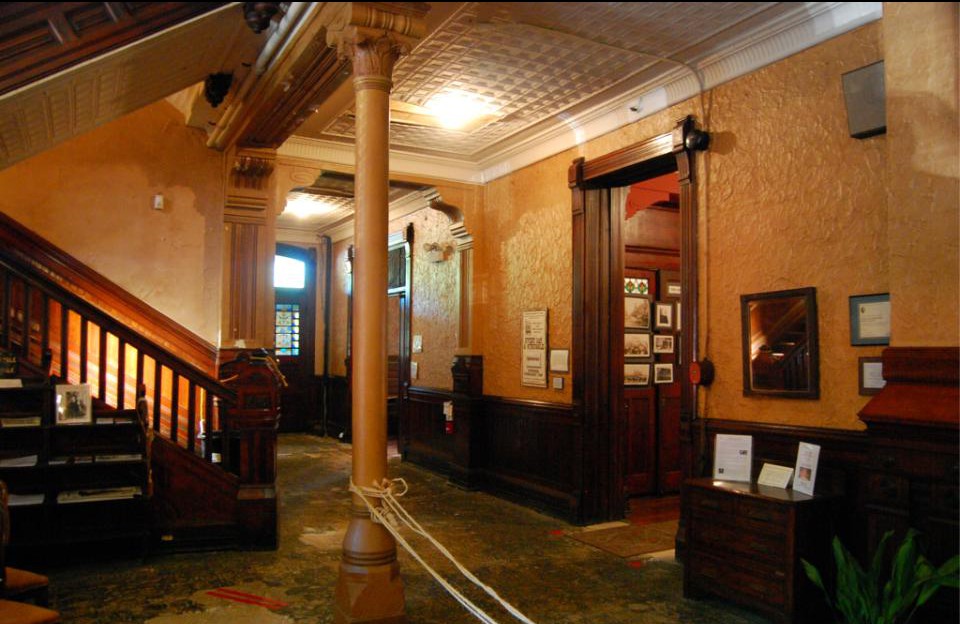
Lobby at the Hotel Florence in Pullman. Credit: Eric Allix Rogers

And while the parents themselves certainly deserve some blame for this, I’m going to go ahead and add it to the j’accuse from “The Dignity of Fifth-Graders” and ask that media outlets in Chicago and nationwide consider how their coverage of crime on the South Side has contributed to this situation. If you spend years telling your readers that the South Side is a “war zone,” then you don’t get to be surprised when your readers treat it like a war zone.

We don’t get to celebrate one baseball team’s worth of black kids from the South Side while we’re shunning all the rest.

The dignity of fifth-graders

In a timely development, the Columbia Journalism Review just published a long essay on how media outlets cover violent crime in Chicago. They interview a lot of very smart people, including some who have done some of the city’s best reporting already; the whole thing is worth a read.

There seems to be general agreement that the current coverage falls short in a variety of ways: that’s it too obsessed with “box scores” (X Killed Over Y Hours This Weekend), and can be too light on humanizing victims – both the people who are shot, and the family, friends, and neighbors who are also traumatized – and on explaining the larger picture, the social and economic forces that create Chicago’s landscape of crime.

But I think Natalie Moore, the South Side bureau chief for WBEZ, got to the heart of the issue best:

“What do we want people to know? Are we just trying to tell them to avoid the neighborhoods with many homicides?” Moore asks.

Obviously, ideally, you’re checking many boxes: that crime is a major problem in many neighborhoods; that its victims are real people, with families and lives that every reader should be able to empathize with, even white North Siders; that in most places, crime has been falling; that the concentration of crime in Chicago is the more or less predictable result of decades of segregation and economic decline; that in most ways, despite the violence, normal life continues in these neighborhoods: people go to work, to school, have birthdays, and so on.

But I think nearly as important as coming up with an ideal list is acknowledging that choosing one path over another involves tradeoffs. That sounds stupidly obvious, but I think it may be obscured by the coverage philosophy taken by both the Tribune and Sun-Times over the last several years. Both papers have committed themselves to covering every homicide in the city at a level of detail that, as Alex Kotlowitz says in the CJR piece, they have not, historically. The principle, as I understand it, is that each victim deserves the dignity of being recognized, of having their passing officially and publicly acknowledged, and that to do otherwise is an abdication of our collective responsibility to face one of our city’s ongoing tragedies.

That’s an admirable principle for a news organization to hold itself to, and it’s certainly an improvement over ignoring the issue, or pretending it’s not a big deal. But if that is the focus of scarce journalistic resources, then what does that say about our implicit answer to Natalie Moore’s question? More to the point, what are we saying we don’t think is important? Or – to really get down to it – whose dignity aren’t we upholding?

A class of fifth-graders in South Shore has some ideas about that:

We saw your news trucks and cameras here recently ad we read the articles, “Six shot in South Shore laundromat”…. You don’t really know us.

Those who don’t know us think this is a poor neighborhood, with abandoned buildings everywhere, with wood covering the windows and broken doors. They see the candy wrappers and empty juice bottles and think that we don’t care. Uneducated, jobless and thieves. You will be scared of these heartless people. When you see us coming, you might hurry and get in your car and lock the doors. Then speed through these streets at 60 mph like you’re on the highway, trying to get out of this ghetto.

We want you to know us.

The authors of those lines are ten and eleven, and they already know that they and all of their friends and all of their neighbors are pariahs. That is also a tragedy, and not one that any paper I’ve seen has seen fit to dedicate any journalistic resources to at all, prior to this op-ed.

Their pariahdom, of course, was not invented by the media. Its roots go back to the way white people reacted when black people began moving into their neighborhoods, not so long ago – the panic, the desperate attempts to use laws, violence, or anything within reach to keep black people as far from their homes as possible. In short, racism.

The South Shore Drill Team. Credit: Eric Allix Rogers

But a social phenomenon as widespread and powerful as the pariahdom of Chicago’s black communities requires ongoing rationalization, and by far the most powerful at the moment is an overwhelming fear of violence that is completely untethered from the reality of daily life in those neighborhoods. Visiting the South Shore Cultural Center, or getting a meal at Lem’s BBQ on 75th St., does not actually involve taking your life into your hands; but a huge number of North Siders, suburbanites, and non-Chicagoans who have been fed a steady diet of “war zone” stories for years think otherwise.

Fifth-graders in South Shore, and every other black neighborhood, are children like their peers everywhere else. They are not thugs to fear and mock. But a huge number of North Siders, suburbanites, and non-Chicagoans fear and mock them. And the fifth-graders know it.

That is also an affront to dignity.

I’m not, of course, under the impression that newspapers have the power to erase the legacy of racism. But I think that if the answer to “What do we want people to know?” doesn’t include “That you don’t have to be terrified of everyone, including fifth-graders,” we need to think about that some more. And if we think about it and decide that that is still our answer, we need to acknowledge what, and who, we have chosen to shortchange, and we need to have some very good reasons for it.

Things that are true about crime in Chicago

I can’t find the tweet, but the other day Chris Hayes (backed up by @prisonculture) was talking about how several facts that are often presented as contradictory are, in fact, simultaneously true. Here’s a partial list:

1. Crime is too high. This is the point from which discussions should begin, both to acknowledge that these conversations are, in fact, about the really intense suffering of human beings, and also to preemptively tether any further points to the very serious and sad reality they’re trying to describe.

2. Crime has fallen dramatically, both in the city as a whole and in the vast majority, if not all, neighborhoods. I’ve written about this; Andrew Papachristos, who has better credentials than me, has written about it.

3. Crime statistics in Chicago, as in many other cities, are manipulated. The two-part Chicago Magazine piece that came out a bit ago is the best place for details on the Chicago version, though if you’ve seen The Wire, you basically know the story. Note, though, that even the authors of the Chicago piece acknowledge that what they’ve uncovered doesn’t mean crime hasn’t been falling, even over the three-year period they investigated.

4. Chicago is nowhere near the “murder capital” of the United States, nor is it anywhere near as dangerous as wartime Iraq or Afghanistan. The media, by and large, has simply failed to do its job on this front, repeatedly claiming or strongly implying that Chicago is the most dangerous city in the country. It’s not even remotely true.

5. Chicago’s “murder inequality” has gotten worse, and may be worse than other cities’. I’ve written about this before.

You rarely see any one person make – or even acknowledge as true, despite what I would consider overwhelming evidence – all of these points at the same time. I suspect that’s because for reasons both general (police departments don’t like to admit to their own funny business; neighborhoods suffering from crime are loathe to be told things are getting better) and specific to Chicago (extreme, and mostly earned, distrust of the police; distrust of Mayor Emanuel; a strong national narrative about Chicago’s crime rates going back to the 1920s), conversations about crime tend to break down into “sides.” On one side – blatantly generalizing – are city officials and their supporters, who would like to emphasize that things are getting better, while acknowledging more quietly that things are still pretty bad. On the other are people who believe that city officials aren’t doing everything they could to prevent crime, and emphasize the extent to which the status quo is traumatic and unacceptable.

There are, of course, lots and lots of people who don’t fit easily into either of these camps. But to the extent you do, you’re likely to resist acknowledging some of the facts above, because you don’t think they help your side. If you’re Rahm Emanuel or with the CPD, you don’t necessarily want to talk a lot about the extent to which crime is a disaster in huge parts of the city, or the extent to which crime is suffered unequally – other than when you have to, for example after the Fourth of July weekend, at which point you’ll pound a lectern and then try to move on. If, on the other hand, you’re trying to press the case that Emanuel hasn’t done enough about crime, you might think that someone who talks about the fall in crime – or the fact that Chicago isn’t actually the most dangerous city in the country – is making excuses for policies that are costing people’s lives.

Since Rahm Emanuel and Garry McCarthy don’t make a habit of responding to this blog, I mostly get pushback from the latter group. When I write about Chicago’s fall in crime, or about the extent to which people exaggerate Chicago’s crime relative to other cities, I often hear from people who aren’t just incredulous about whether I’m telling the truth; they accuse me of actively wanting to sweep the problem under the rug. Given that I’ve written about how serious Chicago’s crime problem is on this blog and in national outlets, that seems a bit weird; but it’s true that if you see every conversation about crime as a debate between two “sides,” these facts don’t necessarily help theirs.

That said, they’re really important. Partly that’s just because they’re the truth, and promoting a culture that says it’s offensive to talk about facts that might not mesh with a given political program or narrative is a really terrible idea for all sorts of reasons. But it’s also because in the larger picture, the widely-believed falsehoods about Chicago crime – that it’s getting worse, and that it’s exceptionally bad in an American context – are actually devastating for the very neighborhoods that their deniers are dedicated to serving.

Fleck’s Coffee on 79th in Chatham. One of many really pleasant corners of the South Side that more people might know about if they weren’t so terrified. Credit: Strannik45, Flickr

As Robert Sampson wrote in Great American City, neighborhood reputation has an enormous impact – larger, in many cases, than the actual crime and poverty that reputation is supposed to reflect – on a community’s future trajectory: whether people will move in or leave; whether people will spend their money at local businesses; whether, in other words, the neighborhood thrives or suffers. Misinformation about crime is certainly not the only contributor to the negative reputation of Chicago’s black neighborhoods on the South and West Sides (and, to a lesser extent, Latino neighborhoods there) – there’s the heavy baggage of racism, among whose many tentacles (if you’ll forgive the mixed metaphor) an eagerness to believe in mythological quantities of violent crime is only one.

But myths about crime is one of them, and it is hard to read the coverage – and listen to how people talk about it – and read Sampson’s research, and conclude that it doesn’t have an effect.


On the subject of Metra

Got a couple other things in the works, but for the moment, a developer read my post at Streetsblog last week about how Metra needs to get some people near its damn stations and proposed a 20-story rental tower across the street from a station in suburban Park Ridge. Park Ridge is not amused:

“Something like this is not going to be well-taken. And it’s not well-taken by me,” said commissioner Jim Argionis.

“We can’t make this work. This can’t be done,” Kocisko said. He added that though the city may generate added property tax from the development, there would also be an increase in city services required for so many new residents.

Kirkby called the plan “preposterous” and compared the design to something that might be found in Chicago’s Gold Coast neighborhood or in Dubai.

A couple thoughts.

1. That is one ugly building. (There’s a rendering in the article I linked to.)

2. Park Ridge is exactly the kind of suburb/neighborhood that is hugely desirable and yet has used its zoning laws to keep out the kind of people for whom moving to Park Ridge would be a major advancement in terms of neighborhood safety, access to jobs, and high-quality public education. As of 2010, Park Ridge was 93% white, the median family income was $110,000, and the median house sold for $420,000. It’s got to be less than half an hour on Metra to downtown Chicago. And yet Park Ridge – like, say, Lincoln Park – actually lost population between 2000 and 2010.

3. In the real world, Park Ridge is never going to approve a 20-story glass box in the middle of a small, low-rise downtown surrounded by single family homes. But there is, in fact, a middle ground. Instead of saying “We can’t make this work,” a commissioner might say something like: “This plan as submitted doesn’t make sense for Park Ridge. But we know that we have to let our town grow. Come back to us with something that won’t look like it was airdropped in by mistake. Come back with a midrise, in other words, whose aesthetics match the expectations of the community.” There are ways to add density without sticking your finger quite as deeply into the eyes of your new neighbors.

Just for fun, here’s Park Ridge’s zoning map. See if you can find the places where apartments aren’t illegal! (Hint: It’s almost nowhere.)

parkridgezoning

Two for Thursday: Milliken and Metra

I have two pieces up elsewhere today. At the Washington Post, a look back on the 40th anniversary of the Supreme Court decision that reversed Brown v. Board of Ed:

In other realms, Roth’s logic – that political boundaries must be subservient to larger questions of justice, including segregation – is taken for granted. Think, for example, about Congressional districts. To start with, they’re redrawn every ten years to adjust to shifting populations. Not only that, but there are lots of rules designed to make sure the new districts aren’t unfair in ways that violate anyone’s civil rights. If they are, they can be thrown out by a judge, and ordered to be redrawn.

We go through all of this because we understand that unfair Congressional districts can be devastating for minority communities, denying them political power and, along with it, the ability to fight for policies that improve their lives.

School districts, of course, play just as large a role in determining their residents’ life chances, but share basically none of these rules.

And at Streetsblog Chicago, a post on ridership trends and the incredible wasted potential of Metra, Chicago’s commuter rail:

A coordinated effort between Metra, Chicago, and the suburbs to increase service and encourage development around walkable stations that serve relatively high population density could go a long way to improving access to jobs and amenities via transit for hundreds of thousands of people — and at a fraction of the cost of new rail construction.

At its most ambitious, that might look like the long-sought conversion of the Metra Electric line to true rapid transit — promoted most recently by the Transit Future campaign. But short of that, Metra could take a page from our sister city to the north, Toronto, whose commuter rail agency recently announced it would increase all-day frequency to every 30 minutes, making off-peak trips there much more convenient.

MetraRiders

Watch New York City’s middle class (and poor) get pushed around; or: the incredible invisibility of disadvantage in the proximity of privilege

EDIT: Actually, there is something in particular I’d like to get out of this. It’s similar to the point I made with the Brooklyn map: namely, that the invisibility of the poor and nonwhite when they aren’t interacting with more privileged people is just astounding. Look at Manhattan; look at the Bronx. Look, for that matter, at Brooklyn again. Whose stories do we hear?

That would be a stupid rhetorical question – duh, Daniel, we hear rich people’s stories – if it weren’t for the fact that even I, a person who has made this exact point multiple times before, was shocked at the extent to which very low-income neighborhoods persist in New York. Why was I so surprised? Because all people talk about is how New York has become a gated city of the ultra-rich. Because of the social bias that I just suggested was blindingly obvious. And which nevertheless, in this case, I fell for.

And if I fell for it in this case, then surely I’m still falling for it in dozens of others. Andrew Sullivan’s blog, for as long as I’ve read it, has carried on its masthead an Orwell quote: “To see what is in front of one’s nose needs a constant struggle.” That’s true in a very general way, of course, but it’s also worth remembering that it’s true in some pretty specific ways: for whatever reason, the struggle is particularly difficult when it’s poor or nonwhite people in front of your nose. That’s a lesson for anyone who cares about cities – or, you know, humans, since an interest in cities is at bottom an interest in humans and their habitats – whether you’re part of the media, or an urban planner, or a neighborhood activist, or just one of those humans in their habitat.


I’ve been holding onto this for a while, not quite sure what to do with it, but now I’m releasing it into the wild. It comes from the same data set and researchers (Sean Reardon and Kendra Bischoff) as the Chicago map, with the same disclaimer that any mistakes in the translation of spreadsheet to map are entirely of my own doing.

Anyway, I know much less about New York’s social geography than I do Chicago’s, so I won’t say too much, but several things obviously stick out here. One is that though Manhattan has almost entirely eliminated middle-class or economically balanced neighborhoods, the rest of the city has a good deal more of them than Chicago. To some extent, I suspect this has something to do with New York’s much more ambitious (and, sometimes, progressive) housing policy: fewer than half of tenants there live in pure market-rate housing. Although New York, like most of the rest of the country, would do well to allow more housing where there’s capacity, demand is high enough that lots of subsidies are likely called for.

The other thing is just how much of New York, currently a global symbol of gated-city affluence, is actually poor. Look, for example, at the Bronx: it’s a sea of red. A decent amount of Brooklyn, too. Another reminder of how the obsession with gentrification obscures the larger issue of income segregation.

Also: man, Harlem is gentrifying. That sort of dark-red-to-green is something you didn’t see too much in the Chicago map.

Finally, this map really ought to have a scale capable of showing the extremes of wealth in parts of Manhattan that just don’t exist in Chicago. Twice the metro median family income really doesn’t cut it.

* These are not polished maps: I just don’t have time to polish them, but I wanted to get them out, and the broad trends are pretty apparent. You’ll see that some tracts in Staten Island are missing until 1990-2000; I figure people don’t care that much about Staten Island. (Sorry, Staten Island.) Also there are some weird things that happen with tracts that include parks, where small populations are included where they weren’t before. Apologies.

NYGIF


frame_000 frame_001 frame_002 frame_003 frame_004

The “Take a stand against violence” slur

This is quick, but it’s one of my least favorite things:

As he has in the past, Emanuel said gun violence plaguing the city must be addressed in a variety of ways, which he said include policing, tougher gun laws, more investment to help children in impoverished neighborhoods and instilling a “shared sense of purpose and values” in communities across Chicago….

Right: similarly, the Mexican drug war began in 2006 when Mexicans suddenly found themselves without a shared sense of purpose and values.

Chicago gangland violence unleashed by Prohibition in the 1920s might have been assuaged if Chicagoans had just felt themselves more strongly to be part of a larger, purpose-driven community.

This slur – that violence could be prevented by the people who live in the neighborhoods it affects, if only they cared or tried hard enough – needs to end. For one, you only have to walk a few blocks in most of the communities most affected by crime in Chicago to see lots of indications that the people who live there – shock of shocks – are, in fact, “taking a stand” already.

You see signs like this all over the South Side. It’s almost as if black people like safe neighborhoods, too! Photo credit: yochicago.com

But what makes this trope really sublime is the fact that neither mayors, nor police commissioners, nor the most esteemed criminologists, have more than the barest understanding about why crime goes up or down to begin with. Concentrated poverty and unemployment can’t help, of course, but consider that crime continued to fall or remain steady in Chicago and the rest of the country during the worst economy since the Great Depression. So people like Mayor Emanuel, faced with a problem he doesn’t know how to fix, instinctively reach to blame the people who are most brutally affected.

Of course, this slur wouldn’t work if we weren’t so eager to believe that people who are poor or non-white – the people who disproportionately suffer from crime – are somehow less civilized, less moral, less interested in their communities, than everyone else. But that’s a lie.

So is “take a stand.” End it.