Media coverage of BRT continues to be stellar

The Atlantic Cities, which is usually better about this sort of thing, gets exactly eleven words into its latest feature about bus rapid transit in Chicago before stating something so obviously ridiculous it’s hard to imagine how the piece could recover. To wit:

Just ten years ago, living in Chicago without an automobile was considered eccentric behavior.

Was it? Really? The one out of four people who didn’t own cars back then, they were eccentric? Is that what “eccentric” means? Things that 25% of the population does?

No. Really, as he explains over the next few paragraphs, what he means is that among a certain set of professional-class people (the newsroom of the Tribune, specifically), it was considered eccentric. Or, not to put too fine a point on it, it was considered something poor people do. But now it’s considered acceptable for middle-class people, so hurray!

I don’t really need to write a whole thing about this, but I do want to point out that this kind of selection bias has been a huge problem in the debate over Ashland BRT, and over public transit more generally. That is, people who work for major media outlets, or people who run businesses, or people who are alderman – the people whose voices get heard the most – look around at their friends, who are also mostly privileged, and see that very few of them are in a position where paying for a car is a major financial burden. Better public transit, then, is at best a kind of luxury for them, and at worst a huge nuisance. Having observed these facts, the journalist/business owner/alderman decides that the cost-benefit calculation doesn’t work out, and opposes the new transit project.

Of course, the problem is that the general population doesn’t look anything like these people’s social circles.

That’s how you get this quote from one of the main BRT opponents:

One night in October, while canvassing businesses on behalf of BRT opponents, Wahl felt a pain in her stomach and went to the emergency room at the University of Illinois Medical Center on Ashland. She was fine, but the adventure highlighted what she sees as a major drawback of removing traffic lanes and increasing congestion.

“If that was post­-BRT, I’d have my husband driving in the BRT lane. If that was my daughter, I’d be driving on the sidewalk,” she said. “A bus to the ER? Are you kidding?”

I took a deep breath just now so I wouldn’t type this in all caps, but fuck it: A QUARTER OF YOUR NEIGHBORS ALREADY TAKE THE BUS TO THE ER BECAUSE THEY DON’T HAVE CARS.

That thing? That thing that is so ridiculous, so inconvenient that you use it as a punchline?

A QUARTER OF YOUR NEIGHBORS HAVE TO DO IT. NOW. THERE ARE SOME OF THEM LITERALLY ON THE BUS RIGHT NOW, ON THEIR WAY TO THE ER.

It’s not a punchline. It’s reality.

I’m not under the impression that people like Suzanne Wahl are going to be convinced by facts like this, of course. But at the very least it behooves journalists – whose job description is, literally, providing accurate depictions of reality to the general public – to take details like that into account in pieces like this. That involves not opening stories by providing wildly inaccurate context. It also involves giving a realistic account of who the stakeholders in this debate are. As with most stories from the Sun-Times and Tribune, this Atlantic Cities piece pretends that this is a debate between, on the one hand, neighborhood residents who drive, and on the other, government transportation planners and their transit-nerd friends. There is literally not a single quote from a person who just happens to ride the bus about what their commute is like now, what it would be like after BRT. Because why would we want to include them? They’re “eccentrics”!

Incidentally, this would also be an “opportunity growth” area for the largely white subculture of urbanism to recognize that other, nonwhite people live in cities. Some of them ride the bus, too. Some of them care about their buses. I bet they’d love to talk to you.

Why is urbanism so white?

The answer has to start, of course, with an acknowledgment that there are multiple things one might call “urbanism,” and that not all of them are notably white. Within recent memory here in Chicago, for example, majority-Latino and majority-black organizations have led marches supporting better bus service and El extensions, and housing activists tend to be a reasonably diverse bunch.

That said, the people who tend to use the term “urbanist” to describe themselves – and the ones whose ideas and political programs are represented in national media outlets and departments of transportation across the country – tend, overwhelmingly, to be white. I suspect anyone who spends much time following “urbanist” news knows this to be true; but, if we need more concrete proof, Planetizen’s list of the “Top 100 Urban Thinkers,” selected by the votes of its readers, contains approximately three people of Hispanic origin and not a single black person. Whether or not this reflects an actual absence of important nonwhite urbanist thinkers (I’m doubtful), it certainly reflects the kinds of people urbanists look to for intellectual leadership.

As Pete Saunders wrote in this 2012 post (which directed me to the Planetizen list), this is curious. In most of the older, walkable, transit-oriented American cities where urbanists tend to congregate – New York, Chicago, Philadelphia, DC – whites are a minority. Even in Seattle and Minneapolis, which Aaron Renn once singled out for being urbanist causes celebres with notably pale inhabitants, nonwhites are about a third of the population. Moreover, up until very recently – and still, in certain circles – the very word “urban” was a euphemism for black people.

Saunders has a few ideas about this, and I think they mostly make sense. You should really read the post. But I would synthesize his points, and add a bit of my own ideas, like this:

1. Areas that were built up by the 1960s or so – the ones that are reasonably urbanist-friendly – were subject to public policies and social norms that basically ensured racial segregation, and also ensured that black areas would be starved of investment, and that most white areas would not. Then, of course,  we decided to tear down half of our inner-city black neighborhoods and replace them with highways, sports stadiums, or anything else that sounded better to the average midcentury city councilman than houses for black people. Thus, with some exceptions, when people think about urban black neighborhoods – the ones that still exist – the feelings they evoke are much more complicated, and less purely nostalgic and positive, than those felt by young white adults about the neighborhoods their parents and grandparents abandoned.

Moreover, it’s not totally clear how many trendy, vibrating* urban neighborhoods are unproblematic for large numbers of black or Latino people, given general preferences for places where your ethnic group makes up, at least, a large minority of the population (preferences obviously shared by white people, who however are not in the position of having to choose between vibrating urban spaces and being among their coethnics). This is a problem even in places where white people are generally surprised to hear it (for example, large parts of  Manhattan), and even the places that come immediately to mind as exceptions are also places where the white population is rapidly expanding.

Instead, the most prosperous black neighborhoods tend to be in the suburbs, or in relatively newer city neighborhoods – places like suburban DC or Calumet Heights in Chicago. It’s not an accident that Saunders writes of his own feelings in a more recent post:

I did not grow up in the suburbs.  I grew up in Detroit, albeit in a solidly stable, black middle class environment.  As a child, I never saw the suburbs as a place of stultifying soullessness or oppressive homogeneity.  I guess you have to grow up in them to view them that way.  I always viewed the suburbs as the other side of the new Wall, an escape from the messiness of the city.  I grew up a half mile from Eight Mile Road, Detroit’s northern boundary, and in the ’70s the differences between my side and the other side were pretty stark.  They still are.

In that context, a movement whose premise – whose ticket to membership – is the embrace of all things “urban,” and a corresponding disdain for suburbia, doesn’t make a ton of sense.

2. Urbanism, broadly speaking, is an optimistic, technocratic movement among people who believe – at their most cynical – that city governments can do the right thing, if only they are harangued enough. Suffice it to say that this worldview is somewhat harder to maintain while standing in a black neighborhood. Since most of the projects of urbanism are about using levers of public policy to reshape neighborhoods (even if, in very important ways, those policies would be liberalizing), there’s a sort of assumed trust in government, and if you don’t have that trust, the movement will be much less attractive to you. Given the sorts of interventions governments have taken in nonwhite neighborhoods, it’s reasonable to think that white people would be more likely to have that trust. (It’s probably worth taking this one more step and saying that, broadly, middle-class and especially educated upper-middle-class white people will be even more likely to have that kind of trust, and, indeed, I think urbanism is a pretty thoroughly upper-middle-class movement.)

Generally, it’s not ideal when a political movement in a democratic society is made up of a group of people who are wildly unrepresentative of the general population. Urbanists clearly have this problem. And it’s not just a matter of optics, or tokenism. Urbanism is still a relatively new, evolving movement, which is being shaped in front of our very eyes by the academics, writers, and activists we’ve just established are overwhelmingly white. If those shapers are missing important perspectives – the priorities, of, say, the majority of the people who live major American cities – they’re going to be missing a lot.

Partly, that suggests that urbanism is going to lean towards the yuppie variety, rather than the egalitarian. I’ve written about that issue before.

But it also suggests that even when you get people who are trying to construct an egalitarian urbanism, they’re going to have a skewed vision of what needs to be addressed. For example, they might spend an awful lot of time thinking and writing about gentrification, since educated upper-middle-class white people are much more likely to live in gentrifying neighborhoods than other people. They might spend less time thinking about, say, the problems associated with blue-collar inner-ring suburbs, where very few of them live, go to, or come from. Despite the fact that the latter is just as much – if not more – of a problem than the former, and that really they’re both part of the same problem, namely the way current policy encourages income segregation and damaging waves of investment and disinvestment.

Or you might also get people who are more invested in improving bicycling infrastructure – which is, to be fair, worthy in its own right – than bus networks, which carry orders of magnitude more people.

Anyway, I’m not sure what one does about all of this, except that if you’re part of an urbanist organization, you probably ought to make an active effort to reach out and recruit people from various neighborhoods and communities. And you ought to do it not by convincing them of things they don’t already believe, but by appealing to things they consider in their own self-interest. And if they don’t think anything you’re working on is in their self-interest, then you should probably re-evaluate what you’re working on.

* This is my announcement that I will hereafter never again use the word “vibrant,” which I hate, and when I am tempted I will instead use the word “vibrating.”

Crain’s Chicago…

…has republished a longer version of my post, “Zoning: It’s just insane.” From the new part:

But people have to live somewhere, and the city essentially has made it illegal to build any reasonable amount of new housing outside downtown. Most of us have probably been led to believe that Chicago’s population problems are all about the South and West sides, in neighborhoods where crime and economic issues are driving people out. But the other half of the problem is that the parts of the city among the most desirable urban areas in the country essentially have zoned population caps. Surely, you might think, a neighborhood like Lincoln Park grew its population over the course of the 2000s. But no. Lakeview? No. North Center? Completely flat. Wicker Park? Nope.

As always, the best part of this is the comments. Already someone has decided I’m a “loud-mouthed kid who arms himself with ‘facts.'” I guess I should arm myself with something else. I’m skeptical that anything will top the comment at Atlantic Cities that said, “This article is a joke to which, ‘Daniel Hertz is a masters student at the University of Chicago’ is the punchline.” But here’s hoping.

My first Atlantic Cities piece…

…is up. I’m not in love with the title, which I didn’t choose, but c’est la vie. But you should read it. Excerpt:

As Ta-Nehisi Coates has written, the ghetto is public policy. So, to an amazing extent, is gentrification, which is really only another face of the ghetto. If the market is amoral, casting aside Darwinian losers without regard for human dignity, then the legacy of urban governance in postwar America is deeply immoral, a targeted annihilation and segregation of any and all people — blacks, Appalachians, immigrants, the poor of any color or language — who happened to be of the wrong crowd. Gentrification on the scale we see it today would be nearly impossible without help from exclusionary zoning laws; nor is it clear what would have happened to the major American downtowns around which gentrification now orbits without the government removing hundreds of thousands of undesirables during urban renewal.

The Illinois Network of Charter Schools rebuts my numbers with…the same numbers

The Illinois Network of Charter Schools, the state’s main pro-charter advocacy organization, took exception to my earlier analysis of Chicago’s market in high schools. In particular, they don’t like my conclusion that charter schools represent a particularly troubling failure of that market, in that mediocre or poorly-performing charter schools seem to be attracting just as many students as high-performing charters.

Last week, the INCS’ Catherine Deutsch, a senior manager there, wrote a response in Catalyst Chicago, entitled “Charters not the problem with high school ‘market.'” In explaining where my analysis went wrong, the piece focused on two things I should have done with my data, but didn’t. The points are as follows:

1. “Focus on growth instead of attainment.”

This was one of the arguments Matt McCabe made in his response, and which I mostly conceded. Ideally, we would measure school quality by how much they help students grow, not whether they attract good students to begin with. It’s not totally clear, though, that it makes sense to use growth measures to compare charters and regular public schools.

Here’s why. Growth measures depend on comparing test scores across years: a class’ average score in 9th grade, for example, compared to the same class’ average four years later. But since not all students, obviously, are in the same position to make large gains, it matters that schools don’t skew their student body towards the most-disciplined, best-positioned children.

But many charter schools very clearly do just that. The Noble network of schools – which, incidentally, makes up all ten of the top-performing charter schools in the city according to growth – admits that it loses about 35% of each freshman class by senior year. Urban Prep, another star performer, has lost as much as half of its freshmen four years later. Why? Probably a lot of reasons, although at least in the case of Noble, discipline so harsh that it attracted Congressional attention (and collected $400,000 in student fines) might have something to do with it.

In any case, if you’re measuring growth in a given cohort of students, removing the least-disciplined third of the cohort is a great way to skew your numbers. I should be clear that I’m not accusing schools of doing this on purpose; but regardless of intent, the effect is the same. Regular public schools, on the other hand, are much more constrained in their ability to remove students. Maybe this is a good argument for not using growth; maybe it isn’t. But the matter isn’t nearly as cut and dry as the INCS piece suggests.

2. “Exclude selective schools.”

This was also part of Matt McCabe’s response; as I’ve written before, whether you want to do this depends on what question you’re asking. If we’re trying to judge families’ choices about where to send their kids, then of course it doesn’t make sense to punish them for not enrolling in schools they can’t enroll in.

But if we want to have a debate about whether letting students choose new schools will give them meaningfully better educational opportunities, then I’m not sure why we would begin that debate by agreeing to ignore the fact that nearly all of the city’s acceptable schools – let alone best – don’t allow students to choose them. As I’ve said before, this obviously isn’t the parents’ fault; but my original point wasn’t that families are getting a failing grade in making the “right” school choices, but that for a variety of reasons, students aren’t moving to above-average schools in anything like the numbers you would want for this to be a viable strategy. Matt McCabe, the INCS, and I all agree that the selective enrollment system is a major cause of this problem. I assume we all agree that the selective enrollment system isn’t going anywhere anytime soon. We disagree, I guess, as to whether that matters for the future of school-market-based reform strategies.

But for the sake of argument, I’ll concede the point, so we can move on to the big reveal: INCS’s redone version of my graphs, adjusted for these two points.
INCSgraphic

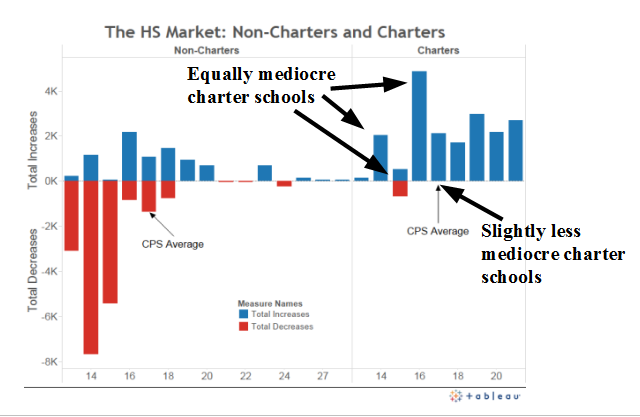
I don’t get it. Remember that the rebuttal’s central accusation is that I was wrong when I concluded that, in Deutsch’s words, “families are activating their option to leave their low-performing neighborhood school, but sometimes in favor of an equally mediocre charter school.” Now let’s turn back to the INCS’s graph, which I have annotated:

2014-02-16_12h01_40

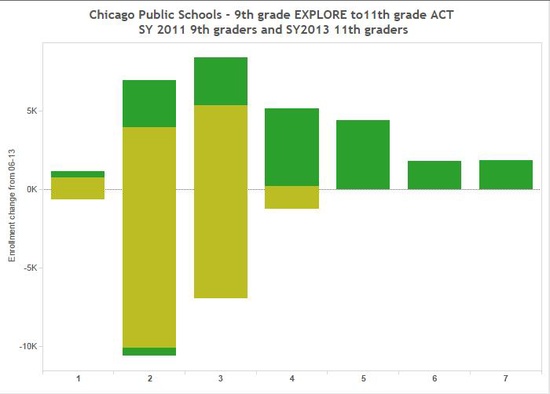
The overall proportions, in fact, don’t appear to be significantly different from what I originally found:

2014-02-16_12h11_50

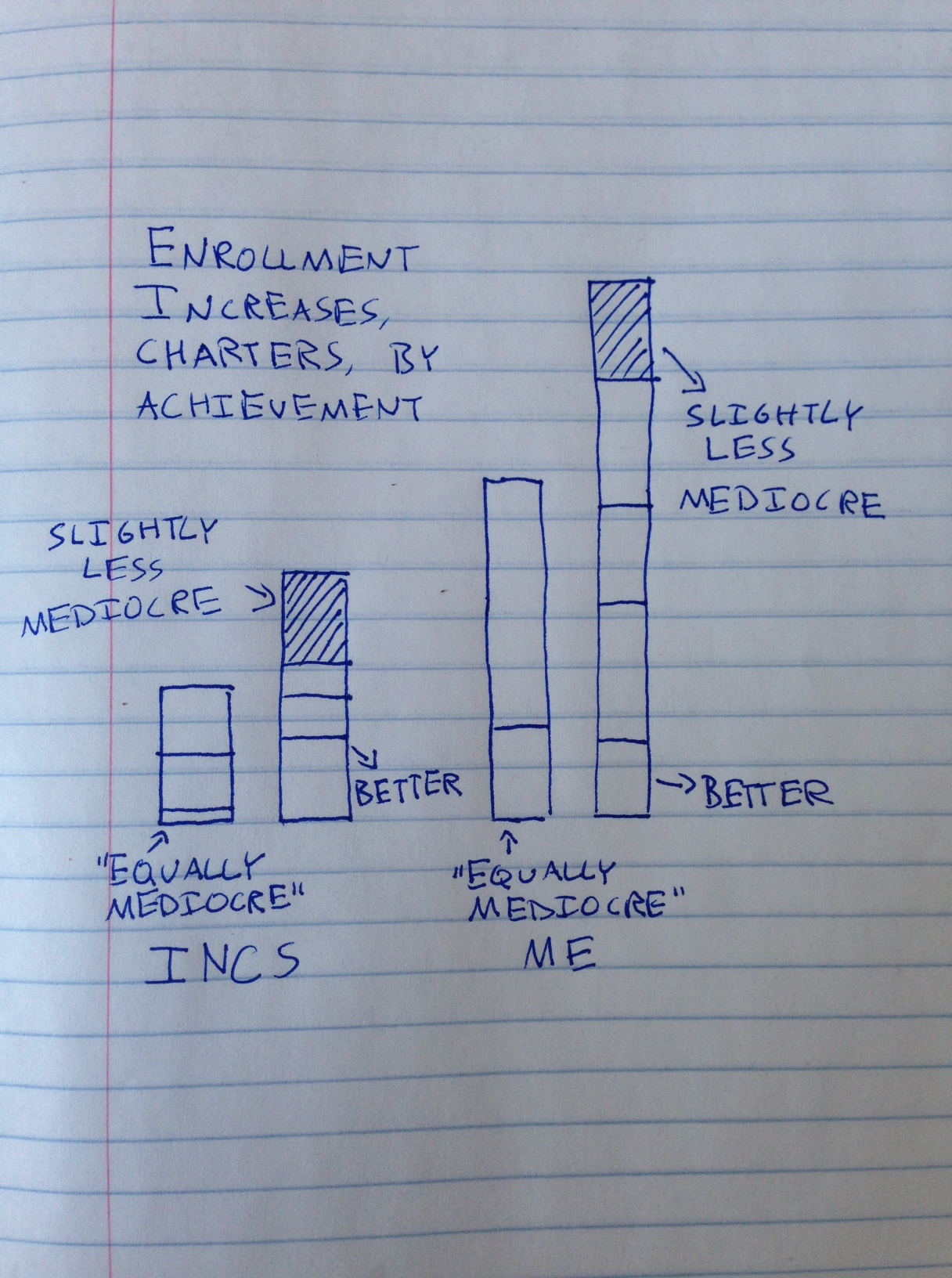
Using a semi-exact method (tracing the bars on a piece of paper over my computer screen), I compared the enrollment gains to “equally mediocre” and non-mediocre charter schools across our two graphs. Here’s what I got (it looks unofficial, but you can easily check for yourself at your desk in about 2.5 minutes):

photo

The INCS uses a different scale, so their bars are a bit shorter, but the ratio between the enrollment gains at “equally mediocre” and non-mediocre charter schools are almost exactly the same. If anything, my data is a bit more generous to charter schools, with a slightly higher unambiguously-better-to-“equally-mediocre” ratio.

So the Illinois Network of Charter Schools issued a rebuttal to my numbers by presenting their own numbers, which are the same as my numbers. In other words, regardless of what you think of points 1 and 2 above, there is no rebuttal hereThe analysis is pretty much the same either way: something like a third to forty percent of enrollment increases at charter schools happened at schools that are “equally mediocre” as low-performing CPS schools, and another sizable chunk happened at schools that are only slightly better. If INCS thinks those numbers are bad – bad enough that they felt the need to defend themselves publicly from them – then they have a much more serious problem than an unflattering op-ed. The system isn’t working, even by their own standards.

*

I would like to take all of this one step further, and touch on something that I mentioned only in passing in the original article, and which was not mentioned at all in the INCS response. That is, let’s suppose that students who move to new schools actually do choose better ones, where they get meaningfully better educations. (Although note that both I and the INCS have just provided data that strongly suggests that is not the case.) What then? What happens to losing schools, and the kids who don’t leave them?

The best-case scenario, I guess, is that the schools that lose students realize they have to shape up, and do whatever it takes to improve, and then stop losing kids. In other words, the market forces them to get better. But that seems dubious; we already know that major enrollment losses lead to major financial problems, which seems unlikely to be a catalyst for academic success. What’s more, it seems likely that the kids who are savvy and proactive enough to move to better schools will, on average, be from more advantageous backgrounds, and more academically motivated, than the kids who choose to stay in their terrible schools. Both of those things would suggest that being on the losing end of the market in schools would actually lead to a sort of downward spiral, where the best kids leave, making the quality of education worse, which causes more good students to leave, and so on.

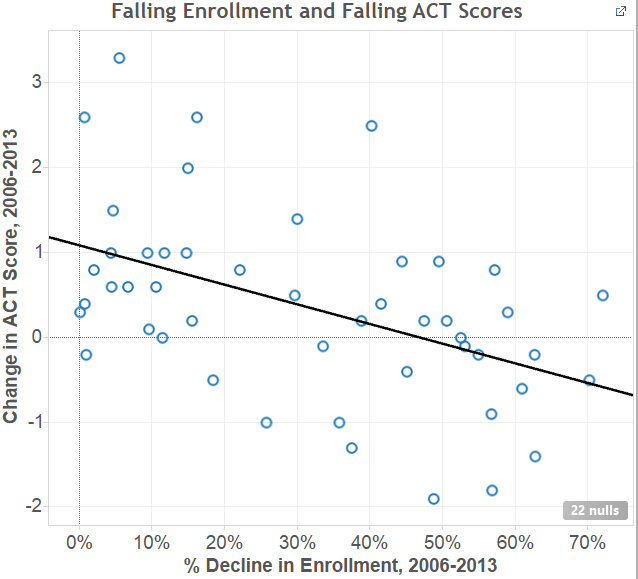
This is something we can make a graph of.

2014-02-16_14h35_29

In fact, it appears that every 20% decline in a school’s enrollment is associated with a half-point decrease in that school’s average ACT score. This isn’t slam-dunk evidence, of course: it can’t distinguish between academic decline caused by students leaving, and students leaving because of academic decline. But if there were a downward spiral effect, this is what it would look like.

So okay. Good kids leave bad schools; bad schools get worse. What do we do then? Probably, at some point, we declare that these bad schools are failing and under-enrolled, and we close them, and force all the remaining students to disperse to other schools. This causes an awful lot of disruption, and costs a lot of money in that we’ve created an under-used school for several years, and then have to find something to do with the empty building. It’s also – if last year’s closures were any indication – a fairly traumatic event for the community around the school.

But okay. We’ve closed the school, forced everyone to move to better ones. Are we done? Have we solved the problem of school quality, at the cost of closing dozens upon dozens of additional schools?

No. Let’s pretend for a moment that scattering the last holdouts from the district’s very worst-performing schools won’t have a negative effect on the quality of education at the schools that receive them, which up until this point have benefited from essentially culling better-than-average students from the system. Let’s pretend their scores and growth stay just like they are now.

They’re still unacceptably low. Only the very best of the Noble network’s schools – the ones that, remember, kick out something like the bottom third of their students from each class – end up graduating cohorts that have, on average, the bare minimum ACT score required for going to a four-year college. Basically everyone else is way below that. If we take the city’s rhetoric about college-readiness at face value, this doesn’t cut it.

So do we open up another generation of charter schools, which will poach students from the current ones, in a repeating cycle of opening and throwing away schools in the hope that, eventually, we’ll reach some acceptable level of education quality? Does that make any sense? What are the social and financial costs to that kind of strategy?

I guess you can be the judge of that. But I would be very interested to hear what INCS thinks is the happy ending to the school market strategy.

Urbanist Books of 2013

Been meaning to do this for a while – a brief rundown of city-related books I read in 2013. Highly recommended books are bolded.

1. The Warmth of Other Suns, Isabella Wilkerson

A history of the Great Migration told through the stories of three individuals who made the move from South to North at various points in the middle of the 20th century. Absolutely deserves the attention it’s got. Not only provides a different angle on the issue of mid-century northern urban racial dynamics, but serves as a kind of bridge in the story of American caste structure between the “feudal” Jim Crow South and “modern” urban renewal in the North. That’s a link that gets buried way too much, and Wilkerson does a great job in illuminating it.

2. Making the Second Ghetto, Arnold Hirsch

The classic history of how Chicago got to be one of the most segregated cities in the developed world. The state power side of things is fairly well-known, but the connections with “polite” civic society groups and organized terrorist organizations – and the sometimes blurry lines between them – aren’t.

3. Black Chicago, Allan Spear

Basically a prequel to Hirsch’s book that covers the original formation of the ghetto between 1890-1920. (Hirsch’s book focuses on the middle of the 20th century.) More state coercion, concerned middle-class white citizens and violence. The history of the ideological and political development of the black community in Chicago is pretty fascinating.

4. The Power Broker, Robert Caro

What even to say? Only that Robert Moses puts Old Man Daley to shame, almost.

5. Gang Leader for a Day, Sudhir Venkatesh

Entertaining enough, but I’m not sure it’s actually more educational than The Wire.

6. The Declining Significance of Race, William Julius Wilson

7. Blueprint for Disaster, D. Bradford Hunt

A history of Chicago’s public housing program. Good to read with Radler’s Modern Housing below. Basic thesis is that extreme targeting to the poorest of the poor – driven both by liberals who wanted to help the most needy and conservatives and moderates who wanted to be sure they weren’t crowding out the private market – drove the system into a death spiral. Also spends a lot of time on the unusual but somewhat convincing idea that focusing on serving large families created an untenably large proportion of children in high-rise towers. Spends some time, though I wish it were more, contrasting with NYC’s comparatively successful program.

8. Family Properties, Beryl Satter

Story of Chicago’s movement against housing contract sales, the incredibly risky and exploitative financial tool blacks used to buy homes when they were redlined out of mortgages. If you’ve never heard of contract sales, you owe it to yourself to read this book. As crucial a part of the story of “how Chicago got to be that way” as Second Ghetto.

9. Modern Housing for America, Gail Radford

Fascinating story of the battle between – as Radler puts it – the reformers and the modernists in the fight for a public housing program, beginning in the Victorian era of Riis and going through the Settlement House movement and cresting in the Roosevelt and Truman administrations. The victory of the reformers, in some ways, drew the “blueprint for disaster” of Hayes’ book.

10. Origins of the Urban Crisis, Thomas Sugrue

The main lesson here is that Detroit is even more fucked than Chicago, and that it’s been that way for a long time. Still, the main reason to read this is if you don’t have time to read Sugrue’s Sweet Land of Liberty.

11. Block by Block, Amanda Seligman

Covers a lot of the same ground as Satter and Hirsch. Good, but I think the others are better.

12. Housing Policy in the United States, Alex Schwartz

Actually very readable as a survey of…you know.

13. A  Better Way to Zone, Donald Elliott

A very fast read. If you’ve got a passing familiarity with zoning issues, it’s worth a look.

14. Contemporary Urban Planning, John Levy

A good introduction.

15. The Great Inversion, Alan Ehrenhalt

Marshals a lot of evidence for a phenomenon that is already conventional wisdom in most urbanist circles.

16. Sweet Land of Liberty, Thomas Sugrue

If it’s criminal that every Chicagoan – even people passing through O’Hare – hasn’t read Second Ghetto, it’s criminal that every American hasn’t read this book. A history of the civil rights movement in the North, the book’s first task is to prove that its subject exists.

17. Rethinking Federal Housing Policy, Ed Glaeser and Gyourko

Whatever your already-existing feelings about housing policy, if you’re going to be part of the debate, you owe it to yourself and everyone around you to read this book. The opening diagnosis of America’s dual housing crises – one for the middle class in elite cities caused by supply restrictions, the other for the poor everywhere caused simply by a lack of resources – is worth getting the book by itself. Most of the rest of the book is a systematic presentation of the overwhelming case against severe development restrictions, along with evidence that the true purpose of restrictions is actually exclusionary, instead of promoting some sort of common-sense urban form. Finally, a proposal for a federal program to encourage housing production and create affordable housing. Read it.

18. Human Transit, Jarrett Walker

Walker, in my opinion, has the best flavor of urbanism’s transit conventional wisdom (he sets a lot of it). This is his blog in book form. Worth it for reference.

19. The City That Became Safe, Franklin Zimring

A frustrating book (not entirely Zimring’s fault) that boils down to: We don’t know why American crime rates fell 40% between 1990 and the late 2000s. We also don’t know why NYC’s crime rates fell an extra 40% on top of that. But it probably didn’t have anything to do with putting people in jail.

20. Sprawl: A Compact History, Robert Bruegmann

See here, here, and here. If you consider yourself an “urbanist,” this is a good book for checking your priors.

21. Sprawl Repair Manual

Pretty pictures. Things to dream about while you look out the window of your bus/car.

22. The New Urban Frontier, Neil Smith

A Marxist take on gentrification, which dispenses with the usual demand-side explanations (change in culture, Millennial desire for vibrancy, whatever), and sticks to a pure supply-side theory that basically posits that there is an inherent cycle to capital investments in real estate, and that after a long period of disinvestment in older areas, we have now reached the stage of reinvestment. Worth reading, although I think a fair amount is left out: why some older areas maintain their investment while others fade, and so on.

23. There Goes the ‘Hood, Lance Freeman

Sociological study of gentrification in Harlem and Brooklyn; comes to much more nuanced conclusions about its effects – and the opinions of existing residents – than the typical conversation on the subject. Quick read.

24. Mayor 1%, Kari Lyderson

Basically a short biography of Rahm Emanuel, followed by a greatest hits of everything the Chicago left hates him for. If you’ve been paying close attention, there isn’t a lot new here, but it does put it all in one place. And there are a couple great anecdotes from Rahm’s past.

You want bad BRT? I’ll give you bad BRT

While the Sun-Times continues its policy of acting shocked that anyone would consider it worth it to invest in a form of transit used by half a million people in Chicago (whose experiences and opinions she has scrupulously avoided covering), I went to visit my brother in St. Paul over the weekend, where I read this article about the Twin Cities’ newest version of highway-going BRT, called the Red Line.

The Red Line goes from the end of the Twin Cities’ first light rail line, way out in the suburbs, to a destination 11 miles even further out into the suburbs. (The Ashland BRT would be about 16 miles long, in the middle of the city.) Its full cost was about $110 million. (Ashland’s would be about $160 million.)

And the Red Line provides – it pains me even to type this – 800 rides per day.

This is an especially ludicrous number – a number so low that it would have been better, as far as social welfare goes, for the local transit agency to just have divvied up their $110 million and distributed it in envelopes sent out to random addresses in the Twin Cities – but it is much less atypical of contemporary American commuter transit projects than one would hope. In fact, many of the country’s new lines carry a ridiculously small number of people at a cost comparable (or greater than) Ashland’s.

The CTA, in contrast, is proposing upgrading a line that already has 30,000 trips per day, and which would carry something like 45,000 after the BRT transformation. That is a lot of people. It is hard to appreciate, I think, without understanding the current flavor of transit projects around the country, just how reasonable and good this is. Unfortunately, one of our main transit reporters seems not only to be unaware of that context, but to be uninterested in learning anything about it, let alone communicating any of her hard-won (Googled) education to the people she is paid to inform.

Thus we get sentences like this:

On Monday, Scheinfeld was asked [by the author] whether it was worth all of that trouble to shave just 7.5 minutes off round-trip bus travel across the Loop.

Right! It’s not like the entire point of the paper’s anti-BRT campaign has been to save Ashland drivers a similar amount of time. (Driving times on Ashland are predicted to increase about 10%, meaning a half-hour trip – which is almost certainly longer than the median driver spends on Ashland – would take about 3 minutes longer, or 6 minutes roundtrip.) Or that there’s another driver-friendly project costing four times as much as Ashland BRT without a proportional time benefit, which the Sun-Times seems to think is just fine.

You can do better than that, guys. Try harder.

EDIT: I should point out that this particular article was written by Fran Spielman, the Sun-Times‘ City Hall reporter, rather than Rosalind Rossi, the transportation reporter. But on this subject, Spielman seems to have taken Rossi’s lead hook, line and sinker.

On being a gentrifier

About two months ago, I convened a meeting of an urban book club at my apartment in Logan Square. The book in question was a scathing indictment of gentrification as a colonial project whose thesis we took turns more or less affirming. Every person in the room was white. Every person had graduated from a relatively prestigious four-year college. And every person was currently living in a neighborhood at some stage of gentrification.

What to call the tension between our conversation and our lives? Hypocrisy? Delusion? Something much worse?

Mine is a cohort – the youngish, college-educated, left-leaning set – that places a great deal of moral significance on geography. (Probably everyone does; I can only speak to our particular code.) Most of us believe in a moral imperative to reject the suburbs: to disavow environmentally-destructive sprawl, ethnic homogeneity, cultural sterility. In the city, well-to-do neighborhoods aren’t much better: you become a hoarder of privilege, sharing a home with the oppressive classes. And if you move to a poor or working-class neighborhood with your college degree, earning potential, and cultural power, the rents that rise in a ripple outward from you and your friends are just as damning.

As a result, we tend to carry a lot of guilt about our living arrangements. We have a lot of conversations about whether or not it’s acceptable to live in our current neighborhood, or the one we’d like to live in. Sometimes we reassure ourselves by discussing the obviously graver transgressions of the people who live in some other neighborhood. Sometimes we find solace in some part of the continuum of gentrification that we’re comfortable with: the very beginning, when you can kid yourself that your presence isn’t changing anything; or when the tipping point has tipped, and the damage has already been done.

And sometimes we pass around articles like this one, entitled “20 Ways Not To Be a Gentrifier in Oakland.” To be clear, I think most of the suggestions in the article are good ones, and without that title, I would endorse it wholeheartedly. But then they would be “20 Ways To Be a Considerate Neighbor,” or “20 Ways To Be a Decent Person.” It’s the title’s promise – learn how NOT to be a gentrifier! – that I think is misguided and dangerous.

That’s because – as the moral geography two paragraphs up indicates – there’s no way out of being a gentrifier, if you happen to have the social or economic capital that causes gentrification. Regardless of whether you say hi to people on the street or forge cross-cultural social ties, your presence in a non-white, non-affluent community will, in fact, make it easier for other liberal arts graduates to move in; to open businesses that cater to you, and not the previously existing residents; to induce landlords to renovate or redevelop their properties to attract other new, wealthier residents who want access to those businesses; and, if your city restricts housing supply (it does) and doesn’t have rent control (it probably doesn’t), to ultimately create an economically segregated neighborhood of the privileged.

Similarly, living in a neighborhood where market and regulatory forces have already pushed out the low-income means you are helping sustain the high cost of living there, and therefore helping to keep the area exclusive. You can’t escape the role you play in displacement any more than a white person can escape white privilege, because those are both systemic processes that have created your relevant status and assigned its consequences. Among the relevant classes, there is no division between “gentrifiers” and “non-gentrifiers.” You don’t get to opt out.

It’s still worth it, of course, to follow all the advice about respecting the people around you and all that. My point, though, is that you can’t stop there. Being considerate in your day-to-day interactions is a good start, but if you spend a lot of time fretting about your contributions to gentrification, I’d like to suggest that you have another kind of responsibility: to be aware of the underlying systemic processes and use what social and political power you have to change them.

In the case of gentrification, I think that means moving beyond the narrow issue of displacement – which I suspect dominates the conversation partly because it fits the narratives of personal guilt we find so fascinating – and to the more fundamental problem of economic segregation. That is, the fact that people get priced out of homes they already live in is only half the problem: the other half, which affects an order of magnitude more people, is that folks can’t move to neighborhoods they’d like to move to, and are stuck in neighborhoods with worse schools, more crime, and less access to jobs and amenities. That problem is easier to ignore for a variety of reasons, but it’s no less of a disaster.

What to do about all this, obviously, is up for debate, although I can’t imagine a solution that doesn’t involve 1) some kind of protections for people about to be evicted because of rising rents, 2) subsidies for the very low-income, and 3) an end to exclusionary caps on housing construction that keep prices artificially high. But I think it’s necessary to shift the debate away from how to achieve personal salvation for the sin of being a gentrifier – both on the part of ourselves or our peers, and on the part of developers and landlords who act according to the rules and incentives of the current system – to how we ought to change those rules and incentives. In other words, Mark Fishman is not why Logan Square is gentrifying. Neither are you, at least not in the ways you might think. But you can do something about it.

Myths about the Ashland BRT project

Having heard these lines from a bunch of people – including, just now, a thread on Everyblock – I submit, for the record:

1. The project is about “punishing” drivers.

Right now, the Ashland bus – which carries 30,000 people a day, roughly tied with Western for the most in the city – travels at about 8 mph, or less than *half* the speed of private cars. That’s ridiculous, and if drivers had to deal with that, they would raise hell – rightly. BRT will increase bus speeds by 80% while reducing driving speeds by only 10%. The project is about replacing the unacceptable current service with something decent for the tens of thousands of people who use it daily.

2. Devoting two lanes to buses is disproportionate, given how many people use them.

The BRT project would devote 33% of Ashland’s lanes to buses – there will still be two lanes for moving cars and two lanes for parked cars. About 30% of people who live near Ashland don’t even *own* a car. Moreover, every other street in the city – again, a city where over 25% of people don’t even have access to a car – is prioritized for automobiles. One-third of one street isn’t disproportionate.

3. BRT is expensive.

BRT will cost about $10 million per mile, 80% of which will be paid for by the federal government. Light rail costs about 50 times more; a subway would actually cost about $1 billion per mile. In other words, we can get 16 miles of BRT for roughly the cost of a single subway station. BRT is by far the most cost-effective, fiscally responsible public transit investment we can make.

4. The Ashland-Western Coalition’s MEB proposal would be cheaper and just as good.

Since the MEB wouldn’t have its own lanes, it would get stuck in traffic just like the current #9. The only thing that would speed it up would be having half as many stops – but the old 9 express, which had 1/4 as many stops, only went 10% faster than the regular #9. BRT would increase speeds by 8 times as much. Moreover, the improvements the MEB calls for – like heated stations – would easily cost as much or more than BRT.

5. There are other good options for moving more people, faster, along Ashland.

We’re close to the limit of moving people efficiently along Ashland in its current configuration. We’re not likely to widen the street – or any others near it – because that would involve bulldozing tens of thousands of homes and businesses. The only way to make the street more efficient is to use more efficient modes – and buses can carry way more people per hour in the same amount of space than can private cars.

I don’t think everyone has to be excited about this – if you drive on Ashland, you probably will go about 10% slower – but you should know how much this project will mean to many, many of your neighbors, and to the economic vitality of the city as a whole, as a result of more efficient, faster transportation.

School Markets, cont.

Teacher and writer Matt McCabe wrote a thoughtful response to my earlier post about the market in high schools, including four pieces of constructive criticism (I paraphrase):

  1. Including selective enrollment schools in the pool of data will skew results to make it look like there is not much self selection for students to move to the top schools.
  2. Using ACT growth over three years would better measure of educational quality than just the junior-year ACT score.
  3. High school is geographically constraining; good schools may be far away.
  4. New schools don’t have a record for parents to make decisions based on, and ACT scores aren’t the only things that matter to parents.

All of this seems right to me. In fact, I mention points 1 and 3  in the original post, but I don’t think that’s an “issue” as much as it suggests that Matt and I are thinking of slightly different questions. It may in fact be the case that, with fewer constraints, parents would create a more functional market than currently exists. But my point wasn’t that parents were failing to make the right choices: it was that, for whatever reason, the market is failing to push students towards the district’s best schools. If the reasons turn out to be structural – as it seems that Matt and I agree it is, largely – that seems just as serious a problem. If parents were the issue, we might hold out hope that they would make better decisions with better information or a more streamlined application process. But if the best schools – not just the best, but a huge percentage of even acceptable schools – are either 1) gated to all but the highest-achieving students or 2) unreasonably far away, it doesn’t seem super clear what realistic market-based solutions there are to that.

Point 2 is just right: that would have made a better analysis, and I didn’t do it mainly because it would have taken much more time. I think what I did is enough to establish the basic idea, though.

Point 4 is I think the most interesting. Why, exactly, do parents send their kids to new, unproven charter schools? What sorts of qualities offset poor testing performance? I don’t know. I would love to hear what parents, teachers or administrators have to say about that, because it seems like a question that would be difficult to answer with data.