This is not encouraging

Let’s think about what a best-case scenario would be re: active desegregation efforts within CPS. Probably we’d be talking about two schools very close to each other, since busing crosstown – into neighborhoods that parents from both sending and receiving schools are unfamiliar with – is probably a no-go. Probably we’d be talking about schools in relatively wealthy, mostly white areas, to minimize the intimidation factor for the middle-class parents whose tentative approval would be needed for local officials to feel comfortable pursuing desegregation. Probably we’d be talking about an area where there had been a recent history of school gentrification, so local parents understood the successful track record of low-performing, high-poverty schools receiving a critical mass of middle-class students and seeing their test scores skyrocket. Those are the conditions in which I’d be most optimistic about seeing some integration efforts.

Oh well.

Parents from Lincoln Elementary reacted at Wednesday’s board meeting to Mayor Rahm Emanuel’s controversial plan to build an $18 million addition to the school, with some expressing elation while others pointed out a less expensive solution: redrawing attendance boundaries so some Lincoln students would be sent to other nearby schools, Alcott or Mayer.

But nothing was said about Manierre, a school just 1.3 miles away and more underutilized than any of the other neighborhood schools. In fact, as the district planned the closings, officials considered using Manierre–or at least its building, emptied of its students–to solve overcrowding in Lincoln Park.

Manierre, a predominantly black school, was initially placed on the list of schools to be shut down… (“Race ‘elephant in the room’ with Lincoln overcrowding,” Catalyst)

So instead of sending a chunk of middle-class (to wealthy) kids to another school in the same neighborhood whose test scores would almost certainly approach the levels of other gentrified elementaries as soon as it became equally gentrified – a school that has so much extra room it was considered for closure – CPS has decided that it has $18 million to spend on expanding Lincoln Elementary. Incidentally, the amount the district says it’s saving per year thanks to those 50 schools it did close is about $40 million. So thanks, South Side kids – we bought a new school for the richest neighborhood in the city by getting rid of about 25 of your schools.

By far the best line of that Catalyst piece:

Asked in a deposition for the lawsuit why CPS officials didn’t consider redrawing attendance boundaries so some students in overcrowded schools would be sent to Manierre, Chief Administrative Officer Tim Cawley said “a reason why not is because it is highly disruptive to relocate people from their existing school to another school.”

I can’t even.


Housing affordability: distribution and quality matters.

It’s true that choosing a place to live not only determines your housing costs, but also your transportation costs, and so talking about “housing affordability” ought to include both. It’s also true, I guess, that amenities in a given city might lead people to be willing to spend more of their income on housing and transportation than they would in another city, and so having a given percentage of income – 30%, whatever – pegged as the national “affordability” line is not ideal.

But even so, I feel like this Atlantic Cities piece about an Urban Institute “adjustment” to standard calculations of affordability is missing an awful lot. The problem is basically that most housing is not sold at median prices, and most people do not earn median incomes, and so any index that involves just comparing the median home price with median income isn’t super helpful. The whole point, really, is how both of those numbers are distributed, both in a high-low sense and in a geographic sense.

This is where I think Ed Glaeser’s argument that there are actually two affordability crises in the U.S. becomes really important. Glaeser (in Rethinking Federal Housing Policy) says that the two crises are: A) the crisis of supply restriction in elite cities and suburbs that artificially inflates prices above the point where middle-income people can afford them, a crisis which, absent those restrictions, would not exist; and B) the crisis of income among the poor, who can’t afford market-rate housing no matter what. These median-v.-median comparisons might be helpful for illuminating crisis A, but they clearly have nothing to say about crisis B.

But even so, I don’t know that I would use median housing prices, even on crisis A. Why? Think about a city like Chicago. The median housing price sits below a bunch of supply-restricted, highly-desirable neighborhoods, and also above some neighborhoods with rock-bottom prices plus terrible local schools, no quality retail options, poor access to jobs, and high crime. I don’t find it very instructive, from the Having a Decent Place To Live Is a Human Right, Or At Least A High-Priority Issue For Any Decent Government-perspective, to have a bunch of really unacceptable housing – housing that is not just inconvenient somehow, but which, were you to live in it, would actually drastically worsen the life paths of you and your children – dragging down the median housing price. This applies also to analyses that try to compare the number of housing units affordable to low-income workers to the number of low-income workers. What does that housing look like?

I guess what I’m saying is that housing quality matters. Housing textbooks, as far as I’ve seen, make a big deal of the fact that “housing quality” supposedly isn’t an issue any more, because the number of housing units without plumbing or whatever is very, very low now. But it seems that in an urban landscape where ghettoization and economic segregation have skyrocketed at the same time as “housing quality” has vanished as an issue, neighborhood quality has basically taken its place. And is no less problematic; maybe more so. So when the Atlantic Cities declares that they have a new metric that shows that coastal cities are “less unaffordable” than we thought, my response would be that no, they’re almost certainly much more unaffordable than conventional statistics show.

Of course, there is also some value in having an easily-understood  number that allows laypeople – or legislators, or regulators – to quickly gauge housing affordability. I don’t want to demean this work; it’s obviously important. But people who care about this ought to be working towards some way of better conveying affordability metrics that take into account distribution and quality.

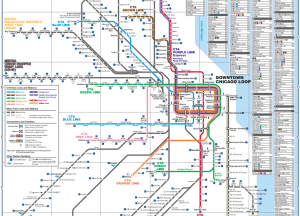
The most exciting map in Chicago


This is the most exciting map in Chicago.

RTA rail map


Actually, that’s a terrible-looking map. But the concept is wonderful: it’s all the urban rail lines in the city – the El in its various colors and, in grey, Metra. Here’s one that’s a bit more illustrative of where everything actually is:

RTA rail map 2 

But the bottom line is LOOK AT ALL THOSE RAIL LINES. Especially on the South Side and Northwest Side. The amount of rail infrastructure in Chicago is just incredible – almost as incredible as how badly we squander it. There is no good reason why all those lines shouldn’t be as powerful a connective tool as the El. If you’re reading this blog, you’ve probably heard of the Gray Line, but that proposal almost misses the point: Metra as a whole should be a useful mass transit network for everyone living or working near one of its stations.

A wish list:

1. In the city and near suburbs, peak frequency should be reliably 10 minutes or less, and off-peak should be 10-20.

2. In the city, fares should never be more than $2.25, or whatever the cost of an El trip is.

3. You  should be able to pay with one card for the CTA and Metra. (This one is happening!)

4. A CTA-Metra transfer shouldn’t be any more expensive than a CTA-CTA transfer.

5. As with El stops, it ought to be legal to build very densely around Metra stations in very desirable areas. Must places like downtown Wilmette or Oak Park remain frozen in amber as if nothing had changed since 1920? They must not. Let people live where they want.

None of these are original ideas on my part, but it would be nice if they would become generalized conventional wisdom throughout the city. The potential for increased mobility (and all that means) is really stunning.

School Gentrification: Not Necessarily a Fix

Steve Bogira says that CPS should focus on bringing in more non-poor students instead of raising test scores. Or, really, it should focus on bringing in more non-poor students in order to raise test scores.

The thinking is that CPS doesn’t actually do a terrible job of educating its children, given the demographics. If you compare low-income students in Chicago to their peers around the state, things are about the same. But 85% of CPS students are poor, and only about half of all Illinois students are poor, so the fact that low-income students do worse than non-poor students pulls down the district’s overall score.

Of course, there’s something kind of disturbing about this line of reasoning, namely that it’s not okay for poor students to fail at school just because they’re poor, and improving test scores by cherry-picking which students you have is not the most honorable way of improving your district data. Bogira says yeah, but poor students do better when they’re not in economically segregated schools, so having more middle class kids would improve their scores, too. In fact, it seems like increasing the number of non-poor students is the most reliable large-scale change we can make to improve a school’s test scores. I’m basically with him on that.

But how do you do that? Note that we’re not talking (yet) about desegregating within CPS. If 85% of CPS students are low-income, total desegregation would just lead to every single school being overwhelmingly low-income. We’re talking about bringing non-poor kids in from outside the district.

As far as I can tell, there are basically two ways to do this: the voluntary way (by creating situations in which middle-class families would rather send their kids to CPS schools than somewhere else), or the non-voluntarily way (by striking down Milliken v. Bradley and correctly concluding that there is no good reason to allow municipal borders to be used for the purpose of segregation).

The non-voluntary way is clearly not going to happen any time soon, which is probably why Bogira focuses on two voluntary proposals: increasing the number of seats at high-scoring CPS magnets, the best of which currently rank among the top public high schools in the state; and creating inter-district exchange programs, which seems to be basically the same as the first, except without requiring families to actually move to the city to enroll their children in CPS.

Neither of these is a terrible idea, but I think it’s worth considering that the number of children currently attending public schools in Chicago is north of 400,000, and so getting to the state average of 50% low-income enrollment would require creating literally hundreds of thousands of new seats for middle-class suburban kids. Emanuel’s expansions at Payton HS, Jones HS, and Lincoln Elementary – all highly desirable, top-scoring CPS schools – are going to create only a couple thousand new seats, and they’ve already provoked some backlash from people on the South and West sides who saw their community schools closed not that long ago. Imagine if City Hall announced a program a hundred times larger, aimed exclusively at not just North Siders, but suburbanites. It’s just not an option, even if it were logistically or financially feasible.

All this also ignores that CPS has already figured out – sort of – how to get families with money to send their kids to neighborhood schools: allow demand for magnet seats to greatly outstrip supply, and watch as residents in middle-class neighborhoods decide it’s easier to band together and gentrify their local schools than to move to the suburbs or cough up private school tuition. So far, the scope of this trend is limited – fewer than two dozen elementary schools – but given how quickly it’s advanced over just the last four or five years, it’s not at all difficult to imagine that in ten or fifteen years, bad elementary schools in gentrified neighborhoods will be the exception rather than the rule.

But then what? All that will have been accomplished for most low-income kids is the economic integration of the district without much of any integration at the school level: the same mechanism that has maintained the rich suburb v. poor suburb/city divide – real estate prices – should be just as effective at keeping families with meager resources out of prized attendance areas in Lincoln Park or North Center. The problem, at bottom, is that when a significant chunk of the middle and upper classes define “good schools” in terms of their economic makeup – and, in turn, schools’ economic makeup actually does have major influence on its academic profile – segregation of the public schools isn’t just an unfortunate byproduct of the market; it’s the point. To mitigate it, the attendance system will have to be purposely designed to create obstacles to that kind of sorting.

But that kind of design, precisely by reducing segregation, will make CPS schools less attractive to the middle class, and will give the city less desegregation material to work with, so to speak. Nor am I convinced that City Hall will see an influx of middle-class students to resegregated public schools in gentrified neighborhoods as a failure. That said, I’m not an expert on education policy, so maybe there is some education Mt.Laurel out there ready to turn me away from pessimism. Any hints?

A Note on Data: Early 90s Population Estimates and Chicago’s Homicide Rate

This came to my attention this week, and I feel like in the interest of transparency I ought to make a note about it.

Because people don’t read all the way to the end of blog posts, I also feel like I should put the conclusion at the beginning. So:

  • Over the course of the 1990s, the Chicago Police Department used two different population estimates to calculate murder rates. In this post, I used the one that the CPD was using in the years I covered. But there is also a reasonable argument to be made for using the one it chose to use later in the decade.
  • If you use the second estimate, mostly things look the same. In particular, the “skyrocketing inequality of violence” skyrockets just as much, still roughly tripling from the early 90s to the late 2000s.
  • One thing that does change is that some, but not all, of the areas that show a rise in homicide rates with the first population estimate show a modest decline with the second population estimate. This is because the second population estimate suggests that fewer people were living in heavily non-white areas of the South and West sides in the early 90s, and so it gives them a higher homicide rate to begin with. Specifically, of the seven police districts that have rising homicide rates according to the first population estimate, four (the 3rd, 7th, 11th and 15th) show modest declines according to the second, one (the 6th) is roughly flat, and two (the 8th and 22nd) still show clear (in fact, larger) increases.
  • I don’t think it’s clear which estimate is better.
  • Bottom line: it’s somewhat ambiguous exactly how much of Chicago’s South and West sides saw homicide rates rise over the last 20 years – although substantial portions certainly did. It remains crystal clear that the inequality of violence has increased by a factor of about three over those same two decades, and that that gap has extremely serious consequences.

In somewhat more detail:

In the early 1990s, the CPD used population estimates from local planning bodies, either the city itself or the Northeast Illinois Planning Commission, to determine how many people lived in each police district. Those are important numbers for calculating crime rates, since a neighborhood’s safety level is usually described in terms of crimes per number of people – number of homicides per 100,000 residents, in this case. Beginning in 1995, however, with a report that covered 1993-94, the CPD switched to using population estimates provided by the U.S. Census. The Census numbers differed from the city/NIPC numbers mostly in that the Census counted fewer people – in some cases as many as 30% fewer – in the mostly black and Latino sections of Chicago’s South and West sides.

As a result, going back and plugging the Census-derived population numbers into the CPD’s earlier reports makes the South and West sides look more dangerous, because there are the same number of crimes but fewer people. This doesn’t affect the trends in geographic inequality of violence, but it does, as I described above, create a higher baseline against which to compare homicide rates from the late 2000s. In four districts, the baselines are so much higher that what previously looked like increases in homicide rates over 20 years look like modest declines. In another, the increase is wiped out but there is no decline, and in two there are still increases – in fact, the increases get bigger.

Which set of numbers – the city/NIPC’s or the Census’ – are better? I don’t know. On the one hand, the Census is clearly the governmental head-counting of record. On the other, the 1990 Census was the target of a lawsuit from nearly every major city in the country, including Chicago, that alleged severe undercounting (in the hundreds of thousands in Chicago)particularly in high-poverty neighborhoods with few white people – ie, exactly the neighborhoods at issue here. Either way, the scale of the disagreement – again, as much as 30% in some districts – means that at least one of these estimates has to be quite flawed.

In any case, to repeat myself: the bottom line is that there is some ambiguity about exactly how much of Chicago’s South and West sides actually saw increases in homicide rates, although substantial portions undoubtedly did.

And what is still crystal clear is that the inequality of violence has increased by a factor of about three over the last twenty years, and that that gap has extremely serious consequences for the city.

Why do we care about mode share?

The New York Times ran an op-ed the other day that helpfully demonstrated the pitfalls of lifestyle arguments in favor of urbanism, namely that they are annoying to everyone but the people making the argument.

The boys, like their father, are lean, strong and healthy. Their parents chose to live in New York, where their legs and public transit enable them to go from place to place efficiently, at low cost and with little stress (usually). They own a car but use it almost exclusively for vacations.


“Green” commuting is a priority in my family. I use a bicycle for most shopping and errands in the neighborhood, and I just bought my grandsons new bicycles for their trips to and from soccer games, accompanied by their cycling father.

These arguments – whether they’re about physical health, or “diverse” or “vibrant” or “creative” communities, or whatever else – are, at bottom, about telling people that they are lacking, and that in order to improve themselves they should become more like the author. In the 1970s, when city dwellers felt superior mainly because of their supposed cultural capital and were telling middle-class suburbanites to loosen up a little, that might have been obnoxious but harmless. In our current situation – when the city dwellers making these arguments are the economic elite (the author of this particular piece, Jane Brody, lives in gentrified brownstone Brooklyn, I believe) – it’s a lot more sinister. Brody talks about commutes as if their length and form were something that most people could freely choose, rather than something imposed upon them by their wages and the price of housing and form of development of their metropolitan area. She makes this a story about personal morality, rather than the constraints we choose to put on people through public policy.

This is related, I think, to the study about mode share in U.S. cities that got passed around the urbanist blogosphere recently. In virtually every instance, the study was presented like a sports power ranking, with the winning cities being those with the least travel by car (“city of Chicago ranks sixth among large U.S. cities for percentage of people either biking, walking, or riding transit,” is a typical formulation of the lede).

But why, exactly, do we care about mode share? The pettiest possible answer is that we do conceive of cars v. transit/biking as a sort of culture war, just like many committed drivers have alleged, and what percentage of people choose to drive or do something else is how we measure whether or not we are winning. This, clearly, is not a particularly edifying possibility. A better answer might be that we really do want everyone else to be more like us – to reap the benefits of non-car commuting, from being healthier (although, contra Brody, I spent my subway commute today scarfing down a pound of spaghetti) to polluting less – and this tells us how many people are enjoying those perks.

That’s much more reasonable, but still problematic in that, like the Times piece, it strongly implies that the issue is individual choice, rather than the circumstances that constrain that choice. The people who write for places like Streetsblog know that circumstances matter, but for the casual reader, articles about mode share makes those issues a sort of specialists’ background.

That’s too bad, because mode share does convey some important information about constraints. If we assume that, allowing for some cultural margin of error, most people will choose to get to work via whatever method they find most efficient and comfortable, then we can determine roughly what percentage of people in any given city have decent access to transit – access that’s at least in the same ballpark of convenience as driving – just by looking at what percentage of people actually use it. Obviously there are complications to this: since one major inconvenience of driving is cost, cities with high poverty rates may have mode shares that exaggerate their transit’s effectiveness, for example. And since transportation choice is basically zero-sum on an individual basis – that is, all that matters is the relative efficiency of each mode – you could get a lot of people on transit by making driving truly hellish, without providing decent service. (Although in the American context, I think there are vanishingly few places where that would be an issue.)

Moreover, if we care about mode share as a proxy for service effectiveness, then beyond a certain point – say, a quarter, a third, whatever, of commuters – you’re kind of done. It doesn’t really matter. If New York City, with one of the most comprehensive transit systems in the world, can only get 50% of its commuters on buses and trains, then surely most of the distinction between it and, say, Asian cities with much higher transit mode shares isn’t the quality of their systems (although they may be of higher quality), but the increased misery of driving in ever-denser places. The issue stops being whether we can get from 40% to 45%, but whether subregions of the metropolitan area have strongly varying mode shares, suggesting that you can only get decent access to transit if you live in the right place. And, of course, that is in fact the case.

But if what really matters is service levels and access – if what we’re trying to accomplish is giving everyone a level of service where transit is a viable option, for reasons outlined here – then why not just measure that directly? Why not have widely-disseminated statistics about the percentage of people in every metropolitan region who can walk to a transit stop? Or make a bigger deal about the number of people who can reach some given percentage of metro area jobs via transit in a reasonable time frame? I almost never see those numbers in urbanist conversations, and to the extent that I do, they’re sort of ghettoized into the “social justice” urbanist subculture.

But these seem like relevant numbers for “mainstream” urbanists, too. In fact, they seem a lot better than mode share. Generalized public arguments in favor of transit projects are more likely to benefit from language that suggests they’ll provide options, rather than language that suggests the ultimate goal of the policy is to force people out of their cars. Because, in fact, that’s what public policy should be about: making transportation easier for more people, rather than moralizing about the perfectly legitimate choices that people make, given their circumstances.

Gentrification in CPS

I have a new article up at The Chicago Bureau. Key map:

ISAT-2001-20131

Key points:

1. The prediction that school gentrification would follow neighborhood gentrification is being played out dramatically on the North Side right now.

2. Because there is such a strong correlation between school demographics and test scores, these gentrified elementary schools are now doing reliably better than all non-test-in schools in the city–much better, for example, than top charters. (More on that in a future article.)

3. The creation of perhaps the most important middle-class amenity–high-performing schools–in the central city will pull even more middle-class and upper-middle-class people to the relevant neighborhoods.

4. Because housing policy restricts market supply, and Chicago doesn’t have a large number of subsidized or public housing units on the North Side, home prices within gentrified-school attendance areas will rise (are rising) so as to price out even more of the working class and poor.

5. Income segregation in schools is being recreated within the CPS district, divided now by attendance boundaries instead of suburb-city borders.

6. Theoretically, there are things CPS could do about this–more, anyway, than it could do about the existence of middle-class families outside its borders–but it’s very unclear what would work, and what would be possible politically.

What are we trying to accomplish with transit? Or: Another reason BRT is great.

Streets.mn has an important post questioning Minneapolis’ plan for a new light rail line through the southwest of the city, pointing out that its current alignment would serve very few people in the dense inner-city areas where the need and potential value of enhanced transit service are greatest:

Do we champion any transit expansion even if its benefits are questionable and opportunity costs very high? Why support a major project that benefits a relatively small group of people while doing nothing for anyone else?

The Twin Cities have had a mixed record on this – their first light rail project (first Hiawatha, now the Blue Line) traveled largely along an industrial/highway corridor where, as I learned when I visited my brother in St. Paul three weeks ago, it is not very pleasant or easy to walk to residential or commercial neighborhoods.* But the Green Line, scheduled to open in 2014, is almost perfect: it gets its own right-of-way down a major commercial street that passes through both regional downtowns, a major college campus, and a good number of fairly dense neighborhoods.

Blue Line: Don’t want to walk here.

You will be able to walk to delicious Vietnamese restaurants from the Green Line.

Nationally, the trend for most rail projects over the last 10-15 years has been similarly mixed. There are at least two major ways that these things get perverted: One, cost considerations push cities to run their trains in places where tracks already exist, or where buying land will be cheap, which tends to be industrial corridors where no one lives or shops. (This is why you can’t walk anywhere from the Orange Line in Chicago.)

You have to walk through a quarter mile of industry before you get to the first house or pedestrian-friendly shopping district from the Kedzie Orange Line.

Two, because rail is often explicitly marketed as a way to attract the middle class to cities**, proposals often fall into one of two categories: downtown or entertainment district “streetcars” that are actually less efficient at transporting people than buses, and which are so short – often between one and three miles – and come so infrequently that it’s often faster to just walk from one end of the line to the other; and light rail lines with widely-spaced stops that stretch waaaaay out into the suburbs and are endowed with massive park-and-rides so white-collar workers can commute into downtown. These are actually the least useful projects possible. Better, of course, would be the creation or reinforcement of a grid of service downtown and in the outlying walkable-ish neighborhoods where transit service might actually be useful as a way of getting around. But those tend not to be the neighborhoods where the middle class lives, and so they usually languish. As, for example, with the Southwest Corridor in Minneapolis.

This is another reason BRT is great: no one thinks it’s cool enough that tech workers will move to your city just to gawk at it, so you don’t get useless downtown “economic development” routes***; and since it runs,  by definition, on major streets, you’re almost guaranteed to have stations in the middle of major activity centers.  Or, at least, that’s much more likely than with trains.

* Although I will say that Minneapolis has allowed some fairly impressive development around some of the stations, which partly makes up for that. More on this in a later post.

** It’s incredible, actually, how frequently people will openly admit that a given rail project is less about transportation than about economic development and making downtown friendly to “creatives,” as if trains were rolling Banksy pieces.

*** Chicago has a downtown BRT project right now, but it actually fulfills a need: transporting the hundreds of thousands of people who arrive in the Loop on commuter trains to their jobs in other parts of downtown a mile or two away.

Things about which I have to write, so I don’t get on the train Monday thinking, I really need to write about that

1. Two worthwhile pieces from Aaron Renn: “Well-Heeled in the Windy City” at City Journal, and “My Presence Is a Provocation” at New Geography. The question of what obligations the political class of a city like Chicago, or New York, or wherever, feels towards those residents, and those neighborhoods, that will never be glamorous is an important one, and I think it goes way beyond Emanuel or Bloomberg or Gilbert personally.

2. Moody’s finds that charter schools can cause a fiscal crisis for regular public schools just as Catalyst notes that Chicago’s neighborhood high schools are having an enrollment crisis. Which precipitates a fiscal crisis. Not much to say here other than Oy. Actually, there is, but I already said it: Is this the educational marketplace that charter backers had in mind, or are we just spreading students thin to the detriment of their education?

3. Chicago’s getting an independent budget office! Thank GOD. This is important because in instances when someone wants to, say, lease our parking meters, an independent budget office is pretty much the only outfit that might warn us, with the numbers to back up the claim, that such a lease would be a disaster. Basically, if this thing works, we will be much, much better-informed about the potential effects of future proposals before they happen. Then again, it may not work. It’s apparently getting $500,000 and a staff of six, which is double what Ald. Ameya Pawar initially proposed, but one-sixteenth of what Scott Waguespack seems to think is necessary. I’m not really in a position to evaluate. Although I will point out that New York City’s Independent Budget Office has a staff of 39.

4. A great four-part series on dream public transit reforms at the Beechwood Reporter. Main thing I would like to emphasize: METRA COULD BE SO GREAT BUT IT’S NOT. OY. Metra, and also BRT. Improving the first – getting trains to run at least every 15-30 minutes – and building a moderate-sized network of the second would pretty much revolutionize rapid transit and access in Chicago without digging any expensive tunnels or anything.

Addendum, or: race- and class-based segregation

I looked at my last post again and realized that, as written, it is entirely race-neutral. Is race beside the point of municipal-level policies that affect inequality? Obviously not. And yet.

And yet I have become aware, in the course of thinking about these things, that when I use the words “integration” and “segregation” in a contemporary urban context I mean, by default, integration and segregation by economic class, and not by race, which is obviously the default for most people. That is, when we want to talk about class-based segregation, we have to say “class-based” or “income-based.” We don’t have to say “race-based”; it’s implied. The opposite is now true for me, or at least the monologues in my head. My language has revealed that I believe class segregation is the more fundamental problem.

Why is that? And is it fair?

This, I suppose, is my thinking: There is something necessarily wrong with economically-segregated neighborhoods that is not necessarily wrong with racially-segregated ones. I can think of two things, in fact. Number one is that in any very roughly capitalist, modern society, it is hard to imagine a disproportionately low-income neighborhood that does not suffer the kinds of neighborhood effects on education, health, mobility, etc., that I mentioned in the last post. It just seems impossible. Number two is that economic class has not traditionally – at least not in the United States – been a dominant cross-generational cultural marker in the way that race or ethnicity has been. That is to say that being of a particular race puts you in a more defined community than being in a particular economic class, and so there seems to be more of a positive reason to have some amount of physical clustering along those lines.

(I don’t think I can emphasize enough, of course, that I AM NOT endorsing the segregation-exists-because-people-want-to-live-among-their-own-kind hypothesis, which is falsified by every possible empirical and non-empirical and imaginary investigation, from actually asking people what kind of neighborhoods they would like to live in, to a historical examination of how neighborhoods actually came to be segregated, and so on. But even in the absence of all of this, I am saying, there would be some push for some moderate amount of clustering, in the same way that, for example, being a young person puts you in a community that creates a push for clustering and the creation of neighborhoods that are somewhat disproportionately full of young people. These neighborhoods are not 98% young people, or anywhere near it, as so many American neighborhoods are 98% black. To get to 98% anything, or anywhere near it, you pretty much always need massive coercion.)

I would add that the purely race-based barriers to racial integration are less today, I think, than the purely income-based barriers to economic integration. Race-based barriers are very alarmingly high, of course. There is steering and lying and mortgage discrimination and so on. But if you are a black middle-income couple and you are committed to moving to a majority-white neighborhood, you will probably be able to do so, even if it takes longer and is more costly (and puts you in a less-affluent white neighborhood) than if you were not black.

Low-income people, on the other hand, also face a variety of discriminatory practices, but the most important one is simply the price of real estate, which makes discriminatory practices moot in many, if not most, instances. If you cannot pay the going rent for a given neighborhood or suburb, you don’t even have a theoretical recourse. Except Section 8, I suppose, if your income is low enough, which puts you back in the world of discriminatory practices – one in which it’s perfectly legal in most places for landlords to flatly state that you are not welcome. The fact that racial segregation is slooowly declining, while economic segregation is skyrocketing, is more evidence of this.

But. There are at least two very obvious problems with my argument. The first is that because race is still a characteristic that on its own provides privilege or the lack of it, there is something inherently wrong with racially segregated neighborhoods in the United States in 2013, and, in fact, there will be for the foreseeable future. The fact that it’s possible to imagine a world in which that is not the case doesn’t mean a ton. The existence of a massive number of communities in Chicago, and across the country, that are 95%+ non-white is itself evidence (if more evidence is necessary) that race continues to provoke coercion.

The other thing is that, largely because of point #1, race and class are so intermixed that it’s not really practical to talk about integration of what without integration of the other. Especially if we take into account wealth, and not just income, economic status is so skewed by race that serious integration along one of those axes would necessarily create integration along the other.

So I have built up an argument in favor of focusing on economic segregation instead of racial segregation, and then knocked it down. I think the wrongness – in both the ethical and the logical sense – of privileging the economic issue to the exclusion of the racial one is clear.

There is one last factor, though, which is practicality. From a policy perspective, at least, economic segregation looks much easier to deal with (in most instances). The issue is, on the one hand, about just giving lower-income people more money so they can pay rent; and, on the other, allowing developers to increase housing supply so prices go down. There are huge logistical and political obstacles to that, of course, but the basic ideas are there, and there’s a fairly diverse and vocal constituency for them, from the large number of people who would like to pay less for housing – or be able to afford better housing given their budget – to the ecosystem of affordable housing nonprofits and CDCs, to the developers who would like, selfishly, to make money from building more stuff.

On the other side, it’s not at all obvious how you significantly speed up racial integration. Increased enforcement of anti-discrimination laws would help, of course, but almost by definition it’s difficult to prove those cases without a huge amount of time, energy, and money. Real estate counseling programs help, but not that much, and plus it’s kind of paternalistic, which may or may not bother you. Moreover, there just isn’t any massive, organized groundswell in favor of racial integration. Steve Bogira has been doing a BenJoravskyonTIFs thing with racial segregation, which is terribly important, and he is one of the only people, if not the only person, with real media access who’s doing that in Chicago. But his own articles are often about the fact that it’s basically impossible to get anyone with power to even acknowledge that government might have some role to play in directly promoting racial integration.

I guess what I’m saying is that this, in the end, is why I spend more energy thinking about policy responses to economic segregation than policy responses to racial segregation, and probably will continue to do so: it seems less hopeless. That, and, like I said before, promoting economic integration will almost certainly push along racial integration as well. But I don’t think coming to that conclusion is an excuse for ignoring the very real relevance of race, and I think it’s important that in particular the wonkish conversations a la Glaeser and Krugman and Yglesias and Avent (all white, like me! a hint of more of the problem) don’t become so focused on pure economics that they forget that.