Does Chicago’s market in high schools work?

The answer is: sort of for traditional public schools; definitely not for charters.

This post began when I read reports from WBEZ and Catalyst Chicago about the rapidly growing number of public high schools in the city:

But Chicago high school students are being spread thinner and thinner across all those choices. High school enrollment has grown slightly in the last decade, around 8 percent. But the actual number of high schools has exploded in that time, from 106 to 154 today.  Nearly all the new schools are charters.

Roberto Clemente Community Academy in Humboldt Park is one of [the schools facing declining enrollment]. It’s an eight-story building. Until recently escalators carried 1,800 kids from floor to floor. There are just 130 freshmen enrolled today. Another 473 freshmen live in the area but go to high school somewhere else. In fact, the Noble Street network of charter schools, with its various campuses, enrolls more students from Clemente’s attendance area than Clemente.

This is certainly not the kind of problem most people think about when they think about CPS – who would have guessed that, in an era of massive school closings, Chicago has increased the total number of high schools by 50% in a decade? – but it’s a big one. Underenrolled schools like Clemente have to cut extracurricular programs and special academic classes that no longer have enough students to support them; they also end up requiring extra financial help from the district just to maintain a functioning building.

If you wanted to put a positive spin on this, of course, you might say that Chicago has created a functioning market in high schools: students and their families are free to choose the ones that offer a better education, and if that creates winners and losers, good! The bad schools ought to fail. That’s exactly what charter proponents have  been asking for all along.

But that only works if students are leaving bad schools and enrolling in good ones. If we’ve just created enrollment churn without moving students from bad to good, all we’ve managed to do is add another serious problem to a district that already had plenty.

So which is it?

Happily, CPS provides data on 1) enrollment in every school in the district and 2) every school’s ACT score. (Here is the obligatory caveat about how good ACT scores do not equal a “good” education. Given the district’s laserlike focus on test scores, though, it seems fair to judge them – on an at-least-you-have-to-be-good-at-this basis – by whether they’re moving this particular needle at all.)

So, using the district’s numbers, I calculated how much enrollment has changed in every high school between the 2005-06 school year and the 2012-13 school year. Then I grouped all the schools by their ACT scores – all the schools that scored 15 in one bucket, 16 in another bucket, and so on – and added up the positive and negative enrollment changes for each bucket. Here’s the graph:

Dashboard_1

What we should see, if the market is working, is big red bars on the left side, indicating that lots of students are leaving low-scoring schools, and big blue bars on the right side, indicating that people are flocking to high-scoring schools. Obviously, that’s not quite what’s happening. True, it looks like schools with above-average ACT scores are mostly gaining students; and lots of students at  below-average schools are leaving. But a lot of those students are going to other below-average schools. That’s why you see sizeable blue bars even way to the left side of the graph. Why, if the market is working, are we seeing any enrollment increases at schools with average ACT scores of 13 or 14, both of which are truly, truly abysmal? Random guessing, for comparison’s sake, gets you a score  of 12. Twenty is considered the minimum to get into college.

Just to be clear about what these graphs show: It is not only that some students are enrolling at bad schools. People move, and new classes come in, and so on, and so it would be highly surprising if any school was so bad that not a single new student showed up. What these numbers show is that some terrible schools are seeing their total enrollments increase, to the tune of about four thousand students in all at schools with an average ACT score of 15 or lower.

So the fact that enrollment decreases outnumbered enrollment increases helps only a little, because it doesn’t change the fact that some of the “winners” in this market are providing some of the worst educations in the district. That suggests a problem.

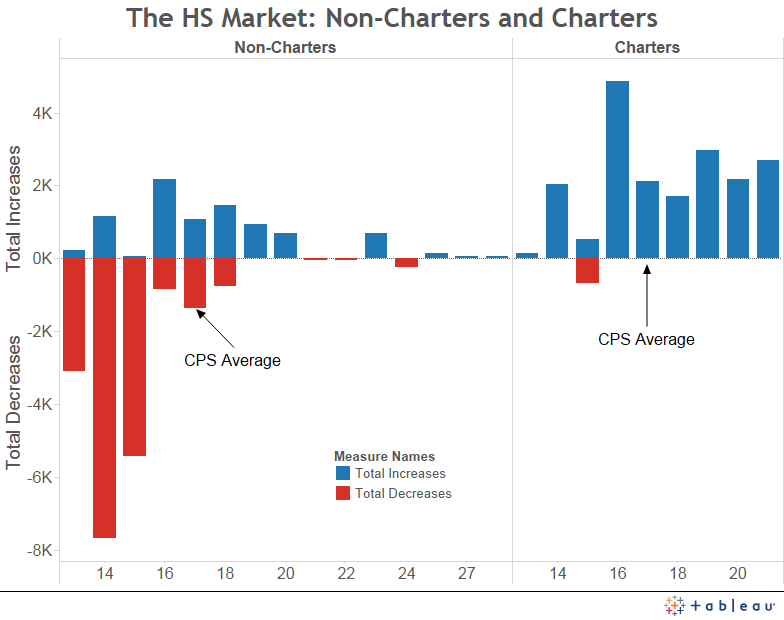
Part  of the problem is explained by breaking out that graph into charter schools and non-charter schools:
Dashboard_2

Now things are a little bit clearer. There are still some enrollment increases at non-charter high schools with very, very bad ACT scores, which is still a problem. But they’re a much smaller proportion of all student migration, and are much more massively outweighed by enrollment decreases at other low-scoring non-charter high schools.

But oh man, look at those charter numbers. The high-scoring charters have enrollment increases. The mediocre-scoring charters have enrollment increases. The low-scoring charters have enrollment increases. The very-low-scoring charters have enrollment increases. Basically all charter schools have enrollment increases, no matter the quality of their education.

Why might that be? I can think of two general possibilities:

  1. Charter schools provide a better education than non-charters in ways that don’t show up on ACT scores. For example, a zero-tolerance approach to discipline that creates a safer learning environment. Or a curriculum that encourages more creative and critical thinking skills. Or teachers and administrators who forge tighter, more nurturing relationships with students and parents.
  2. Charter schools get better PR than non-charters, and so parents want to enroll their children there whether or not they actually provide a better education.

Obviously Possibility 1 would be much much better news for the market in high schools than Possibility 2, which suggests a major kind of failure. My guess is that both are going on, though I don’t feel like I have any particular insight about in what proportion.

That said, I’m going to go ahead and suggest that there is almost no way that the unmeasured benefits of Possibility 1 actually outweigh the awfulness of any high school where the average ACT score is 13 or 14. I am definitely in the camp that believes we make too much of standardized tests in education; and yet, having been (very briefly) a teacher myself, I know that there are scores below which there is just no way that a student has received a decent education; scores low enough they pretty much guarantee a failure of adult literacy and numeracy that not only rules out any kind of higher education, but even the most menial of non-physical work, as well as physical work that requires any kind of computation or written communication. In other words, these schools are graduating people who simply have not been prepared to participate as adults in our society, and we’re rewarding them by handing them responsibility for thousands of extra students.

*   *   *

But let’s pull back  a little bit. In the beginning of this post, I asked: Is Chicago’s market in high schools working? Are students moving from bad schools to good ones?

The numbers have established, I think, that on one end of the spectrum – low-performing charter schools – the market is failing spectacularly.

But it’s clear from the first graph that, overall, there is some movement to the right – that is, to higher-scoring schools. Specifically, the median net enrollment decline has been from a school with an ACT score of 14.9, and the median net enrollment increase has been to a school with an ACT score of 17.7. That’s a huge and heartening gap.

Unfortunately, it also indicates one of the major problems with the “school market” approach. Why? Mostly because, as I mentioned earlier, the minimum ACT score that indicates college readiness is a 20. Very few of the schools winning more students in this market graduate a large minority – let alone a majority – of seniors who score that high.

But not just that. CPS’ districtwide average score is a 17.6. Meaning that half of all enrollment increases have been at schools that are below average, even by CPS’ low standards.

Why would that be? I don’t know, but I can take a couple of guesses. For one, the top-scoring high schools in the city are mostly selective enrollment, and unlike neighborhood schools – which have to find room for students in their attendance areas no matter what – they won’t grow significantly unless they get extra room. Or maybe, since parents often send their children to schools where  they know other families, there’s something going on with social networks.

More importantly, I would imagine, is that there is a geographical problem: most of the city’s very bad high schools are in certain neighborhoods on the South and West Sides, and a disproportionate number of the above-average ones are on the North Side. One-way commutes of over an hour would definitely be a disincentive to send your kid to the better high school across town – especially if you live in an area where getting to and from the nearest public transportation means crossing gang lines.

HSAverageshsaverageslegend

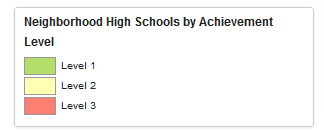
This isn’t a definitive map – it only shows neighborhood schools, excluding charters, etc., but it gives a general sense of where the high-scoring and low-scoring high schools are around the city, and how tightly the low-scoring (Level 3) schools cluster, and how far you might have to travel from one of the low-scoring clusters to something better.

*   *   *

So Chicago has a market in high schools. CPS created this market in large part by increasing the total number of schools by 50% over about ten years. The market is creating clear winners and losers. For the losing schools, the market is actually a disaster. Whether this is worth it for the city overall is to some extent a judgment call, but to me it seems pretty doubtful. Even though there is some movement to higher-scoring schools…

  1. …half the city’s enrollment increases are happening at schools with ACT scores that are below district average.
  2. …charter schools, which make up virtually all of the schools added to the district over the last decade, appear to be almost totally unaffected by whether or not they provide a good education to their students; they grow rapidly regardless.
  3. …there are major structural impediments to moving kids from low-scoring to high-scoring schools.

A rare design post: transforming streets in NYC and Chicago

I don’t write much about design here – partly because it feels less urgent to me as a matter of public policy than issues of equity, partly because there are lots of other people in Chicago who writing what I would write, but doing it much better – but if you care at all about this kind of thing, you should really watch this video, especially if you haven’t been to New York to see it firsthand.

It makes me feel, at least, like the “transformative” reign of Gabe Klein kind of pales in comparison. Maybe I’ll feel differently if (when) BRT comes. We’ll see.

Worth noting that CDOT has been making some noises in the direction of reclaiming unnecessary road space – but I haven’t seen anything like a dramatic transformation yet. They are building a new little triangular plaza near me, up at Milwaukee and Diversey. Again, we’ll see.

Dystopian urban planning in Portland

Next time you hear the word “Portland” wistfully pass an urbanist’s lips, send them this link:

Planners under the watch of then-Commissioner Charlie Hales made wholesale zoning changes to push in higher density. East Portland went on to add more than its fair share of new homes while city leaders let affluent Southwest Portland, which staged a political firestorm against growth, shrug off its burden….

In the mid 90s, Portland decided to upzone large parts of the city to accommodate residential growth. In poorer East Portland, the changes went through smoothly. But when they tried to take it to wealthier parts of town, you can guess what happened.

In September 1996, just eight months after the City Council approved the Outer Southeast plan, officials breezed into the West Hills looking to equitably spread their vision of housing growth to all corners of the city….

Residents were furious….

The pushback was too much. Within a month, Hales, who at the time lived in Southwest’s Hayhurst neighborhood, announced changes “to ensure that we don’t sacrifice the very thing community plans are designed to protect – neighborhood livability.”

Even so, the stripped-down plan continued to evoke anger.

Amanda Fritz, then a planning commissioner who today serves on the City Council, fired off an indignant email to the manager of the Southwest plan in 2001. Fritz, a resident of West Portland Park neighborhood, was upset about an area that planners wanted to zone for townhomes. She thought larger lots would better serve families with children.

Oh, would they, Amanda Fritz? Thanks for the input. And for the people who can’t afford single-family homes on large lots? Where should they raise their children? When they move to a far-flung, car-dependent suburb, will you harangue them for not living in a chic inner-city neighborhood with bike lanes?

At least, of course, those low-income people got denser, more amenity- and service-rich neighborhoods, right?

While city leaders eliminated growth targets for Southwest Portland, new zoning in east Portland ushered a massive influx of homes and people. New services to support the growth never materialized. That made conditions particularly difficult for the residents of Southeast Schiller Street…. Schiller Street is still gravel….

On 122nd Avenue, the tract’s western boundary, city planners justified zoning for as many as 65 units an acre because TriMet’s No. 71 bus line was nearby. But frequent bus service hasn’t arrived. To the contrary, the 71 rumbles north and south 109 times each weekday, down from 121 in 1996.

The tract’s eastern border is 136th Avenue, a two-lane road where city officials increased zoning to as many as 32 units an acre but never installed a sidewalk. One will be built next year following the death of 5-year-old Morgan Maynard-Cook, hit by a vehicle while crossing the street in February.

So the planning process has been entirely co-opted by the privileged. The moral, I think, is that there is a problem with the process. How do you design a democratic planning process that’s harder to co-opt? I’m not sure. More thoughts later.

Great things from the Tribune

The Trib’s “Poverty and Profit” series has had some truly impressive investigative pieces, and they also have an amazing data project where you can see how racial and socioeconomic trends have changed in Chicago neighborhoods over the last 40 years. Really, check it out, if you have an hour or two to lose.

Classism in zoning and coalitions behind streetcars

1. In Wicker Park, neighbors are opposing a four-story, 30-apartment building on the grounds that it’s too “damn big,” despite being in a neighborhood full of three- and four-story apartment buildings, and being right next to a dozen-story highrise on what is, by some distance, the busiest corner on the Northwest Side.

In Irving Park, neighbors are opposing turning an already-existing church building into apartments. Quoth the neighbors:

“This is a single-family-home neighborhood,” Engel said, questioning whether Sonco had considered another use, such as townhomes, which would be “more simpatico with the neighborhood.”

The size of the proposed apartments — 700 to 800 square feet — “might imply more of a transient nature,” he said. “It’s not quite SRO, but it’s not far from it.”

“Renters don’t contribute to community groups,” which have been instrumental in combating crime in the area, said Caperton. “I’ll do everything I can to keep another rental unit property from coming into that place.”

Your trusty blogger will translate:

“This is a well-to-do neighborhood,” Engel said, questioning whether Sonco had considered building homes for wealthier people, which would be “more simpatico with the neighborhood.”

The economic class of the proposed tenants  “might imply more of a transient nature,” he said. “It’s not quite SRO, but it’s not far from it.”

Poor people don’t contribute to community groups,” which have been instrumental in combating crime in the area, said Caperton. “I’ll do everything I can to keep more poor people from coming into that place.”

I will say, because I guess it needs  to be said, that we live in a free country and everyone is free to tell everyone else what they think they should do, and what their ideal world looks like. If it looks like all the poor people have to live very, very far away from you, fine.

But it is simply morally repugnant for the government to be playing economic segregationist. And that is exactly what they’re doing. This isn’t just about failing to actively create affordable housing; this is about using the force of the law to prevent the private market from creating working-class housing. It’s disgusting, and it needs to stop.

2. The Cincinnati streetcar is saved!

Although this is not the most popular thing to say, the calculus over whether or not this is a good thing is complicated. On the one hand, as I wrote yesterday, the streetcar is close to useless as a transportation project; even if it’s extended to a length where it would be faster to wait and get on it than to walk from one end of the line to the other, it’s a colossal waste of money. The same time savings could probably be achieved for a tenth the cost with improvements to buses, and the chance that “rail bias” will bump ridership on a tourist trolley enough to make up the difference is basically nil. (Of course, at this point, it may be cheaper to continue than cancel the project – but that doesn’t make it better as a poster child for Rust Belt urban planning.)

The generic response to that sort of argument, when it’s made by people like Stephen Smith at Market Urbanist and Jarrett Walker, is to admit that there’s little transportation benefit and then claim that’s not the point: instead, the real purpose of streetcars is to promote development.

But if that’s the case, then I’m not inclined to be any more sympathetic to the project than I am to other enormous public expenditures to boost already-gentrifying districts.  If I think that Rahm Emanuel is halfway criminal for spending $40 million on a basketball stadium on the edge of downtown Chicago, then why is it any better to spend $130 million for tourists in downtown Cincinnati – which, although it’s got miles to go before it reaches the elite-playground status of the South Loop, is clearly one of the few parts of the Queen City with market-based redevelopment momentum?

And yet. And yet I’m still at least 65% happy about how this turned out. Because even if it’s terrible urban planning, the streetcar’s victory is a victory for a coalition of people who believe in making investments in transit and the inner city. That coalition may be skewed in favor of gentrifying neighborhoods and elitist projects, but I still believe that even co-opted urbanism is better than the status quo.

Two notes

1. The news out of Cincinnati and LA reminds me, yet again, how miraculously sensible the Ashland BRT proposal is. At a time when it is in vogue – even in LA, which, despite its reputation, is probably building more and better public transit than any other place in the country right now – to spend gobs of money on vanity transit projects aimed at attracting development instead of actually giving people better transportation options, Chicago’s major transit infrastructure programs are about bringing already-existing lines up to good repair and expanding their capacity, and creating cost-effective large-scale rapid transit along one of the most important corridors in the city.

LA’s downtown streetcar – which would crawl through mixed traffic in a four-mile loop, barely two miles on its longest side, and therefore be practically useless for actual commuting or traveling – is going to cost at least $125 million, or ~ $30 million a mile. Cincinnati’s half-dead streetcar project – also a four-mile loop, also basically pointless as far as transportation goes – is $133 million. Ashland BRT is 16 miles of El-quality transit for only slightly higher cost. I don’t know what else to say about this, except: yay. And: man, does this need to actually happen.

2. I think this is a really important post at Austin Contrarian:

Brian mainly advocates policies that increase human capital (let’s give our young people better schools/education) and income (let’s draw better paying jobs).  Or put more simply (perhaps too simply), he thinks the affordability problem is mainly about making people wealthier. He’s “skeptical that we can ‘build our way’ to greater affordability in Austin, especially without an equally ambitious strategy for human capital development–i.e. investing in people so they can afford to live and raise families here.”

[But f]reezing the housing supply while raising wages will attract higher-skilled workers and push out lower-skilled workers, turning the city’s real estate market into a giant sorting machine.

There is a tendency on the left and the left-leaning center – one that I certainly share – to believe that all of our major problems are about the distribution of resources. Crime will go away when people have legal economic opportunities that are more attractive than selling drugs or stealing. Schools will be better when they’re fully paid for, and the children in them don’t have to worry about money-induced stress at home. Housing affordability won’t be a problem when everyone is paid a living wage.

On crime and schools, I’m pretty much on board. But housing really is different: if there are a limited number of homes within commuting distance of a major source of jobs and amenities, then those homes will go to whoever the richest people are. It’s a zero-sum game, in which a rising tide doesn’t lift your boat unless someone else’s boat sinks. And if the richest people get to congregate in one corner of the city, then they will have the best amenities, job opportunities, schools, and so on – so while a higher wage might make your neighborhood more livable, it won’t get rid of the fundamental problem of inequality: not just of outcome, but of opportunity.

The only way out of that trap is building more housing. No one wants to hear that (except, I guess, developers and the tiny brigade of Gated City-ites), but it’s true.

2.1 We Need to Build More Housing, In One Chart (h/t Austin Contrarian):

TX prices

What you’re looking at is housing prices in the four largest Texas cities. All four are going through major housing booms; Dallas, Houston, and San Antonio allow new development and housing units relatively easily; Austin does not. Starting on the left side of the chart, you can see that new development in Austin is more expensive than the other three cities – about $50 more than Dallas and $150 more than San Antonio. But as we move to the right – to older buildings – the gap gets much bigger. By the time we’re looking at housing that’s at least 70 years old, median Austin rents are at least $100 more expensive than Dallas and $300 over San Antonio.

What’s happening is that with new development, there’s a floor to how cheap rents can be – it’s expensive to build apartments, and no one will build them unless they can get rents that will cover costs. With older buildings, though, all that matters is the cost of maintenance, so they should be relatively cheaper. But if developers are blocked from attracting high-rent tenants to new development, they’ll attract them to older buildings by renovating them to luxury-market standards. This is called “filtering up,” and it’s why preventing new luxury development doesn’t stop gentrification – it exacerbates it.

Dear Alderman Cardenas*:

*And everyone else who is skeptical about the Ashland BRT

Let me come right out and say: Cars are great. Some people on my side – I mean people who favor BRT – aren’t quite on board with that. But I’m on board. Without a car, it would truly be a pain in the ass to go see my parents, who live in Evanston, or my friends and their baby, who live at 79th and Homan. It would be a pain to go grocery shopping before a big get-together. It would be a pain to visit family in other Midwestern cities. Cars are great.

It would be silly, in a place like Chicago, to design roads without regards for cars. Cars go fast. They’re ready whenever you need them. They sit (almost) directly outside your home, and can take you (almost) directly where you’re going. They have multiple natural advantages over transit, walking, biking, and taxis, depending on what you’re trying to do. Cars are great.

But there is, unfortunately, a problem with cars. You are familiar with this problem already. It is that cars are big, and add up very quickly. They add up especially quickly in a place like Chicago, with almost ten million people revolving around a single, increasingly popular city center. Very quickly, cars fill up all the available space on the road, and then they become much, much less useful, because they don’t go as fast. They also fill up all the available parking spots, and then they become much, much less useful, because you have to drive around for a while to find a place to park, and then walk five or ten or fifteen minutes to the place you’re actually trying to go.

There’s not a lot to do about that problem. In an earlier era, cities tried to fix it by making more space, but unfortunately 1) that led to tearing down a lot of people’s homes and businesses, and 2) it turns out that in cities as big as Chicago, it’s basically impossible to make enough space for all the cars. I was in Dallas last summer. Dallas is only about 2/3 as big as Chicago, and it has gone all-out to try to create as much space as possible for cars. Any Dallasite will tell you – and I will back them up – driving in Dallas is one of the more hellish things you can do to yourself. There is still way too little space.

So at a certain point – a point we’re pretty close to already – everyone is miserable and you can’t fit any more people. That means no more growth. It means no more customers for your businesses; no more liveliness on your streets; no more residents; no more jobs.

This is where the bus comes in.

Buses can fit a lot of people in a relatively tiny amount of space. Since this is the Internet, here is a GIF (pretend that Canadian streetcar is a bus; it’s basically bus-sized):

streetcar-gif-toronto

It’s not complicated, so I won’t belabor the point: buses allow way more people to use the same amount of space. They allow all those people to move around much faster than if they were all in cars. In a word, buses are efficient. Efficiency in transportation means growth. It means – speaking generally – more people, more customers for businesses, more jobs.

You are not yet convinced. Maybe you agree that we should invest more in public transit, but wouldn’t trains be better? Also, how can we justify spending $160 million when the city is in such financial straits?

This, though, is the great thing about BRT: it will cost $10 million per mile. Do you know how much a mile of subway costs? Somewhere between $500 million and $1 billion. Not kidding. We can get 16 miles of rapid transit for something like the cost of two blocks of subway. On top of that, the federal government requires that cities pay for only small amounts of approved transit projects.

What I’m saying is this: You can still believe that we can’t afford BRT. But if you believe that, you believe we can’t afford any real investments in new transportation. Because this is by far the cheapest investment around. (That “modern express bus”? Almost no time savings, since it’s still stuck in traffic, and probably almost as expensive.)

So a point for BRT. But still: we would be taking two lanes from cars. We would be increasing congestion. Just a few paragraphs ago I was saying that it would be silly to design roads without regard for cars. So how do we justify this?

Well, I could start by pointing out that the official assessment predicts that driving times will increase by only 10%, max, so my 30 minute trip will take 33 – not the end of the world.

I could also point out that if you think those three minutes are a disaster for your driving constituents, you should probably know that it takes your bus-riding constituents about 60 minutes to cover the same amount of ground. Not in some terrible future, but right now. BRT would reduce that time by 80%.

But forget that. The real point is that roads should be designed so people can get around. When cars are the best way to do that, we should design for cars. When the road gets full and we need to be more efficient, we need to add something else. The point of BRT isn’t public transit; it’s movement. Accessibility. Growth. Jobs.

There’s also this: 25% of all trips made on Ashland are already done by bus. (That’s 30,000 people, the highest ridership of any line in the city.) And yet all six lanes are optimized for cars: four for traveling and two for parking. In fact, basically every lane in Chicago – all 9,000 miles of them – is optimized for cars. This in a city where the buses give about a million rides every day. Looked at that way, taking two lanes – one-third of one street – for buses isn’t so outrageous. In fact, it’s a tiny step towards fairness to the thousands upon thousands of your constituents who depend on buses to get them to work, to school, to shop, to visit family and friends.

Maybe you’re still not convinced. There are still things to work out: left turns, for example. We can write some angry letters about those.

And in the end, maybe you’re still not on board. But we should at least be clear about what the stakes are for the city. Our streets aren’t getting any bigger. The 30,000 people who ride the Ashland bus – and the hundreds of thousands more who take other buses – already face disastrous commute times. This is the cheapest way to move more people around the city, faster. We ought to make it work.

Yours,

Daniel

Is housing about community or commodities?

This is definitely not an original thought, but it is under-acknowledged: We have a conceptual problem with housing. We have a conceptual problem, which is this:

1. Sometimes we think and talk about housing as if it were a communal good – not even a communal good; good is too transactional. We think and talk about housing in terms of communities: communal rights, communal values, communal history, community preservation and protection. We talk about preserving the character of our neighborhoods, about not allowing businesses we consider undesirable, or people we consider undesirable, or types of buildings we consider undesirable. People feel very strongly about this, and the assumption that there ought to be community control of housing and housing development runs so deep that usually no one even thinks to argue in its favor.

2. Sometimes we think and talk about housing as if it were a commodity. Housing units are things to be bought and sold on the open market, like cars or furniture, and like cars or furniture the quality of housing is stratified into many different price points for people of different financial means. And just like no one thinks you’re owed a nice car, no one thinks you’re owed a nice housing unit, so if you can’t afford to live in a place with decent schools or low crime and you complain, it sounds about as silly as complaining that you can’t afford a new Infiniti instead of a beat-up Kia. You’re on your own. But once you do buy your housing unit, it’s yours, and the incursion of other people onto your private property is as much an offense as if someone thought they could repaint your car without asking permission.

I should point out that although Perspective Two is largely the province of conservatives and market-oriented liberals (who, together, make up the vast majority of Americans), Perspective One is promoted by pretty much everyone when it suits them. Leftists and even market liberals appeal to it when they talk about social responsibility with regards to homelessness and fair housing and gentrification; otherwise market-y urbanists talk up building community and placemaking and locally-driven planning; and laypeople (and non-laypeople!) across the political spectrum lean on it to argue for or against any given piece of development in their area.

The problem here isn’t that the cognitive dissonance annoys me, or even that there’s no way to rationalize some combination of these ways of thinking. The problem is that a) the way in which we have chosen to apply these clashing ideas to policy tends to maximize benefits to the already privileged, and b) the existence of two competing definitions of what housing is leaves people who would like to change problem a) on shifting and unstable argumentative grounds.

As far as a) goes, I marshal these pieces of evidence: We apply communal housing standards to planning and zoning, so that municipalities can ban apartment buildings or even small houses or dense construction or otherwise outlaw the type of housing that moderate- to low-income people might be able to live in, or limit overall supply to preserve the exclusivity of a neighborhood or entire city, thereby raising property values to unaffordable (and, more importantly, non-market-rate!) levels. All these laws rest on the premise that what happens down the block, or on the other side of town, should be at least partially under community control, even if that means putting major restrictions on private property rights. On the other hand, we apply commodity standards when it comes to housing access: even during the triumphant heyday of public housing, those who argued for a broad social housing commitment were defeated by those who believed government ought only to step in with public or subsidized housing as a patch on the most egregious market failures. And, over the past fifty years, even that obligation has been rolled back to ever-shrinking protections for people in a metropolitan scene that is radically more segregated by income – both within metro areas and across them – than it was a few generations ago.

So people who believe that the government should, at the very least, not make things worse for society’s disadvantaged are getting it from both sides. In response, though, fair housing advocates (with some exceptions) overwhelmingly focus their rhetoric and policy prescriptions on communal arguments. This makes sense in some respects, since the vision of housing access as a right is, at bottom, almost impossible to reconcile with the idea of housing as a commodity. But if I have nothing to say about the commodity perspective except that it’s wrong, my arguments are going to fall on an awful lot of deaf ears, attached to people who are primed (when it suits them) to think that talking about the right to live in a decent neighborhood is as ridiculous as talking about the right to drive a nice car. At the same time, focusing all my energy on promoting a communal vision of housing makes it much more difficult for me to attack local community control when it’s used for radically anti-progressive goals – ones that are pretty hard to square with any reasonable conception of legitimate state interests.

What to do about this? It seems to me like there’s quite a bit of hay to be made by turning the usual fair housing script on its head and talking about justice in terms of commodities. To begin with, it allows us to much more effectively attack zoning provisions whose regressive effects on not just the poor, but the middle- and working-class, are massively underappreciated. And, unlike communal arguments, the commodities perspective has the additional benefit of making many (powerful, at least compared to fair housing activists) developers the natural allies of fair housing policy, since they stand to gain if restrictive zoning is lifted. Moreover, it highlights the truly perverse circumstance of the privileged using government activism to protect their interests, rather than focusing on ways in which we would like government activism to support a relatively small but disadvantaged proportion of the electorate. Especially in places where the privileged beneficiaries of exclusionary development law can be made out to be a small elite – San Francisco, very wealthy suburbs, etc. – the former suggests a more natural majority coalition in favor of progressive legal changes.

It’s absolutely true, of course, that government activism is necessary to support those who will never be able to afford market-rate housing; but a) switching between commodity and communal housing arguments is obviously a workable solution – I’m arguing that we ought to be using the commodity perspective more, not necessarily exclusively – and b) there are examples of commodities for which we recognize the imperative of government support: food, for example.

In any case, I was heartened this last week to see the seeds of this sort of thinking among fair housers: in this Nation essay, for example, which argues for more market-based development to drive down prices; and in a recent San Francisco referendum on a large waterfront housing project, lower-income districts were some of the only ones to vote in favor of increased housing supply. I’d love to see more.

Ventra is among the smallest of potatoes; or: dear Rossi & Hilkevitch, et al

Jarrett Walker’s post makes me nod:

OPAL, an environmental justice organization that claims to focus on the needs of low-income people, is demanding that Portland’s transit agency, Tri-Met, institute a fare cut…. At the same time, Portland has a throughly inadequate level of midday service, by almost any standard…. OPAL’s demand for a fare cut costing $2.6 million (about 2% of the agency’s revenue) is, mathematically, also a demand that Tri-Met should not restore frequent service.  This money is more than enough to restore frequent all-day service on several major lines…. So OPAL’s position is that because service has been cut, Tri-Met must mitigate the impact on low-income people instead of just fixing the problem…  If you are money-poor and time-poor — working two jobs and taking a class and rushing to daycare — you will benefit from a good network that saves you time as much as from one that saves you money.

The connection to Chicago is not that we’re debating between lowering fares and improving service, but that for the last three months, we’ve been waging an extremely intense war on the wrong battlefield. Consider two transit-related problems facing the city:

Problem A is Ventra, a new farecard system that has been poorly implemented in a variety of frustrating ways, and which is also bad for low-income occasional transit users, and anyone who decides to activate its optional debit card feature and doesn’t intimately acquaint themselves with the schedule of fees. The ways in which these things are the case have been rehashed so many times that it makes me angry even to consider rehashing them here, so I will leave it to you and Google if you’re not familiar. Suffice it to say the problems range from annoyances that will eventually be fixed to more serious obstacles for the truly cash-strapped.

Problem B is the ongoing crisis of transportation in the Chicago region, in which virtually every poor household outside the central city – and many inside it – must pay thousands of dollars a year in car expenses to have basic and timely access to critical amenities like jobs, or risk being isolated from mainstream economic and social life.

Problem A has been treated in the local media as a catastrophe of nearly unimaginable proportions. Seriously, if you are reading this from outside Chicago, it is just impossible to overstate how breathless the coverage has been. After months of it, Chicago Tonight just held a big special live-cast forum about it, during which I can’t imagine what new things they thought of to say. Non-Chicago-based Jacobin recently linked Ventra to global class struggle. It’s quite a thing.

Problem B, which is more serious than Problem A by at least three orders of magnitude,  has mostly gone unremarked upon. But it’s worse than that. While this Ventra thing has been happening, the CTA has proposed a program that would go further to mitigating Problem B than any other initiative in at least the last 20 years: bus rapid transit on Ashland Avenue, doubling transit speeds and radically increasing in a single stroke (and at an incredibly effective cost) access to amenities among the low-income. What’s more, an expansion of BRT to a network of other arterials has the potential to be truly revolutionary. How has this program been reported on? Well, mostly it hasn’t; but to the extent that it has, it’s been portrayed as an elite attack on the common people, who will have less space to drive.

The point is not that we shouldn’t talk about Ventra, or that no reasonable person could oppose Ashland BRT. The point is that if you care about public transit – and especially if you care about public transit in its role as a crucial service for those of moderate incomes – then you need to get your priorities in order. It is just insane – and self-defeating – to spend this amount of time on Ventra while pretending that something like BRT is a sideshow. This goes for reporters; it also goes for the activists and lefty urbanists who have been a little too eager to jump on this as a public rallying cry against public contractors.

Because at the end of the day, the reason that Ventra is getting so much attention has nothing to do with its downsides for the low-income. It has to do with the fact that it has spread minor but real frustrations around to nearly everyone who uses the CTA, including many middle-class and wealthy newspaper readers (and less-wealthy journalists). As soon as those inconveniences are remedied – and they’re already much, much better than they were a month ago – the subject will be dropped. We are advancing the conversation about the fundamental importance of transportation not at all, and doing much less than we might to actually make it better.

School Gentrification, part 5823: the actual schools and their numbers

This is a quick post, but in regards to this piece and blog follow-ups (here, here, here), I’ve been sitting on these numbers for a while, so I figured I may as well just publish them for the edification of the Internet.

Here are the fourteen CPS neighborhood elementary schools I identified as being in the process of major gentrification, with each school’s change in the percentage of low-income students and change in the percentage of students exceeding ISAT standards in 2010 and 2013.

  1. Lincoln
    • % Low Income
      • 2010: 15.2
      • 2013: 13.2
    • % Exceed
      • 2010: 47.4
      • 2013: 56
  2. Burley
    • % Low Income
      • 2010: 28.9
      • 2013: 19.9
    • % Exceed
      • 2010: 33.3
      • 2013: 41.2
  3. Blaine
    • % Low Income
      • 2010: 24.7
      • 2013: 17.1
    • % Exceed
      • 2010: 32
      • 2013: 39.7
  4. Alcott
    • % Low Income
      • 2010: 27.4
      • 2013: 17.8
    • % Exceed
      • 2010: 24.8
      • 2013: 31.2
  5. Audubon
    • % Low Income
      • 2010: 40.4
      • 2013: 29.4
    • % Exceed
      • 2010: 17.3
      • 2013: 26.4
  6. Ogden
    • % Low Income
      • 2010: 27
      • 2013: 21.3
    • % Exceed
      • 2010: 23.9
      • 2013: 26.1
  7. Nettelhorst
    • % Low Income
      • 2010: 30.9
      • 2013: 28.3
    • % Exceed
      • 2010: 17.2
      • 2013: 25.1
  8. Agassiz
    • % Low Income
      • 2010: 56.2
      • 2013: 46.8
    • % Exceed
      • 2010: 8.6
      • 2013: 24
  9. Columbus
    • % Low Income
      • 2010: 88.9
      • 2013: 77.2
    • % Exceed
      • 2010: 14.1
      • 2013: 20.2
  10. Waters
    • % Low Income
      • 2010: 65.7
      • 2013: 48.2
    • % Exceed
      • 2010: 11.7
      • 2013: 19.6
  11. Prescott
    • % Low Income
      • 2010: 81.2
      • 2013: 60.4
    • % Exceed
      • 2010: 3.9
      • 2013: 17.8
  12. Hamilton
    • % Low Income
      • 2010: 62.6
      • 2013: 39.1
    • % Exceed
      • 2010: 7.4
      • 2013: 17.6
  13. Ravenswood
    • % Low Income
      • 2010: 65.5
      • 2013: 55.2
    • % Exceed
      • 2010: 7.5
      • 2013: 13.1
  14. Burr
    • % Low Income
      • 2010: 66.6
      • 2013: 52.3
    • % Exceed
      • 2010: 5.8
      • 2013: 10.7